Blog · Tennis
Tennis, shot by shot: how club players win more points and keep playing for years
Footwork, the forehand, the backhand, the serve, the return, volleys and the overhead, explained for club players, with the off-court training that makes each shot easier and your body more durable.
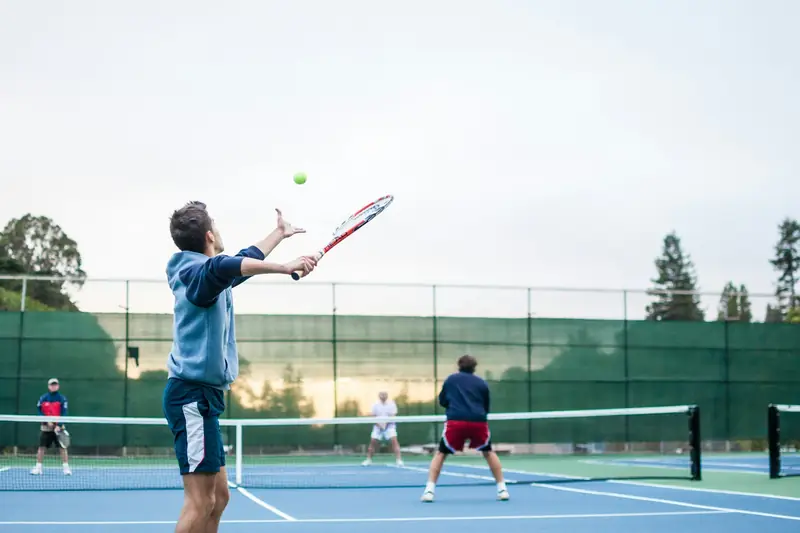
Every club has one. The player who never seems to hit the ball hard, never seems to run much, and somehow beats everyone. You walk off court wondering what just happened. You hit more winners. You also hit more balls into the net.
That player has worked out what tennis actually rewards. This guide walks through the shots that matter for club players, from footwork to the serve: what each one is for, how to hit it, the classic mistakes, and what you can do off court to make it easier on your body. The research has plenty to say about tennis, so you will find a few numbers along the way, and every one links to the study it comes from.
The big idea: points are short, and most end with a miss
Two facts change how you should think about a match.
First, points are short. At the Grand Slams, somewhere between two thirds and three quarters of points are over within four shots.[1] Across professional tennis, the ball is actually in play for only about a fifth of a match, in rallies averaging around four shots and five or six seconds.[2] The rest is walking, towelling off and getting ready. So the serve, the return and the first ball after them decide most points, and tennis fitness is about short, sharp bursts repeated for an hour or two, not steady running.
Second, most points end with a miss, not a winner. Even among professionals, missed shots end more points than clean winners, and the exact split depends on who is counting.[3] At club level, the gap is almost certainly bigger. That is the secret of the player at your club: they make you play one more ball, and wait for you to miss it.
Footwork: the split step and the first move
Tennis movement is mostly sideways. One analysis put it at about 70% lateral and 20% forward, in bursts of a few metres,[4] adding up to roughly 8 to 10 metres per point at the top level.[2] Good movement starts with the split step: a small hop that lands just as your opponent hits the ball. World-class returners time it to the server's contact, and land ready to push off the moment they read the direction.[5]
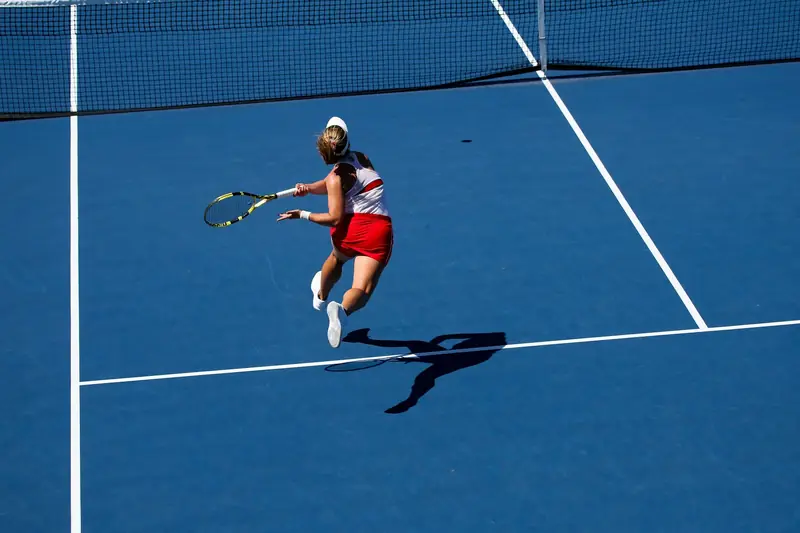
How to do it:
- Hop as they hit. Land as their strings meet the ball, not after
- Land with your feet wider than your shoulders and your weight forward, head still
- Make your first move a turn: open your hip towards the ball and push off the outside foot. No little step backwards first
- Treat recovery as part of the shot. Shuffle or crossover back towards the middle of your opponent's possible angles, then split again
- On clay, slide into the shot, not past it: outside foot leading, hips low
The classic mistake is standing flat-footed and then running. The opposite one is splitting too early, so you land before they have hit and are stuck on the ground.
Train it off court. Sideways power and the ability to stop: lateral bounds and skater hops, cut-and-stick drills, split squats and step-ups for single-leg strength, and calf raises with the knee straight and bent for springy lower legs. If you play on clay, add groin and adductor work, such as Copenhagen planks.
The forehand: a throw, not an arm swing
The modern forehand works like a throw. Your legs load, your hips turn, your trunk follows, and the arm and racket come last, whipping from low to high to put topspin on the ball. In elite players, what separates the best from the rest is not how fast they rotate but when: the timing of the hip and trunk turn.[6]
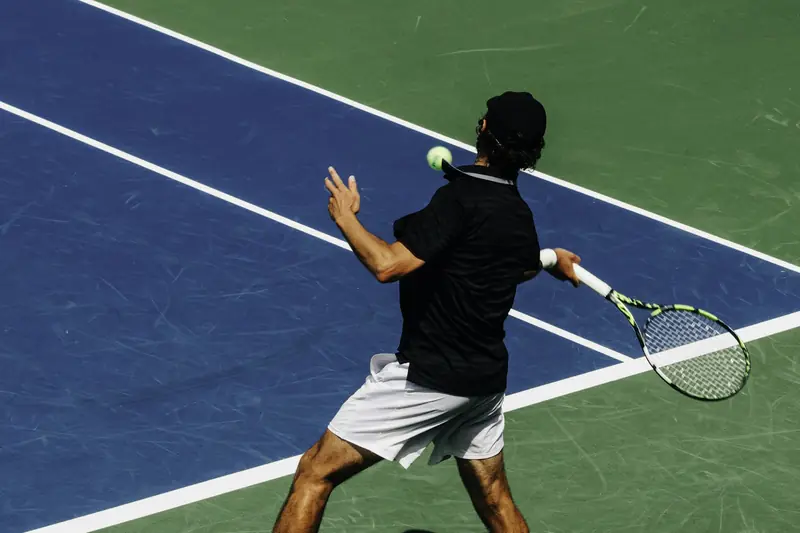
The open stance, where you hit with your chest still facing the net and your weight on the outside leg, gets a lot of attention. It is a great tool for wide and fast balls because you recover quicker. But below world-class level, researchers found no measurable gain in racket speed from it.[7] Use it when the ball pulls you wide, not as a shortcut to power.
How to do it:
- Turn your shoulders early, as soon as you read a forehand, with your free hand on the racket or pointing at the ball
- Sit into your outside leg as you set up
- Start the swing with your hips and trunk, and let the arm lag behind
- Make contact out in front of your front hip, brushing up the back of the ball
- Finish over your shoulder, then recover
The classic mistake is arming the ball: swinging with the shoulder while the hips and trunk stay still, often with contact late and beside the body. It costs you depth and power and puts the load on your shoulder and elbow.
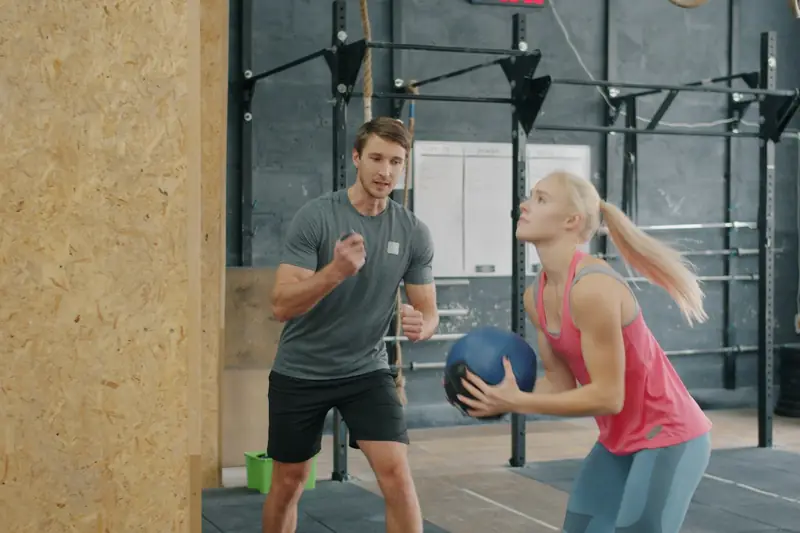
Train it off court. Rotational power is the engine here. Side-on medicine-ball throws against a wall, cable or band woodchops, Pallof presses for trunk control, and hip and upper-back mobility so you can turn fully.
The backhand: two hands, one hand, and the slice
There are three backhands worth knowing:
- Two-handed: both arms work as one unit, driven by the trunk. It is easier to learn and more stable on high and fast balls, which is why it is the usual recommendation for adults starting out. Lab work shows the two-hander leans more on the trunk's rotation[8]
- One-handed: the hitting shoulder leads and the arm swings out from the body. More reach and variety, but it needs better timing and a stronger shoulder and forearm
- The slice: a high-to-low swing with a slightly open racket face that puts backspin on the ball. It is the club player's Swiss Army knife, for defending, approaching the net and changing the pace
How to do it:
- Get your feet there first. Most bad backhands come from being too close or too late
- Two-hander: turn your back to the net a little, let the top hand do the work like a left-handed forehand (for a right-hander), and finish over your shoulder
- One-hander: lead with the shoulder, make contact well in front of your front foot, and pull your free arm back at contact to keep your shoulders sideways
- Slice: start with the racket above the ball and carve under it, finishing out towards the target rather than chopping down
The classic mistake has a name, because it gives so many club players a sore elbow: the late one-hander, hit with the elbow leading and the wrist bent back. Studies of wrist movement found that less-skilled players, and players with a history of tennis elbow, move their wrist differently around impact on the one-handed backhand than experts do.[9] For the slice, the classic mistake is chopping steeply down, so the ball floats up or dies in the net.
Train it off court. One-handers need strength at the back of the shoulder and shoulder blade (band pull-aparts, face pulls) and wrist-extensor strength, including slow lowering with a light dumbbell. Two-handers benefit most from rotational power, with medicine-ball throws from the backhand side. Everyone gains from grip and forearm endurance.
The serve: power from the ground up
The serve is the one shot you fully control, and it is a throw. You toss, sink into the "trophy" position (knees bent, tossing arm up, racket arm cocked behind you), drive up with your legs, turn and tilt your trunk, and finally the shoulder rotates and the forearm turns over to snap the racket through the ball.
Where does the speed come from? Shoulder specialist Ben Kibler estimates that the legs and trunk produce about half the energy that reaches the hand.[10] The arm finishes the job: in high-performance servers, the shoulder's inward rotation supplied about half of the racket-head speed at impact and the wrist about a third.[11] Both matter, in that order. When researchers compared elite servers with beginners, the elite players pushed harder into the ground and served far faster (169 against 107 km/h), even though their jumping power was similar. The difference was coordination, not raw leg strength.[12]
That chain also protects you. In a study that followed expert players over two seasons, those who went on to injure their shoulder or elbow had poorer energy flow through the chain, slower serves, and more of the load absorbed at the shoulder and elbow.[13] A serve that is all arm is slower and harder on the arm.
There are three serves worth knowing:
- Flat: for speed, usually a first serve
- Slice: curves sideways, great for pulling an opponent wide
- Kick: you brush up the back of the ball for heavy topspin, so it clears the net high and bounces up. For most club players, it is the best second serve there is
How to do it:
- Use a continental grip, held like a hammer. A frying-pan grip blocks the forearm from turning over
- Toss up, not out: release at full stretch, slightly in front and to your hitting side, and keep the tossing arm up
- Bend your knees in the trophy position, chest up
- Push the ground away, driving up and into the court before the arm swings
- Lead with the edge of the racket and let the forearm turn the face through contact. For a kick, brush up from seven o'clock to one o'clock
The classic mistakes: an arm-only serve with straight legs, a toss that drifts behind your head, and a second serve pushed in slowly instead of hit with spin.
One more thing for club players. At pro level, about 30% of points end with a serve that doesn't come back. In one sample of club league matches, it was about 13%.[14] Your serve wins far fewer free points than a pro's, so a reliable second serve and a solid return matter even more for you.
Train it off court. The muscles at the back of your shoulder slow the arm down after every serve, so build them: band external rotations with your arm out to the side, side-lying rotations and slow lowering. Add work for the shoulder blade (wall slides, prone Y and T raises), upper-back mobility, overhead medicine-ball throws and slams, and jumps for leg drive.
The return of serve
The return is the other half of most points. Split step as the server hits, then keep it simple: a short backswing, and against a big serve, a block or a chip. Aim deep through the middle, which gives the server no angle. Against a weak second serve, step in and take it early. The classic mistakes are a full forehand swing against a fast serve and standing too far back against a slow one.
Net play: volleys, the overhead and doubles
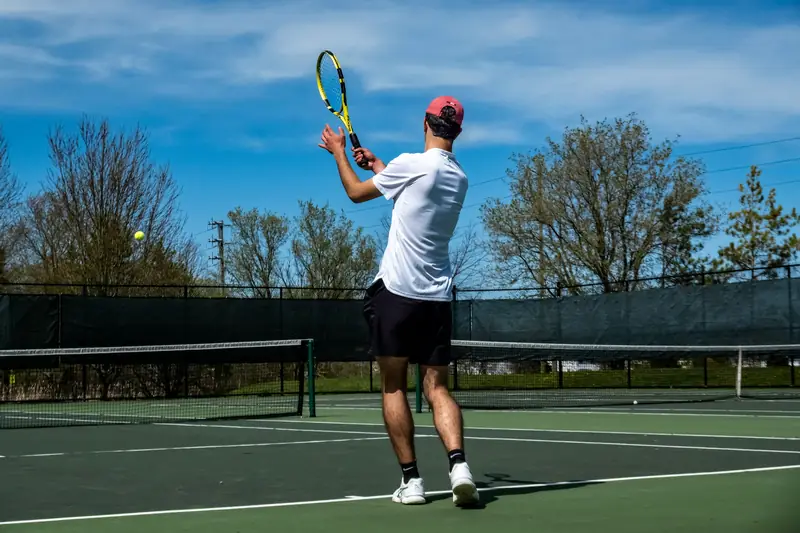
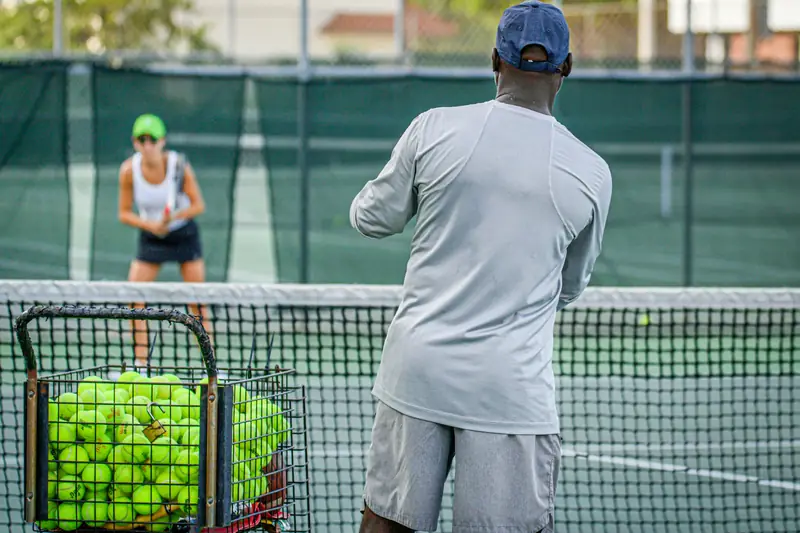
A volley is a short punch or catch of the ball before it bounces. Little backswing, contact in front, and let your legs and the ball's pace do the work. The approach shot gets you there: hit it deep, usually down the line or through the middle, often with slice, then follow the ball in and split step around the service line.
How to do it:
- Volley: racket in front, split, step, punch. Use a continental grip and keep the racket head above your wrist
- Low volley: get down with your legs, not by dropping the racket head, and play it deep rather than hard
- Overhead: turn sideways at once, point your free hand at the ball, take small adjustment steps, and hit it in front with a shortened serve. Let very high lobs bounce
- Doubles at the net: watch the opponents' racket, not your partner. Move forward on your partner's good shots and back on weak ones, and agree a signal before you poach
The classic mistakes are swinging at volleys, letting the racket head drop on low balls, and backpedalling flat-footed for an overhead. That last one is worth fixing for safety as well as for tennis: turning side-on and using a crossover or scissor step is steadier than running backwards.
Train it off court. Quick first steps (reaction drills with a partner dropping a ball), deep-lunge strength and mobility for low volleys (split squats, lateral lunges), and backward and crossover footwork with controlled stopping.
Rally tolerance: the shot nobody practises
If most points end with a miss, the most valuable shot in club tennis is simply one more ball. Two bits of geometry help. The net is about 15 cm lower in the middle than at the posts (0.914 m against 1.07 m),[15] and the cross-court diagonal is the longest line on the court. So a rally ball cross-court, with plenty of net clearance, is the safest shot in tennis.
How to do it:
- Aim one to two racket lengths over the net on rally balls
- Go cross-court until you get a short ball
- Pick big targets well inside the lines. Deep through the middle beats risky lines
- Only change direction off a ball you own: a short, slow or central one
- Practise counted rallies: ten cross-court balls in a row, then twenty
The classic mistake is the hero ball: going for a winner off a neutral or defensive ball.
Train it off court. Staying sharp for one more ball, in the third set, is fitness. An aerobic base (easy cycling or running, a couple of times a week) helps you recover between points, and short interval work that mimics tennis, about 5 to 10 seconds hard and 15 to 25 seconds easy, builds the repeat-sprint ability matches demand. Tired players miss more, so the fitness pays off in accuracy too.
Does training off court really help?
For the serve, the evidence is good. A 2025 review pooled 16 controlled trials of strength and conditioning in tennis players. Resistance training improved serve speed by a moderate amount, and programmes that combined several kinds of training did best of all. Core work on its own did not make a clear difference.[16] In one classic study, college players who followed a structured, progressive lifting programme for nine months added 29% to their serve speed, against 16% for a group doing a simpler programme.[17]
One honest caveat: almost all of these trials were in juniors and college players. Nobody has yet run the same trial in 50-year-old league players. But the principle carries over. Stronger legs, a more powerful trunk and a well-conditioned shoulder give your technique more to work with.
Two short sessions a week alongside your tennis is plenty to start. Here is how the work lines up with the shots:
| Build this | It helps your | Try |
|---|---|---|
| Sideways power and stopping | Split step, wide balls, recovery | Lateral bounds, skater hops, split squats |
| Calves and springy feet | Every first step, the serve's leg drive | Calf raises (straight and bent knee), small hops |
| Trunk rotation | Forehand, two-handed backhand, serve | Medicine-ball throws against a wall, woodchops |
| Back of the shoulder and shoulder blade | Serve, overhead, one-handed backhand | Band external rotations, pull-aparts, prone Y and T raises |
| Forearm and grip | Volleys, one-handed backhand, slice | Wrist curls and slow lowering, heavy holds |
| Repeat sprints | Third sets and long rallies | 5 to 10 seconds hard, 15 to 25 seconds easy |
Staying on court
Tennis injuries in club players tend to come in two kinds. In the legs, they are mostly sudden: ankle sprains, and the calf strain so typical of the sport it is called tennis leg, which tends to strike in middle age.[18] In the arm, they are mostly slow-building overuse, with tennis elbow the best known.[19] Tennis elbow becomes more common with age,[20] and adult club players in general cope with less playing volume and get more overuse problems than younger players.[21]
There is no magic routine. A large trial gave 579 adult club players a 12-week online prevention programme, and it did not reduce injuries.[22] What the research points to instead is the slower stuff: the strength work above, done consistently over months,[23] playing time that rises gradually rather than in jumps,[24] and technique that lets your legs and trunk do their share so your arm doesn't have to do it all. If your elbow aches after every session or your calf is tight every morning, ease back and build capacity before it costs you weeks off court.
The long game
There is a good reason to keep playing for decades. In the Copenhagen City Heart Study, tennis players lived about 9.7 years longer than people who didn't exercise, the largest gap of any activity studied.[25] In a separate study of more than 80,000 British adults, people who played racket sports had a 47% lower risk of dying over the study period.[26] Both studies are observational, and tennis players may differ from non-players in other ways, so they can't prove tennis is the cause. But they fit with everything else we know about regular, social, stop-start exercise.
The point is to keep playing, for years. That is where the strength work earns its keep.
Training built around your tennis
Most club players never do any of this, because it is hard to know where to start. A generic gym plan doesn't know you play league matches on Tuesday and Saturday, that your elbow grumbles after a long session, or that you only have a pair of dumbbells at home. Your coach can fix your toss, but rarely builds your strength plan.
Achilles does. Pick a goal such as Stop getting injured or Play my sport better, and tell it how often you play, the time and equipment you have, and anything that bothers you, from a sore elbow to an old calf strain. Achilles builds your plan from a library of sports-science research: the warm-up, the work for your legs, trunk, shoulders and forearms, and how to progress it, each exercise with its sets, reps and rest, and the studies behind it.
Log your sessions and your matches, and the plan moves with you, so you keep getting stronger without overdoing the weeks you play the most.
See how Achilles worksFurther reading
- Exploring break point dynamics: a preliminary performance analysis in men's professional tennis (US Open 2021). Revista Iberoamericana de Ciencias de la Actividad Física y el Deporte. Link
- Pluim B.M. et al. (2023). The physical demands of tennis across court surfaces, performance levels and sexes: a systematic review with meta-analysis. Sports Medicine, 53. Link
- Tennis Abstract (2016). Winners, errors and misinformation. Link
- ITF Coaching & Sport Science Review (2021). Movement in tennis. Link
- Mecheri S. et al. (2019). Split-step timing and leg stiffness in world-class tennis players returning fast serves. Link
- Landlinger J. et al. (2010). Key factors and timing patterns in the tennis forehand of different skill levels. Journal of Sports Science and Medicine, 9. Link
- Yandell J. Comparing open and closed stances. Tennisplayer.net. Link
- Stępień A. et al. (2011). The kinematics of trunk and upper extremities in one-handed and two-handed backhand strokes. Journal of Human Kinetics. Link
- Knudson D. & Blackwell J. (1997). Wrist movement in one-handed backhands of players with and without tennis elbow. International Journal of Sports Medicine, 18(2). Link
- Kibler W.B. The kinetic chain in tennis: do you push or pull? Aspetar Sports Medicine Journal. Link
- Elliott B., Marshall R. & Noffal G. (1995). Contributions of upper limb segment rotations during the power serve in tennis. Journal of Applied Biomechanics. Link
- Girard O., Micallef J.P. & Millet G.P. (2005). Lower-limb activity during the power serve in tennis: effects of performance level. Medicine & Science in Sports & Exercise, 37(6). Link
- Martin C. et al. (2014). Energy flow analysis during the tennis serve: injured and non-injured players compared. American Journal of Sports Medicine, 42(11). Link
- Foy C. Pro statistics and league statistics. Tennisplayer.net. Link
- International Tennis Federation (2026). Rules of Tennis. Link
- Deng N. et al. (2025). Strength and conditioning interventions and serve speed in tennis players: a systematic review and meta-analysis. Frontiers in Physiology. Link
- Kraemer W.J. et al. (2003). Physiological changes with periodized resistance training in women tennis players. Medicine & Science in Sports & Exercise, 35(1). Link
- Tennis leg: a narrative review (2024). Medical Journal of the Islamic Republic of Iran. Link
- Abrams G.D., Renström P.A. & Safran M.R. (2012). Epidemiology of musculoskeletal injury in the tennis player. British Journal of Sports Medicine, 46. Link
- Gruchow H.W. & Pelletier D. (1979). An epidemiologic study of tennis elbow. American Journal of Sports Medicine. Link
- Jayanthi N. & Esser S. (2013). Racket sports. Current Sports Medicine Reports, 12(5). Link
- Pas H.M.I. et al. (2020). An e-health tennis-specific injury prevention programme: randomised controlled trial in adult recreational players. British Journal of Sports Medicine, 54. Link
- Lauersen J.B., Bertelsen D.M. & Andersen L.B. (2014). The effectiveness of exercise interventions to prevent sports injuries. British Journal of Sports Medicine, 48(11). Link
- Injury risk factors in high-performance tennis: a systematic review (2025). Sports, 13(10). Link
- Schnohr P. et al. (2018). Various leisure-time physical activities associated with widely divergent life expectancies: the Copenhagen City Heart Study. Mayo Clinic Proceedings, 93(12). Link
- Oja P. et al. (2017). Associations of specific types of sports and exercise with all-cause and cardiovascular-disease mortality: a cohort study of 80,306 British adults. British Journal of Sports Medicine, 51. Link