Blog · Swimming
Swimming, stroke by stroke: how lap and open-water swimmers glide further, breathe easier and keep their shoulders happy
Body position, breathing, the catch, the kick, turns, breaststroke and open water, explained for lap, masters and triathlon swimmers, with the out-of-pool training that protects your shoulders and bones.
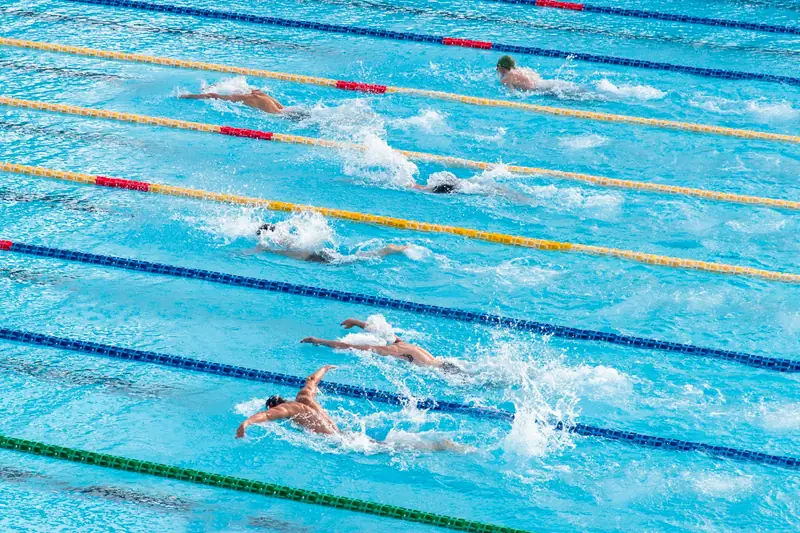
You've seen them in the next lane. They don't look as if they're trying, the water barely moves, and they lap you every few lengths. You're kicking furiously, gasping at every breath, and somehow going slower.
They aren't stronger than you, or not by much. They lie flat in the water, breathe without lifting their head, hold on to the water with their hands, and push off every wall like a torpedo. This guide walks through the skills that matter for lap, masters and open-water swimmers: what each one is for, how to do it, the classic mistake, and what you can do out of the pool to make it easier on your body. Where the research has something useful to say, we say it, and every number links to the study it comes from.
The big idea: swimming is a drag sport
On land, getting faster mostly means pushing harder. In water, it mostly means slipping through more easily. Water is far denser than air, so the shape you make matters more than in any land sport. When your head lifts, your hips and legs sink, and you end up shoving a bigger shape through the water.
That's why technique comes first in swimming, and why strength out of the pool is mostly about holding a good shape and keeping your shoulders healthy, rather than raw power.
Body position: look down, hips up
The aim is to lie long and flat, with your head, hips and heels close to one line near the surface. Many adult swimmers kick hard just to stop their legs sinking. The fix is usually balance, not more kicking.
How to do it:
- Look at the bottom of the pool, slightly ahead. The back of your head, not your forehead, sits at the surface
- Press your chest into the water. Your hips rise like a see-saw
- Stay long from fingertips to toes, and reach forward before each pull
- Hold a light brace through your middle, so you don't sag
- Aim to feel slightly downhill, with your hips a touch higher than your chest
The classic mistake is looking ahead to the end of the lane. Your head lifts, your hips drop, you kick harder to compensate, and you tire fast. When swimmers were towed through the water, keeping the head down or in line with the body cut drag by 4 to 5% with the arms by the sides, and by about 10% with the arms stretched overhead, compared with lifting the head.[1]
Train it out of the pool. Holding a long, flat line is a trunk job: dead bugs, front planks and hollow-body holds. Your arms also need to go overhead without your lower back arching, so add wall slides, upper-back extensions over a foam roller, and lat stretches.
Breathing: rotate, don't lift
You don't lift your head to breathe. You roll with your body and turn your head just enough for your mouth to clear the water, in the little trough your head makes as it moves forward. Breathe out steadily while your face is in the water, so turning to breathe is just a quick breath in.
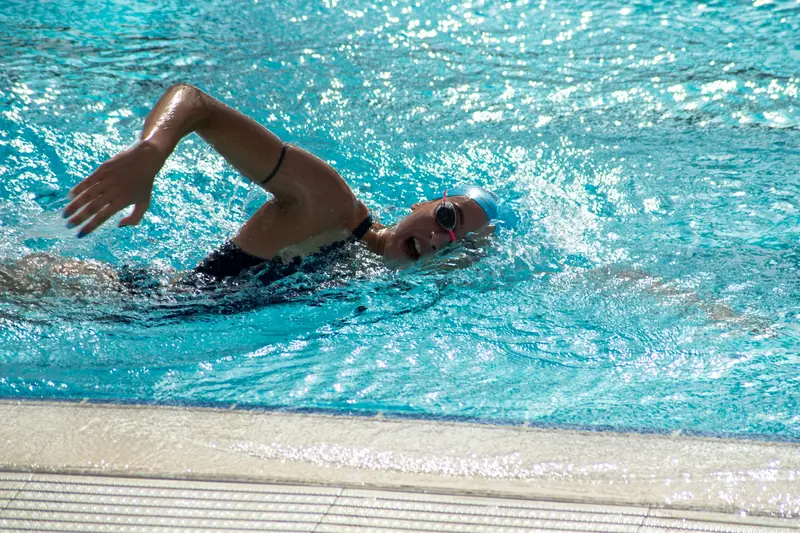
How to do it:
- Hum or blow bubbles the whole time your face is in the water
- Keep one goggle in the water. Rotate, don't lift
- Turn your head with your body, not instead of it
- Get your head back down before your arm lands in front
The classic mistake is holding your breath and then trying to breathe out and in during one short turn. That is the main cause of "I can't get enough air". The other is lifting your head forward to breathe, which drops your hips. And a myth worth dropping: there is no rule that you must breathe every three strokes. In elite swimmers, breathing to one side only made their hip roll more lopsided[2], so breathing to both sides is a good way to train an even stroke. But many adults swim better breathing every two strokes at harder paces. The useful skill is being able to breathe on both sides.
Train it out of the pool. Rolling to breathe without lifting your head needs a mid-back that rotates: open books and seated rotations. Chin tucks build the neck endurance that saves you from cranking your neck. Slow breathing drills on land, lying with your feet up on a chair, can make long, relaxed breaths out feel normal.
The catch: reach over a barrel
After your hand enters and stretches forward, the catch is the moment you get hold of the water. Good swimmers keep the elbow near the surface and bend it, so the forearm and hand tip down to face backwards early, as if reaching over a barrel. Then they push the water back towards their feet, not down towards the floor. In skilled swimmers, how well they kept this high-elbow position went with how fast they moved during the pull.[3]
How to do it:
- Enter with your hand in line with your shoulder, not crossing the middle
- Reach over the barrel: elbow high, fingertips pointing at the floor
- Push the water towards your feet
- Keep a patient front arm. Don't start pulling until the other hand is nearly in
- Speed up the push as your hand passes your hip
The classic mistake is a dropped elbow: the elbow sinks first, the hand presses down on the water and slides through without much grip. Crossing the centre line on entry is the other one, and coaches often link it to sore shoulders.
Train it out of the pool. A high-elbow catch needs shoulders that rotate well with the arm overhead, shoulder blades you can control, and strong pulling muscles. Band pull-aparts, face-down Y and T raises, band external rotations, straight-arm pulldowns, rows and assisted pull-ups all help.
The kick: balance first, engine second
In front crawl over any distance, the kick mainly keeps your legs up and your body balanced, and helps time your rotation. It is less of an engine than most people think. In young national-level swimmers pulling against a tether, the arms produced about 70% of the force and the legs about 30%.[4] Triathletes and open-water swimmers often use a light two-beat kick to save their legs for later.
How to do it:
- Kick from your hips, not your knees
- Keep your ankles loose and toes pointed, like a ballet dancer
- Small and fast, inside the shadow of your body
- Let your big toes brush past each other
The classic mistake is a big, bicycle-like kick from the knees, with the thighs dropping. Stiff ankles are the other: a flexed foot pushes water forward and acts like a brake. In women swimmers, those with more pointable ankles kicked faster.[5]
Train it out of the pool. Ankle flexibility here means pointing the foot, the opposite of the stretch runners usually do. Kneel and sit back gently on your heels with your feet flat, and progress slowly. Glute bridges and hip extension work help you kick from the hip.
Turns and push-offs: be a pencil
Each push-off from the wall is the fastest you'll move all length, so don't waste it. Stack one hand on top of the other, squeeze your ears with your arms, tuck your head between them, and make your body long and tight. With the arms overhead, keeping the head down between them is exactly the position that cut drag by about 10% in the towing study.[1] You don't need tumble turns. A quick open turn with a tight push-off gets you most of the benefit.
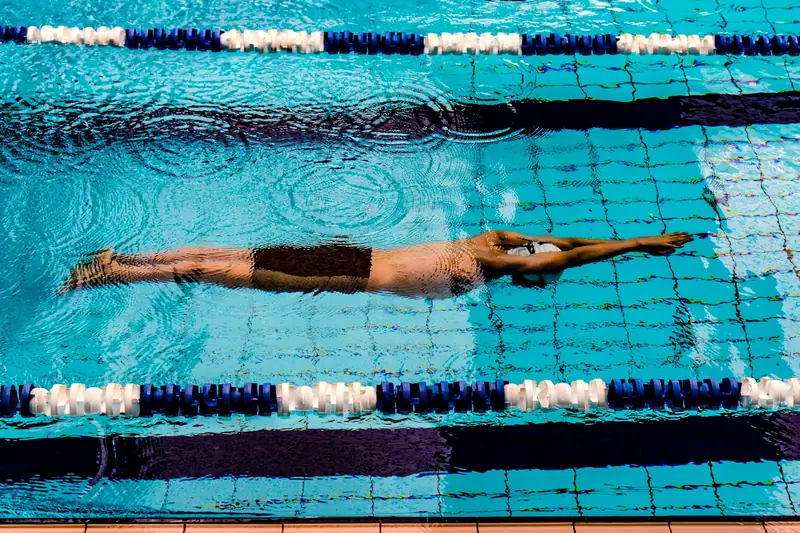
How to do it:
- Squeeze your ears with your arms and stack your hands
- Head between your arms, eyes down
- Push off a little below the surface, not on it
- Start kicking, then take your first stroke as you slow to swimming speed
The classic mistake is pushing off with your head up and arms apart, like a starfish. The others are pushing off in the choppy water at the surface, and standing up to rest on every wall.
Train it out of the pool. A tight streamline needs overhead shoulder mobility without arching your back: wall angels, lat stretches and upper-back extensions. A strong push-off comes from leg power, so squats and jump squats help. Hollow-body holds keep you tight while you glide.
Breaststroke and your knees
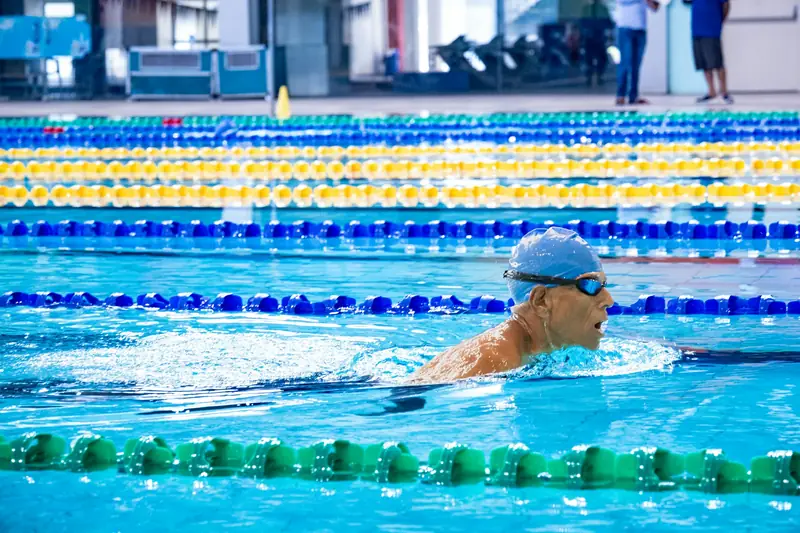
Breaststroke is all timing: pull, breathe, kick, glide. The arms sweep out and in without pulling past your shoulders, your head lifts with the pull to breathe, then your arms shoot forward as your legs kick, and you glide. The kick is a whip. Your heels draw up towards your backside, feet turn out, then drive back and together. That whip twists and loads the inside of the knee.
How to do it:
- Pull, breathe, kick, glide. Never kick and pull at the same time
- Heels to your backside, not knees to your chest
- Knees about hip-width apart, feet wider than your knees. Don't force your knees wide
- Push the water back with the soles and insides of your feet
- Glide for a beat in a streamline before the next pull
The classic mistake is pulling too wide and too far back, with no glide. For your knees, the classic mistake is a sudden jump in breaststroke, or lots of kick drills without a proper warm-up. Breaststroker's knee is very common in competitive swimmers: 73% of breaststroke specialists in one survey had knee pain, against 48% of other swimmers.[6] In another study of breaststrokers, those who had knee pain more often warmed up less and had less inward hip rotation.[7]
Train it out of the pool. Inward hip rotation is the link worth working on: 90/90 hip switches and seated internal-rotation drills. Side-lying hip work, short-lever Copenhagen planks and split squats build the hip and knee control the kick needs.
Open water: sight, draft and respect the cold
Open water adds three skills. Sighting means lifting your eyes just above the water to look ahead ("crocodile eyes"), then turning to breathe to the side, rather than lifting your whole head and stopping your kick. Start by sighting every six to ten strokes, then less often as you learn to swim straight.
Drafting is the free speed. Swimming close behind another swimmer's feet cut drag by about 20% and lowered heart rate, oxygen use and how hard the effort felt.[8] Swimming beside them, the saving was much smaller. A wetsuit helps too, mostly by lifting sinking legs, and weaker swimmers gain the most from it.[9]
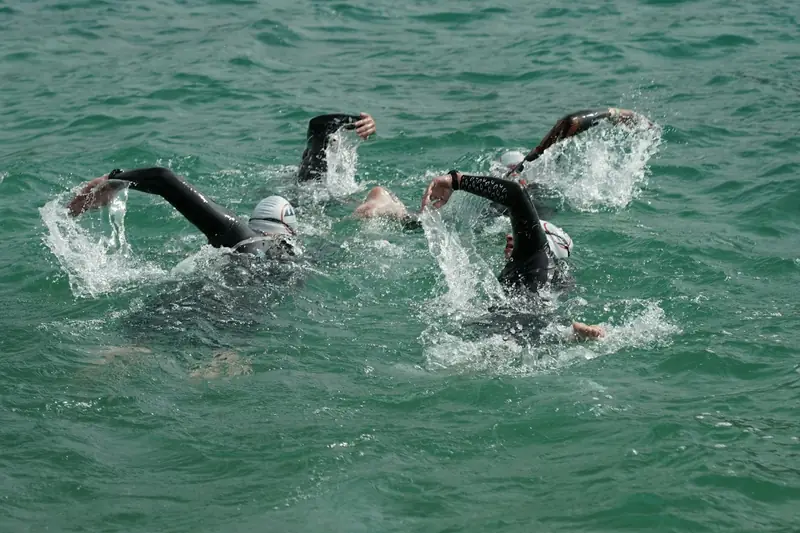
Cold water deserves respect. The danger is cold shock: an involuntary gasp and fast breathing in the first minute or two after you get in, which is thought to cause more open-water deaths than hypothermia.[10] Get in slowly, swim with others and close to the shore, build up your time in cold water gradually, and if you get into trouble, float on your back until your breathing settles.
Train it out of the pool. Sighting uses your neck and upper back, so chin tucks and face-down head lifts help. For triathletes, your aerobic base can come partly from cycling and running. The main out-of-pool job is shoulder resilience, so you can handle a training block.
Give your sessions a shape
Most adult swimmers swim every length at the same comfortably-hard pace, and stop improving. A session with a shape works better:
- Warm-up, 10 to 15 minutes. Easy mixed swimming and a few drills
- Skill set, 5 to 10 minutes. For example, 6 x 50 m alternating a drill and a swim, with one focus per length
- Main set, 15 to 30 minutes. For example, 8 to 10 x 100 m at a steady pace with 10 to 20 seconds' rest, aiming for even splits
- Speed, optional, 5 minutes. 6 to 8 x 25 m quick, with plenty of rest
- Cool-down, 5 minutes. Easy
Build your weekly distance gradually. A review of shoulder injuries in competitive swimmers found sudden spikes in training load among the clearest risks, while simply swimming often was not one.[11] That swim camp or sudden triathlon block is when shoulders go.
Does training out of the pool really help?
For speed, a little. In competitive swimmers, adding land training to pool training improved 100 m times by about 2 seconds, and land-based strength work ranked best.[12] Not every study agrees: in one review, 7 of 16 studies found no effect on swimming performance.[13] In masters swimmers, six weeks of weight training plus fast swimming raised power in the water by about 6%, while swimming alone did not.[14]
For most adult swimmers, though, the bigger payoff is durability: stronger shoulders, healthier bones and a body that can absorb more swimming.
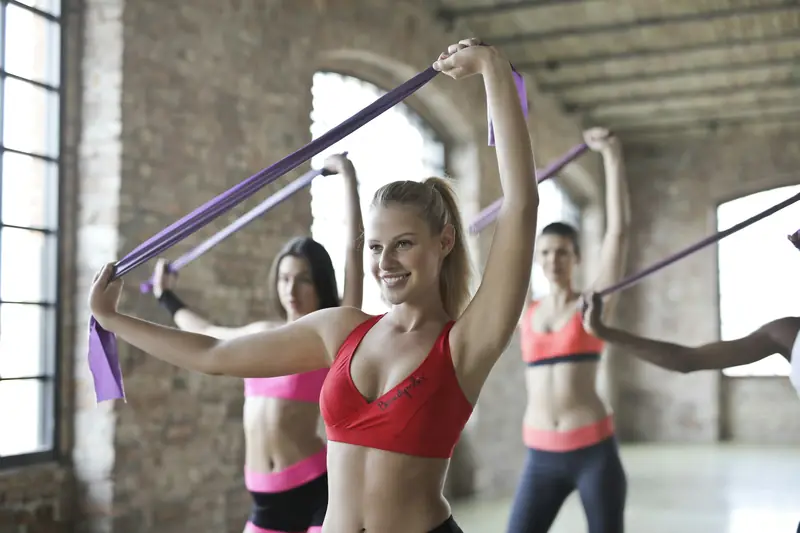
Two short sessions a week alongside your swimming is plenty to start. Here is how the work lines up with the strokes:
| Build this | It helps your | Try |
|---|---|---|
| Back-of-shoulder endurance | Every stroke, healthy shoulders | Band external rotations, face-down Y and T raises, face pulls |
| Pulling strength | The catch and pull | Rows, straight-arm pulldowns, assisted pull-ups |
| Trunk control | Body position, streamline | Dead bugs, hollow holds, side planks |
| Upper-back mobility | Breathing, overhead reach | Open books, foam-roller extensions, wall slides |
| Hip rotation and control | Breaststroke kick, healthy knees | 90/90 switches, split squats, Copenhagen planks |
| Leg strength and impact | Push-offs, bone health | Squats, deadlifts, jumps, skipping |
Staying in the pool
Swimming is gentle on your joints, but it isn't injury-free. Regular swimmers take thousands of strokes a week, and the shoulder takes most of them.
The shoulder. Swimmer's shoulder is an umbrella term for overuse pain around the rotator cuff. In a survey of South African masters swimmers, 62% had shoulder pain over three years, and those who did strength training were less likely to.[15] In masters women, those with problems were more likely to have tight chest muscles and to do no other sport.[16] No single risk factor has strong evidence[17], but the best study pointed to two things you can change: sudden jumps in training load and weak endurance in the muscles at the back of the shoulder.[11] Nobody has yet shown that a shoulder programme prevents swimmer's shoulder, but building that endurance, stretching your chest and increasing distance gradually are sensible.
The knees. Breaststroke is the main culprit. Mix your strokes, build up breaststroke kick slowly, warm up properly and work on your hips.
The neck and lower back. Lifting your head to breathe or to see ahead arches your neck and lower back. Better body position and rotation do more here than anything you do in the gym.
Your bones. This is the one people miss. Swimming takes weight off your skeleton, which is great for sore joints and not much use for bones. Across 64 studies, swimmers' bone density was generally similar to that of non-exercisers and lower than in impact-sport athletes.[18] Lifting and impact work fill the gap: in women past menopause with low bone mass, eight months of twice-weekly heavy lifting and impact training improved bone density at the spine and hip.[19] If you only swim, add some lifting and some jumping, skipping or brisk walking.
The long game
Swimming is something you can keep doing for life. In a large study of men, swimmers had about 50% lower death rates than sedentary men, walkers and runners.[20] In more than 80,000 British adults, swimming was linked to 28% lower death rates overall and 41% lower from heart disease.[21] Both are observational, so swimmers may have been healthier to start with. But the trial evidence points the same way: in adults over 50 with high blood pressure, 12 weeks of swimming lowered systolic blood pressure from 131 to 122 mmHg.[22] The out-of-pool work in this guide is what keeps your shoulders, knees and bones able to collect all of that.
Training built around your swimming
Most lap swimmers never do any of this, not because they don't care, but because it's hard to know where to start. A generic gym plan doesn't know you swim three mornings a week, that your right shoulder aches after long sessions, or that you only have a resistance band at home.
Achilles does. Pick a goal such as Play my sport better or Stop getting injured, and tell it how often you swim, the time and equipment you have, and anything that bothers you, from a sore shoulder to a twinge in your knee. Achilles builds your plan from a library of sports-science research: the work for your shoulders, upper back, trunk, hips and legs, including the bone-building work swimming can't give you, and how to progress it, each exercise with its sets, reps and rest, and the studies behind it.
Log your sessions and your swims, and the plan moves with you, so you keep getting stronger without overdoing the weeks you swim the most.
See how Achilles worksFurther reading
- Cortesi M. & Gatta G. (2015). Effect of the swimmer's head position on passive drag. Journal of Human Kinetics, 49. Link
- Barden J.M. & Barber M.V. (2022). The effect of breathing laterality on hip roll kinematics in submaximal front crawl swimming. Sensors, 22(6). Link
- Suito H., Nunome H. & Ikegami Y. (2017). A quantitative evaluation of the high elbow technique in front crawl. Journal of Sports Sciences. Link
- Morouço P.G. et al. (2015). Relative contribution of arms and legs in 30 s fully tethered front crawl swimming. Link
- McCullough A.S. et al. (2009). Factors affecting flutter kicking speed in women who are competitive and recreational swimmers. Link
- Vizsolyi P. et al. (1987). Breaststroker's knee: an analysis of epidemiological and biomechanical factors. American Journal of Sports Medicine, 15(1). Link
- Rovere G.D. & Nichols A.W. (1985). Frequency, associated factors, and treatment of breaststroker's knee in competitive swimmers. American Journal of Sports Medicine, 13(2). Link
- Chatard J.C. & Wilson B. (2003). Drafting distance in swimming. Medicine & Science in Sports & Exercise, 35(7). Link
- University of Granada (2021). Doctoral thesis on wetsuits and swimming performance, with a review of 17 studies. Link
- Tipton M.J., Montgomery H. et al. (2021). The experience of drowning. Link
- McKenzie A. et al. (2023). Shoulder pain and injury risk factors in competitive swimmers: a systematic review. Scandinavian Journal of Medicine & Science in Sports, 33(12). Link
- Wang et al. (2025). Comparative effectiveness of physical training modalities on swimming performance: a two-tier network meta-analysis. Frontiers in Physiology, 16. Link
- Amaro N.M. et al. (2018). A systematic review on dry-land strength and conditioning training on swimming performance. Science & Sports. Link
- Leban & Pau (2015). Combined weight training and fast swimming in masters swimmers. Link
- Krüger P. et al. (2012). Incidence of shoulder injuries and related risk factors among master swimmers in South Africa. Link
- Tate A. et al. (2012). Risk factors associated with shoulder pain and disability across the lifespan of competitive swimmers. Journal of Athletic Training, 47(2). Link
- Hill L., Collins M. & Posthumus M. (2015). Risk factors for shoulder pain and injury in swimmers: a critical systematic review. The Physician and Sportsmedicine, 43(4). Link
- Gómez-Bruton A. et al. (2013). Is bone tissue really affected by swimming? A systematic review. PLoS ONE, 8(8). Link
- Watson S.L. et al. (2018). High-intensity resistance and impact training improves bone mineral density and physical function in postmenopausal women with osteopenia and osteoporosis: the LIFTMOR randomized controlled trial. Journal of Bone and Mineral Research, 33(2). Link
- Chase N.L., Sui X. & Blair S.N. (2008). Swimming and all-cause mortality risk compared with running, walking, and sedentary habits in men. International Journal of Aquatic Research and Education, 2(3). Link
- Oja P. et al. (2017). Associations of specific types of sports and exercise with all-cause and cardiovascular-disease mortality: a cohort study of 80 306 British adults. British Journal of Sports Medicine, 51(10). Link
- Nualnim N. et al. (2012). Effects of swimming training on blood pressure and vascular function in adults over 50 years of age. American Journal of Cardiology, 109(7). Link