Blog · Skiing
Skiing and snowboarding, turn by turn: how holiday skiers and boarders ride better and come home in one piece
Stance, the parallel turn, moguls and steeps, snowboard carving, falling safely and the first day on the hill, explained for holiday skiers and boarders, with the pre-season training that makes each one easier on your legs.
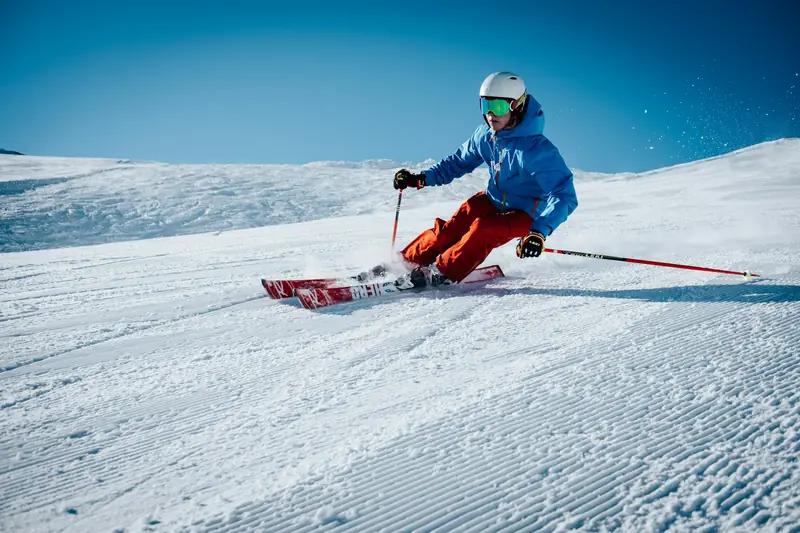
Every ski holiday group has one. They aren't the fastest, they don't do anything flashy, and yet they look as relaxed on the last run of the week as on the first. On day four, when everyone else is walking down the stairs backwards and skipping the afternoon, they're asking which lift goes highest.
They aren't doing anything magic. They stand in the middle of their skis, turn with their edges instead of their shoulders, know how to fall, and turned up with legs that had done some work before the trip. This guide walks through the parts of skiing and snowboarding that matter for holiday skiers and regular weekenders: what each one is for, how to do it, the classic mistake, and what you can do before the season to make it easier on your body. It's October, so you have about eight weeks. Where the research has something useful to say, we say it, and every number links to the study it comes from.
The big idea: skiing is six hours of braking
Skiing looks like gliding. Your legs experience it as braking: every turn is your thighs controlling your body against gravity, for hours a day, several days in a row. That is why your quads are on fire by eleven o'clock on day one.
It is safer than its reputation. Over 34 years at one Vermont ski area, the injury rate fell by 55% to about 2 injuries per 1,000 days on the slopes.[1] In Scotland the figure was 3.7 per 1,000 days[2], and in western Canada it has drifted down to about 2.2.[3] So a week's holiday is a small risk, but the legs pay a price that lasts. In 24 recreational skiers, four hours of skiing reduced the braking strength of their hamstrings and quads, and it was still down the next morning.[4] Ski again the next day and you start with less in the tank than you think.
So what matters most is legs that can brake for a long time, balance on one leg at a time, and enough in reserve to ski well at three in the afternoon. All three can be trained, and October is the time to start.
Stance and balance: stand in the middle
Almost everything in skiing gets easier when you stand in the right place. The athletic stance puts your weight over the middle of your feet, your joints flexed and ready to move, so the skis go where you point them instead of running away with you.
How to do it:
- Press your shins gently into the front of your boots. You should feel the tongue, not the back
- Flex your ankles, knees and hips together, like the start of a small squat, not a deep crouch
- Hands forward and wide, where you could see them out of the corner of your eye
- Weight over the middle of your feet, a little more on the outside ski in a turn
- Look ahead down the slope, not at your ski tips
The classic mistake is sitting back, the "back seat". Your hips drop behind your heels, your thighs burn, and the skis accelerate away from you. It happens because leaning away from a steep slope feels safer. It isn't, and it is the starting position of the backward fall behind many skiing knee injuries.
There is very little research on stance in recreational skiers. This is ski-school teaching, and it is good teaching.
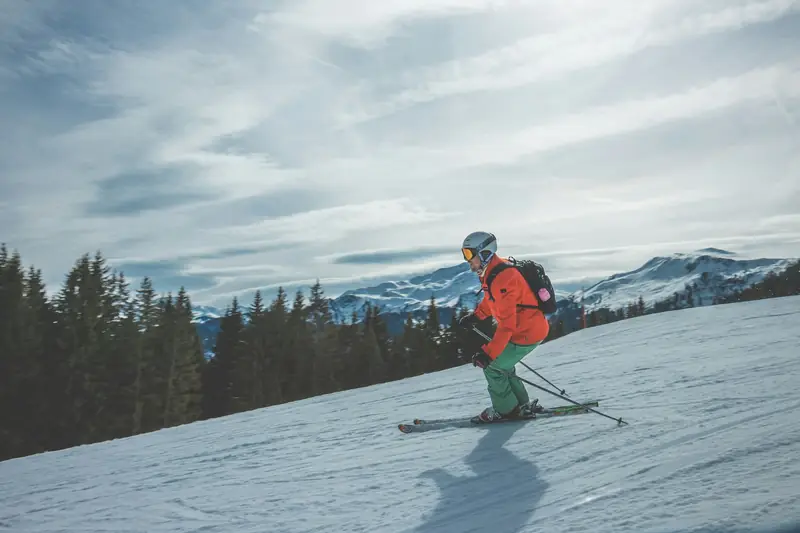
Train it off the slopes. A ski stance is a half-squat you hold and adjust for minutes at a time. Wall sits, slow goblet squats (three seconds down) and split-squat holds build that endurance. Single-leg balance work, and single-leg Romanian deadlifts in particular, teach you to stay centred over one foot when the snow under it changes.
The parallel turn: tip, then edge
A modern ski has a curved shape, narrower in the middle than at the tip and tail. Tip it on its edge and press, and it bends into an arc and turns for you. The parallel turn is mostly the art of tipping both skis onto their new edges at the same time and letting them do the work.
How to do it:
- Start the turn by rolling both ankles and knees towards the new turn, not by twisting your feet
- Let the outside ski take most of your weight
- Keep your upper body facing roughly down the hill while your legs turn underneath it
- Use a light pole touch to time the start of each turn
- Control your speed by finishing each turn across the hill, not by skidding harder
The classic mistake is turning with your shoulders. You throw the upper body round, the hips follow, and the skis skid sideways instead of carving. The other is leaning into the hill, which takes the weight off the outside ski just when it needs it most.
Release bindings are the success story of ski safety: over those 34 years in Vermont, twisting injuries to the lower leg fell by 87%. But knee ligament injuries hardly changed at all.[1] Have a shop set your bindings to your weight, height, age and ability, and be honest about all four.
Train it off the slopes. Edging is a sideways skill, and most gym work is forwards and backwards. Lateral lunges, Cossack squats and banded side steps build strength in the hips that hold you on the outside ski. Skater bounds, jumping from one foot to the other and sticking each landing, are the closest thing to linking turns you can do in a living room.
Moguls, steeps and off-piste
Moguls are bumps carved by thousands of skiers turning in the same places. Steeps and off-piste are where the snow and the gradient stop being predictable. All three ask the same thing of your legs: absorb, extend, and keep doing it without getting tired.
How to do it:
- In moguls, turn on the top or the shoulder of the bump, where your tips and tails are in the air and the skis pivot easily
- Let your knees come up towards your chest as you go over a bump, then push your feet down into the trough
- On steeps, commit to the fall line. Short, quick turns, a firm pole plant, upper body facing downhill
- Off-piste, never go alone, and only with a transceiver, shovel and probe you know how to use. A guide is money well spent
- Check the weather and the avalanche bulletin every morning
The classic mistake in moguls is staying stiff, so each bump throws you into the back seat. On steeps it is leaning back up the hill. Off-piste, it is following tracks and assuming whoever made them knew what they were doing.
A review pooling 55 studies found a clear pattern: experienced skiers and boarders tend to get hurt on jumps, beginners in ordinary falls. Poor visibility from bad weather more than doubled the odds of injury.[5] When the light goes flat, slow down and stick to the pistes you know.
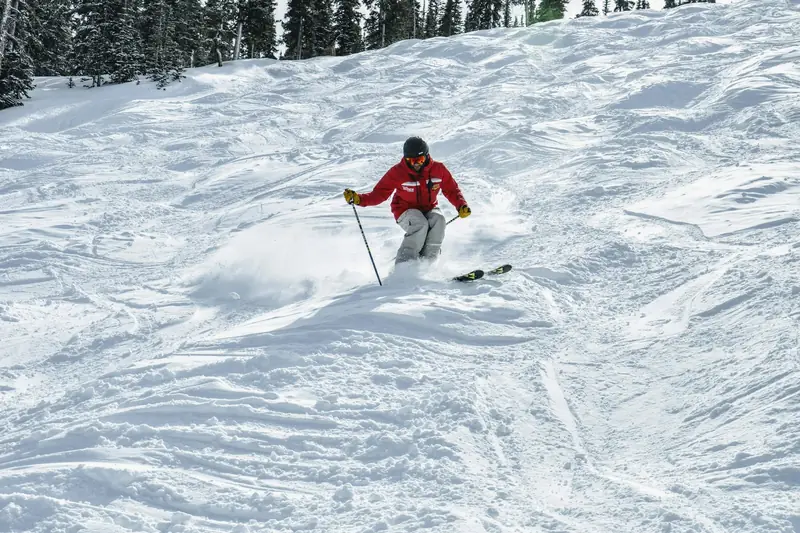
Train it off the slopes. Absorbing bumps is fast braking followed by a quick push. Drop squats (drop into a quarter squat and freeze), box jumps with soft landings and low pogo hops train it. Slow-lowering split squats build the braking strength. A strong trunk keeps your upper body quiet while your legs work underneath, so add side planks and Pallof presses.
Snowboard carving: heel edge, toe edge
A snowboard turns the same way a ski does, by tipping onto an edge. You have two: the heel edge (facing down the slope) and the toe edge (facing up it). Carving means riding cleanly from one to the other without skidding or catching the wrong one.
How to do it:
- Knees bent, weight centred between your feet, upper body over the board
- Lead with your head and shoulders. Look where you want to go and let the hips and board follow
- On the heel edge, sink as if sitting into a chair and lift your toes slightly
- On the toe edge, press your knees forward towards the snow and lift your heels slightly
- Change edges with purpose, and keep the board on an edge when moving slowly across the slope
The classic mistake is catching an edge: the downhill edge digs in and slams you down before you know it, forwards onto your wrists or backwards onto your backside and head. It usually happens when the board goes flat at slow speed, or when you lean up the hill.
Boarders and skiers get hurt in different places. In an 18-season study at a Vermont resort, the most common injury among snowboarders was to the wrist. Among skiers it was a sprained ACL, the main ligament inside the knee.[6]
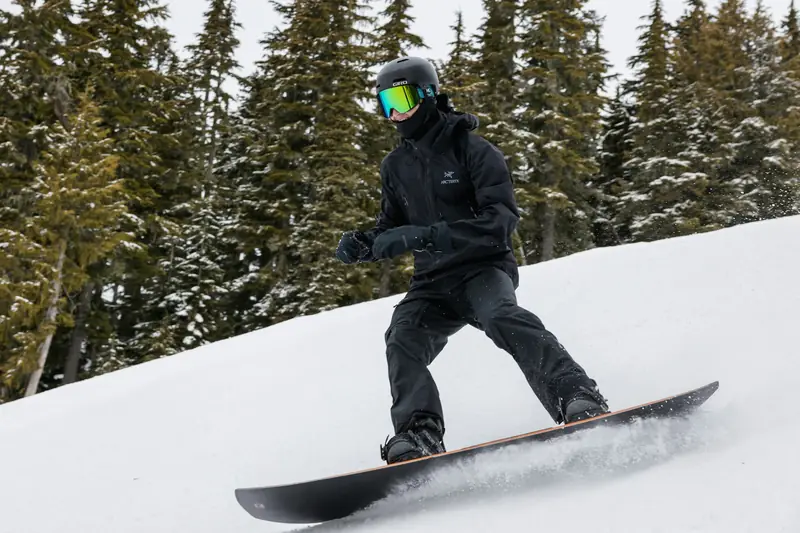
Train it off the slopes. Holding an edge is a long squat on your heels or toes. Wall sits, calf raises and tibialis raises (lifting your toes with your back against a wall) build the lower legs. Rotational work such as cable or band chops trains the upper body to lead the turn. For the falls, push-ups and plank variations help your wrists and shoulders cope with landing on them.
Falling safely: what to do when it goes wrong
Everyone falls. The difference between a funny story and a ruined holiday is often how. For skiers, the danger is the knee; for boarders, the wrist and shoulder.
How to do it:
- Skiers: when you feel a fall coming, keep your arms forward and hands over your skis. Don't throw them behind you
- Keep your feet together and don't try to get up until you've stopped sliding
- Don't fight a fall by fully straightening your legs or trying to sit on your skis at speed
- Let go of your poles as you fall
- Boarders: make a fist and fall onto your forearms and knees going forwards, or roll onto your backside and back with your chin tucked going backwards
The classic mistake for skiers is the "phantom foot". You lose balance backwards, your hips drop below your knees, and your weight lands on the inside edge of the downhill ski. The ski carves sharply inwards, its tail levers the knee, and the ACL tears. In the 1990s, researchers in Vermont picked this out as a common way skiers tear the ACL. Patrollers and instructors at 20 ski areas then watched videos of how these injuries happen and learned to recognise the position. Their serious knee sprains fell by 62% compared with the two seasons before, while staff at 22 comparison areas saw no drop.[7] The other big one, a forward fall with a twist, is the most commonly reported knee-injury fall in recreational skiers: 63% of 392 ACL-injured skiers in one Austrian study.[8]
Your thumb is next in line. Fall with a pole in your hand and the handle levers your thumb outwards, tearing a ligament at its base. A 1982 study found thumb injuries were second only to knee injuries in downhill skiing, about 17% of all injuries.[9] Letting go of the pole as you fall is the advice.
For boarders, the instinct is to put a straight arm out. That sends the force up the arm to the wrist, elbow and shoulder. Shoulder injuries make up 4 to 11% of skiing injuries and 8 to 16% of snowboarding injuries, and falls are the main cause.[10]
Train it off the slopes. For skiers, strong hamstrings and good landings protect the knee: Nordic hamstring curls, Romanian deadlifts, and drop-and-stick landings with your hips back and knees over toes. For boarders, push-ups, planks and rotator cuff band work make your upper body more robust.
Pre-season and your first day on the hill
The riskiest day of any trip is the first: unfamiliar kit, new snow, and excitement. For true beginners, it's the riskiest day of all. In Scotland's three biggest ski areas, people on their first ever day made up more than twice their share of the injured. Among them, risk was higher for snowboarders, people under 17 or over 26, anyone on rented or borrowed gear and, surprisingly, people having lessons, perhaps because those in lessons were the true beginners.[11] Across many studies, beginners in both sports had more than double the odds of injury, and so did people renting equipment.[5]
How to do it:
- Start training now: two short leg sessions a week from October gives you about eight weeks before Christmas
- Check your kit. Make sure rented boots fit snugly, and get bindings set properly, not "about right"
- If you're new, book lessons. They're the quickest way to learn to turn and stop, but they won't make day one safe on their own, so keep it gentle
- Warm up on the first run: a few easy, wide turns on a gentle slope before anything steep
- Stop before you're tired, not when you are
The classic mistake is going from the sofa to six hours on the slopes on day one, then repeating it on legs that haven't recovered. The other is "one last run" at four o'clock, when the light is flat, the snow is chopped up and your thighs are done.
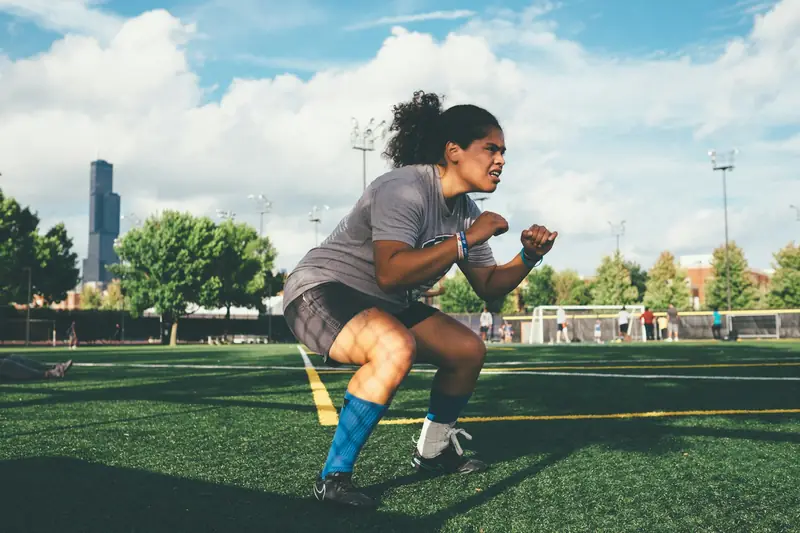
Train it off the slopes. The aim is legs that brake for longer, so the tired part of your day comes later. Squats, split squats and step-downs with a slow lowering phase, plus steady cardio (cycling, stair climbing, hill walking) twice a week. In the last two weeks, add jumps and back off the heavy work, so you arrive strong and fresh rather than sore.
Does training before the season really help?
Honestly, nobody has proven it for holiday skiers. A systematic review of injury prevention in recreational skiing and snowboarding found 80 recommendations in the research, on equipment, education, behaviour and experience, and not one on fitness or training.[12] The trials simply haven't been done.
What we do have is a strong logical case. Skiing causes braking fatigue that lasts into the next day.[4] In women over 40 skiing a full day, measures of thigh muscle fatigue rose through the morning, and a 45-minute lunch break didn't reverse them.[13] Fatigued muscles control the knee less well, and prevention programmes built on strength and control work in other sports. In competitive teenage skiers at Swedish ski high schools, a programme combining video awareness with core stability and balance exercises was followed by half as many ACL injuries: 3.9% of skiers compared with 8.1% in earlier years.[14] That wasn't a randomised trial, and teenage racers aren't holiday skiers. But it points the same way.
Two or three short sessions a week from October is plenty. Here is how the work lines up with what you do on the snow:
| Build this | It helps your | Try |
|---|---|---|
| Braking leg strength | Every turn, moguls, the afternoon | Slow-lowering squats, split squats, step-downs |
| Leg endurance | Stance, long runs, day five | Wall sits, cycling, stair climbing |
| Hip and side strength | Edging, the outside ski | Lateral lunges, Cossack squats, banded side steps |
| Hamstrings | Knee protection, backward falls | Nordic hamstring curls, Romanian deadlifts |
| Landing and bounce | Moguls, uneven snow, small jumps | Drop squats, skater bounds, pogo hops |
| Lower legs | Heel and toe edges on a board | Calf raises, tibialis raises |
| Upper body and trunk | Falls on a board, poles, quiet upper body | Push-ups, planks, Pallof presses, band rotator cuff work |
Staying on the slopes
Most ski and snowboard injuries come down to four body parts, plus your head.
The knee (skiers). The ACL is the skier's injury, and it hasn't fallen the way broken legs have.[1][6] Train your hamstrings and landings, stay out of the back seat, and keep your bindings properly set. If you feel or hear a pop in the knee and it swells within a few hours, stop skiing and get it seen by a doctor that day. Don't ski on it to see how it feels.
The wrist (boarders). Wrist guards are one of the best-supported pieces of safety kit in any sport. In a randomised trial of 5,029 snowboarders in Norway, those given wrist braces had 8 wrist injuries, compared with 29 in those without.[15] A pooled analysis put the reduction in the odds of wrist injury at around two-thirds.[5] They are cheap, so wear them, especially in your first seasons.
The shoulder. Falls on an outstretched arm cause dislocations, collarbone fractures and rotator cuff injuries in both sports.[10] If your shoulder looks the wrong shape after a fall, or your arm tingles or goes numb, don't try to put it back yourself. Get help from ski patrol.
The thumb. Let go of the pole as you fall. A thumb that is weak and painful to pinch after a fall needs checking, because the torn ligament doesn't always heal well on its own.
Your head. Helmets work. A review of 12 studies found helmet wearers had 35% lower odds of a head injury.[16] In Norway, helmet use was linked to about a 60% lower risk of head injury.[17] If you don't wear one yet, this is the year. If you hit your head and have a headache that gets worse, vomiting, confusion or drowsiness, get to a doctor straight away.
Fatigue. Fatigue builds through the day and lunch doesn't fix it.[13] It isn't proven to cause injuries, but late afternoon brings the worst snow, the worst light and the most tired legs. Call it a day while you still want one more run.
The long game
Skiing is one of the few sports people do happily into their seventies. In Salzburg, researchers took 60- to 76-year-olds on 12 weeks of guided skiing to study what a season does for fitness, strength and balance in later life.[18]
Stronger legs make your first day less of a shock and your last day as good as your first. Cleaner turns cost less energy, and knowing how to fall makes the bad days less bad. The off-slope work is what keeps you coming back, winter after winter.
Training built around your ski trip
Most holiday skiers and boarders never do any of this, not because they don't care, but because it's hard to know where to start. A generic gym plan doesn't know you fly out on the 14th of February, that your knee twinged on the last day of last season, or that you only have a kettlebell and a resistance band at home.
Achilles does. Pick a goal such as Play my sport better, Stop getting injured or Get stronger, and tell it when you're going, how often you train, the time and equipment you have, and anything that bothers you, from a creaky knee to an old wrist fracture. Achilles builds your plan from a library of sports-science research: the leg strength, the hamstring and landing work, the trunk and upper body, and how to progress it towards the trip, each exercise with its sets, reps and rest, and the studies behind it.
Log your sessions as you go, and the plan moves with you, so you arrive at the first lift strong, fresh and ready for a week of it.
See how Achilles worksFurther reading
- Johnson R.J., Ettlinger C.F. & Shealy J.E. (2008). Update on injury trends in alpine skiing. Journal of ASTM International, 5(10). Link
- Langran M. & Selvaraj S. (2002). Snow sports injuries in Scotland: a case-control study. British Journal of Sports Medicine, 36(2). Link
- Dickson T.J. & Terwiel F.A. (2021). Injury trends in alpine skiing and a snowboarding over the decade 2008-09 to 2017-18. Journal of Science and Medicine in Sport, 24(10). Link
- Koller A. et al. (2015). Decrease in eccentric quadriceps and hamstring strength in recreational alpine skiers after prolonged skiing. BMJ Open Sport & Exercise Medicine, 1(1). Link
- Hume P.A. et al. (2015). Recreational snow-sports injury risk factors and countermeasures: a meta-analysis review and Haddon Matrix evaluation. Sports Medicine, 45(8). Link
- Kim S. et al. (2012). Snowboarding injuries: trends over time and comparisons with alpine skiing injuries. American Journal of Sports Medicine, 40(4). Link
- Ettlinger C.F., Johnson R.J. & Shealy J.E. (1995). A method to help reduce the risk of serious knee sprains incurred in alpine skiing. American Journal of Sports Medicine, 23(5). Link
- Posch M. et al. (2022). Ski-geometric parameters do not differ between ACL injury mechanisms in recreational alpine skiing. Knee Surgery, Sports Traumatology, Arthroscopy, 30(6). Link
- Engkvist O., Balkfors B. & Lindsjö U. (1982). Thumb injuries in downhill skiing. International Journal of Sports Medicine, 3(1). Link
- McCall D. & Safran M.R. (2009). Injuries about the shoulder in skiing and snowboarding. British Journal of Sports Medicine, 43(13). Link
- Langran M. & Selvaraj S. (2004). Increased injury risk among first-day skiers, snowboarders, and skiboarders. American Journal of Sports Medicine, 32(1). Link
- Hébert-Losier K. & Holmberg H.-C. (2013). What are the exercise-based injury prevention recommendations for recreational alpine skiing and snowboarding? A systematic review. Sports Medicine, 43(5). Link
- Hermann A. et al. (2023). Muscular fatigue and quadriceps-to-hamstring ratio in alpine skiing in women over 40 years. International Journal of Environmental Research and Public Health, 20(8). Link
- Westin M. et al. (2020). Prevention of anterior cruciate ligament injuries in competitive adolescent alpine skiers. Frontiers in Sports and Active Living, 2. Link
- Rønning R. et al. (2001). The efficacy of wrist protectors in preventing snowboarding injuries. American Journal of Sports Medicine, 29(5). Link
- Russell K., Christie J. & Hagel B.E. (2010). The effect of helmets on the risk of head and neck injuries among skiers and snowboarders: a meta-analysis. CMAJ, 182(4). Link
- Sulheim S. et al. (2006). Helmet use and risk of head injuries in alpine skiers and snowboarders. JAMA, 295(8). Link
- Müller E. et al. (2011). Salzburg Skiing for the Elderly Study: influence of alpine skiing on aerobic capacity, strength, power, and balance. Scandinavian Journal of Medicine & Science in Sports, 21(Suppl 1). Link