Blog · Padel
Padel decoded: the shots that win points, and the body that makes them work
The glass, the corners, the lob, volleys, the bandeja, the víbora and the smash, explained for club players, with the off-court training that makes each one easier on your body.
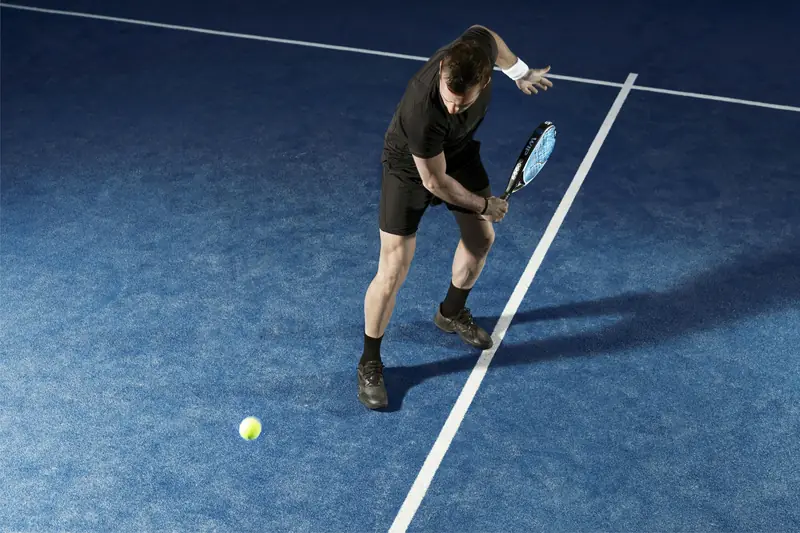
Your first padel game usually goes the same way. Someone explains that yes, the ball can come off the glass, and within ten minutes you are in a proper rally, laughing. By the end of the hour you are hooked. By the end of the month you are playing three times a week and wondering why the pair on the next court always seem to have so much time on the ball.
They are not faster than you. They are using the court. Padel has its own shots, built around the walls and the net, and once you know what each one is for, the game opens up. This guide walks through the shots that matter most: what they are, how to hit them, the classic mistakes, and what you can do off court to make each one easier on your body. Where the research has something useful to say, we say it, and every number links to the study it comes from.
The one idea behind every shot: own the net
If you remember one thing, make it this. Padel points are won at the net. In professional matches, the net zone produces more winners than anywhere else on court.[1] Almost every shot in this guide does one of two jobs: it gets your pair to the net, or it keeps you there.
The second thing worth knowing is more comforting. At club level, matches are mostly lost, not won. A study comparing amateur and professional players found that amateurs lose far more points to their own unforced errors, while pros win more of theirs with winners.[2] So the fastest way to win more is not a bigger smash. It is choosing the right shot and missing less.
Before any shot: ready position and the split step
Good padel starts before the ball reaches you. Stand with your knees soft, your weight on the balls of your feet, and your racket up in front of your chest. Then, just as your opponent hits, make a small hop and land on both feet. That little bounce is the split step, and it is what lets you push off in any direction instead of starting from flat feet.
The classic mistake is switching off when the ball goes to your partner: racket down, feet planted, watching. Then the ball comes back to you and you are a step late for the whole rally.
Train it off court. Lateral movement is the most common movement in professional padel,[3] and the split step is basically a small, fast bounce through the calves. Calf raises, small pogo hops and side-to-side shuffles build the springy lower legs this needs.
Playing off the glass
This is the shot that makes padel padel. When a ball comes deep, you can let it bounce, hit the back glass and come back out to you. That gives you time, takes the pace off a hard shot, and keeps the rally alive. Beginners rush in and hit it early. Better players back up with the ball, let the glass do the work, then play it.
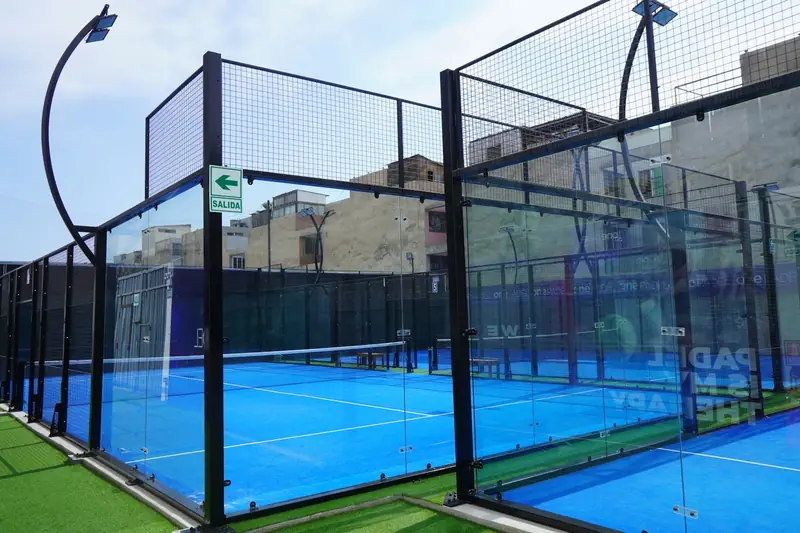
How to do it:
- Get your racket up early, so you can decide quickly whether to take it before or after the glass
- Turn side-on and take the racket back as you move, with small quick steps to adjust
- Stay a metre or two off the glass, never pinned against it. Moving back with the ball is easy; moving forward into it is not
- Read the ball. A hard, flat ball springs well out off the glass, so give it room. A soft, high lob dies close to the wall, so move in towards it
- Get low and swing from low to high. You rarely need pace here; a calm ball back over the net is a good result
The classic mistake is standing too close to the wall. The ball comes straight into your body and you end up jammed, flicking at it.
It pays to practise this. Back-wall shots turn up in roughly a third to a half of professional points,[4] and they are also where most point-ending errors happen in the pro game.[5] If the best players in the world miss most off the back glass, it is worth an hour of your training.
Train it off court. Wall play is lots of short backward and sideways steps, then getting low and staying balanced while you turn. Squats and split squats, reverse lunges, ankle mobility and some trunk rotation work all likely help. They also load the knees and calves in the way padel does, which matters because the knee is one of the most commonly injured joints in padel.[6]
The corners
Corners are where the glass gets tricky. A ball can hit two walls before it reaches you, and which wall it hits first changes everything:
- Back glass, then side glass: the ball usually opens out towards the middle of the court. Turn and track it out
- Side glass, then back glass: typically from a cross-court ball, it stays tighter to the back glass and feels cramped
The trick is to watch which wall the ball hits first, hold your position a step further off the corner than feels natural, and let the ball come out to you. Keep the swing compact and aim for height and depth, usually a lob or a slow ball through the middle. Don't try to win the point from the corner.
The research agrees. Two-wall balls are among the highest-error situations in the professional game,[7] and when pros do play them, they mostly just keep the rally going rather than hit winners.[8] If the pros treat the corner as a place to survive, so should you.
If a ball has already got past you, there is one more trick: the contrapared, where you hit the ball into your own back glass so it rebounds over the net. It is a last resort, and a low one just sets up the other pair for a smash, so aim high.
Train it off court. Corners ask you to change direction in a tiny space. Lateral lunges, hip mobility drills and short change-of-direction drills in a small box help you turn without losing balance.
The lob: your ticket to the net
In tennis, the lob is a rescue shot. In padel, it is a weapon. A high, deep ball over the net pair pushes them back towards their glass and gives your pair the chance to move forward and take the net.
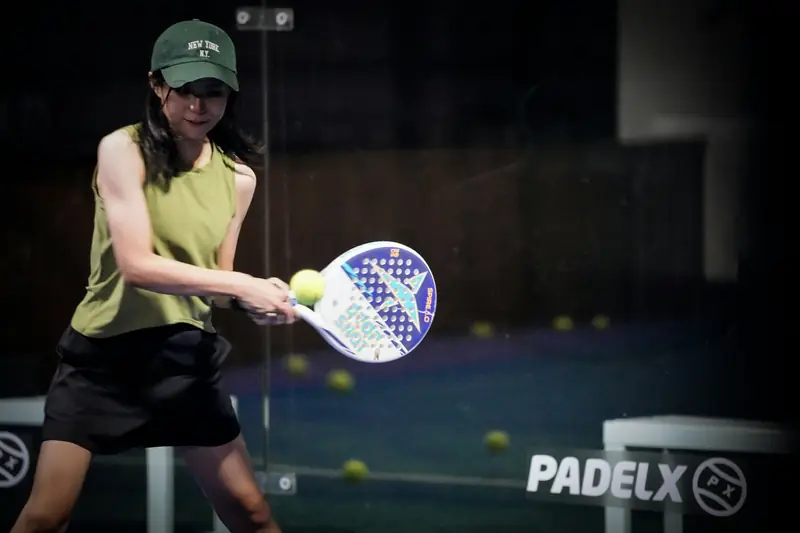
The numbers back it up. In a study of net approaches in men's padel, the lob was used in about 60% of the actions that won the net, and that held for professional and regional players alike.[9] In women's professional padel, it was the most effective shot for taking the attacking position.[10]
How to do it:
- Open the racket face so it points more towards the sky
- Start low and finish high, and drive the height from your legs, not your arm
- Aim to land the ball just beyond the service line but short of the back glass
- As soon as the lob is past them, move forward with your partner
The classic mistakes are a lob that is too low, which gets smashed, and one that is too high or too long, which sails out or gives them an easy ball off the glass.
Train it off court. The height in a good lob comes from your legs and hips. Squats and hip hinges, like deadlifts or kettlebell swings, build that drive.
The chiquita
The chiquita is the lob's sneaky partner. It is a soft, slow ball that barely clears the net and dips at the feet of the net players, forcing them to hit up. While they do, you and your partner move forward. Move as soon as it leaves your racket rather than waiting to admire it, and mix it up: if you play it every time, the other pair will read it. It takes touch, so it is worth practising in a warm-up.
Volleys: the bread and butter at the net
Once you are at the net, most of your shots will be volleys. In men's professional finals, about two thirds of all attacking shots were volleys, far more than smashes.[11] A padel volley is a short punch or a block, not a swing, and there are three you will use all the time:
- The block: against a fast ball, your racket is a shield. Keep the face upright and let the pace do the work
- The deep volley: a firm push that sends the ball back towards their glass and keeps them pinned
- The angled volley: a softer, sliced ball short and wide, towards the side wall, when you have an opening
How to do it:
- Keep your racket up, above net height, so you never have to lift it
- Split step as they hit, then step in and meet the ball out in front
- Keep the racket path short. Think punch, not swing
- Don't hug the net. A couple of metres back is about right, or even a mediocre lob will beat you
- Aim low, at their feet or around the service line, so they have to hit up. Move as a pair: if your partner shifts, you shift with them
The classic mistake is the big tennis-style swing. It is late against fast balls and sends slow ones into the glass.
Train it off court. Volleys are quick hands and quick feet. Grip and forearm work (wrist curls and extensions, holds with a light weight) give your elbow tendons more capacity, which matters because the elbow is the most commonly injured part of the body in padel.[6] Add the split-step work from earlier, and some trunk stability like side planks.
The bandeja: how you keep the net
Sooner or later, the other pair will lob you. The bandeja (Spanish for "tray") is how you answer without giving up the net. The LTA calls it "the antidote to the lob".[12] It is a controlled, sliced overhead, and its job is not to win the point. Its job is to send back a deep, low ball that stops the other pair attacking while you and your partner hold your position.
It is the most-used overhead in professional padel, and it keeps the rally going about 90% of the time.[13] Bandejas appear in more than half of all professional points.[4] Interestingly, at club level it wins a fair share of points too: amateurs scored more of their winners with the bandeja than pros did.[2]
How to do it:
- Turn sideways early, with your racket up and behind your head, and move back with a few big steps
- Let the ball drop to around eye or forehead height and meet it in front of you
- Keep the racket face a little open and swing across the ball rather than down through it. Think of it as a high volley, not a smash
- Aim deep, towards the back glass, so the ball stays low after it bounces
- Recover forward to the net straight away
The classic mistakes are bad footwork, which leaves you under or behind the ball and turns the bandeja into a bouncy gift, and treating it as a smash.
Train it off court. Every bandeja is your shoulder working overhead, again and again. Band exercises for the muscles that rotate your shoulder outwards, and work for the muscles around your shoulder blade, help the shoulder cope with that volume. A study of professional players found that most had, in their dominant shoulder, a strength imbalance between the muscles that rotate it inwards and outwards, which is exactly what that band work targets.[14] Upper-back mobility, so you can turn sideways and keep your elbow up, helps too.
The víbora: the bandeja with bite
The víbora ("viper") is the bandeja's aggressive cousin. It has more speed and more side spin, so the ball skids low off the side glass and is awkward to return. Coaches put the difference like this: on a bandeja you hit the ball from underneath, and on a víbora you brush around the outside of it.[15]
Use it when a lob is short enough to step into but not short enough to smash cleanly, and you are still fairly close to the net. If you have been pushed deep, the calmer bandeja is the better choice.
How to do it:
- Stay sideways. Facing the net kills the spin
- Take an extra step back so the ball is in front of you, then make contact a little lower and further to the side than a bandeja, around head height (coaches differ on the exact spot)
- Swing faster and more across the ball, using your trunk and wrist to create the side spin
- Commit to it. Half a víbora goes in the net
- It doesn't need full power. A well-shaped víbora at three-quarter pace still leaves the other pair with a low, awkward ball
The classic mistake is trying to kill it. The víbora is a risky shot: in professional matches, sliced, cross-court smashes end in errors more often than flat, straight ones.[16] Use it when it is on, not every time.
Train it off court. The víbora is probably the most demanding shot in padel for your shoulder and elbow, because the arm rotates fast and the wrist and forearm add the spin. If the arm does all the work without the trunk turning, the elbow likely takes more of the load. Shoulder rotation work, forearm strength and rotational trunk exercises, like medicine-ball throws against a wall, prepare your body for it.
The smash: flat, por tres and por cuatro
The smash is the shot everyone wants to hit, and the one club players hit most often at the wrong moment. Because the glass gives the ball back, a smash from deep in the court often just sets up your opponents. The research is clear: flat and topspin smashes win about 60% of the time, but that drops sharply the further from the net you hit them.[13] So the rule is simple: smash when the lob is short and you are near the net; otherwise, play the bandeja.
There are three smashes worth knowing:
- The flat smash: hit hard and down, close to the net. When you are finishing a point, aim it straight rather than cross-court: in professional padel, flat and straight finishing smashes end in winners more often, while sliced and cross-court ones produce more errors[16]
- Por tres (x3): a topspin smash that bounces, kicks up off their back glass and flies out of the court over the side wall. It relies on technique and spin more than strength, and it works best on a short lob
- Por cuatro (x4): a flat smash hit steeply into the floor from very close to the net, so the ball bounces high enough to clear the back wall. It needs a really short ball
How to do it:
- Turn sideways and point your free hand at the ball
- Move your feet first, so you are under and behind the ball. A late smash is all arm
- Make contact high and in front for a flat smash, or overhead and a little behind for a por tres
- Pick the smash by where you are standing: por tres from a little deeper, por cuatro only right at the net
One more finding is worth knowing. When researchers measured smash speed with and without an opponent on court, amateurs slowed from about 125 to 105 km/h, a much bigger drop than semi-professional players.[17] Under pressure, technique falls apart first. Practise your smash in drills that feel like a match, not just from a coach's feed.
Train it off court. A fast smash comes from the ground up: legs, then trunk rotation, then the arm. Rotational medicine-ball throws build that chain. Equally important is the brake. The muscles at the back of your shoulder slow the arm down after every smash, so the same band work as for the bandeja protects you here. If you jump to smash, practise landing softly too.
Does training off court really help?
Yes, and there is a neat study to show it. Researchers took 24 well-trained padel players and gave them eight weeks of strength, jumping and agility work. Half did it in the gym; the other half did the same kind of work on court, with a racket in hand. Both groups improved their jump, upper-body strength, endurance, change of direction and the speed of their shots. The on-court group gained a bit more shot speed.[18]
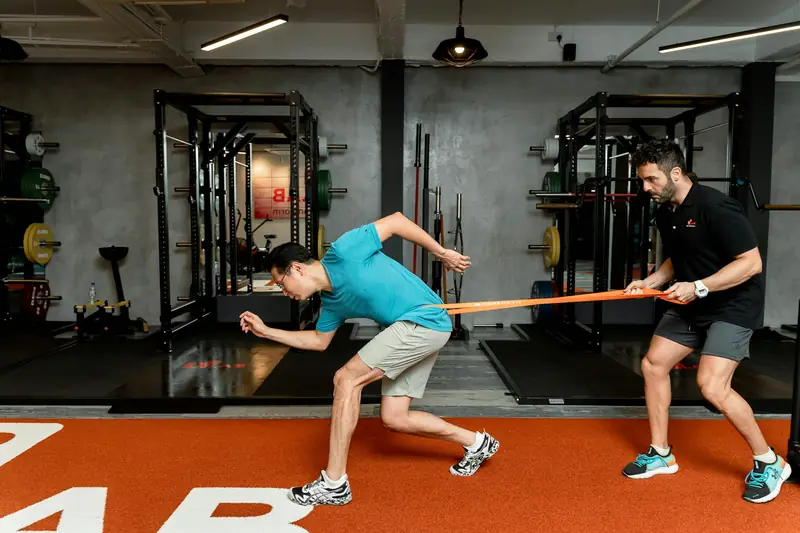
The lesson for the rest of us: build your strength in the gym, then bring it onto the court. Shuffle into a volley, lunge to the glass with your racket, split step on a partner's cue. Two short sessions a week alongside your matches is plenty to start. Here is how the work lines up with the shots:
| Build this | It helps your | Try |
|---|---|---|
| Legs and braking | Glass, corners, low volleys, lobs | Split squats, reverse lunges, step-downs |
| Calves and springy feet | Split step and every quick first step | Calf raises (straight and bent knee), small pogo hops |
| Shoulder rotation and shoulder blade | Bandeja, víbora, smash | Band external rotations, band pull-aparts |
| Trunk rotation | Víbora, smash, turning side-on at the glass | Medicine-ball throws against a wall, side planks |
| Forearm and grip | Volleys, víbora | Wrist curls and extensions, heavy holds |
Staying on court
The flip side of all this stopping, starting, twisting and smashing is that padel players get hurt fairly often. Across studies, between 40% and 95% of players report having been injured. The elbow is the most common site, followed by the knee, the shoulder and the lower back.[6] Calves matter too, especially as you get older: in a study of 645 French players, calf and Achilles injuries made up almost one in five injuries, and players over 40 had about four times the odds of injury of younger players.[19]
The good news is that the training above is also your best protection. Across sports, strength training is the most effective way found so far to prevent sports injuries.[20] No one has run a prevention trial in padel yet, but sports with similar demands have, and two habits stand out:
- Warm up properly. Strolling on court and hitting a few gentle balls isn't a warm-up. In recreational football, a structured warm-up cut injuries by about 39%.[21] A padel version takes ten minutes: easy jogging and side-steps, a few lunges and squats, calf raises, small hops, arm circles and band work for the shoulders, then build your shots up from soft to full speed
- Build up gradually. Going from one match a week to four is exactly the kind of jump bodies struggle with. Add matches one at a time, and treat an elbow that aches after every match, or a calf that feels tight every morning, as a signal to ease back and build capacity before it costs you weeks off court
Training built around your padel
Most padel players never do any of this, not because they don't care, but because it is hard to know where to start. A generic gym programme doesn't know you play three evenings a week, that your bandeja shoulder grumbles, or that you only have a pair of dumbbells at home. Your club coach can sharpen your víbora, but rarely builds your strength plan.
Achilles does. Pick a goal such as Stop getting injured or Play my sport better, and tell it how often you play, the time and equipment you have, and anything that bothers you, from a sore elbow to an old calf strain. Achilles builds your plan from a library of sports-science research: the warm-up, the work for your legs, calves, shoulders, trunk and forearms, and how to progress it, each exercise with its sets, reps and rest, and the studies behind it.
Log your sessions and your matches, and the plan moves with you, so you keep getting stronger without overdoing the weeks you play the most.
See how Achilles worksFurther reading
- Sánchez-Alcaraz B.J. et al. (2022). Analysis of winning shots and errors in professional padel. Revista Iberoamericana de Ciencias de la Actividad Física y el Deporte. Link
- Fernández-de-Ossó A.I. et al. (2025). Skill-level differences in final shot characteristics in padel: amateurs and professionals. Retos, 64. Link
- Priego Quesada J.I. et al. (2013). Padel: a quantitative study of the shots and movements in high performance. Journal of Human Sport and Exercise, 8(4). Link
- Martín-Miguel I. et al. (2024). Game dynamics in professional padel: shots per point, point pace and technical actions. Sports, 12(8). Link
- Escudero-Tena A. et al. (2022). Analysis of errors and winners in men's and women's professional padel. Applied Sciences, 12(16). Link
- Dahmen J. et al. (2023). Incidence, prevalence and nature of injuries in padel: a systematic review. BMJ Open Sport & Exercise Medicine, 9(2). Link
- Conde-Ripoll R. et al. (2021). Analysis of wall shots in professional padel. Revista de Entrenamiento Deportivo, 35(2). Link
- Sánchez-Alcaraz B.J. et al. (2021). The double-wall shot in professional padel: differences between men and women. Acciónmotriz, 26. Link
- Muñoz Marín D. et al. (2017). Net approaches in padel: professional and advanced players compared. Journal of Sport and Health Research, 9(2). Link
- Escudero-Tena A. et al. (2020). Use and efficacy of the lob to achieve the offensive position in women's professional padel. International Journal of Environmental Research and Public Health, 17(11). Link
- Sánchez-Alcaraz B.J. et al. (2020). Analysis of attacking actions in professional men's padel. Apunts. Educación Física y Deportes, 142. Link
- LTA Padel. Overheads: the bandeja and the smash. Link
- Sánchez-Alcaraz B.J. et al. (2020). Analysis of performance parameters of the smash in male and female professional padel. International Journal of Environmental Research and Public Health, 17(19). Link
- Assessment of shoulder joint and muscle side-asymmetry in professional padel players (2025). Sports Biomechanics, 24(9). Link
- The Padel School. The víbora technique. Link
- Escudero-Tena A. et al. (2023). Analysis of the finishing smashes in professional padel. E-balonmano.com. Link
- Rivilla-García J. et al. (2019). Influence of opposition on overhead smash velocity in padel players. Kinesiology, 51(2). Link
- Sáez de Villarreal E. et al. (2023). Comparison of two 8-week training interventions on the athletic performance of padel players. Kinesiology, 55(1). Link
- Lecler A. et al. (2024). Injuries in French padel players. Journal de Traumatologie du Sport. Link
- Lauersen J.B., Bertelsen D.M. & Andersen L.B. (2014). The effectiveness of exercise interventions to prevent sports injuries. British Journal of Sports Medicine, 48(11). Link
- Thorborg K. et al. (2017). Effect of specific exercise-based football injury prevention programmes. British Journal of Sports Medicine, 51(7). Link