Blog · Running
Your first marathon: what the research says about getting to 42.2 km
How much to run, how long the long run should be, how to avoid the wall, and how to fuel, taper and recover. Drawn from studies of thousands of first-time marathoners.

A marathon is not two half marathons. Somewhere after 30 km the race changes: your stored fuel runs low, your legs have taken tens of thousands of impacts, and pace that felt easy an hour ago starts to cost a lot. That is why the marathon has a reputation, and why the training for it looks different.
The good news is that first-time marathoners have been studied closely. Researchers have followed thousands of them through their training, and analysed millions of race results. The picture that comes out is reassuringly practical. Most problems come from a handful of avoidable mistakes: too little base, sudden jumps in training, starting the race too fast, and under-fuelling.
Here is what the evidence says, and how to use it.
Before you start: run a half first
The single most useful thing you can do before a marathon is run a half marathon. When researchers followed 720 people training for their first New York City Marathon, those who had never raced a half were more likely to get injured during their build-up.[1] A half teaches you pacing, fuelling and what a long effort feels like, at half the cost.
Most marathon plans run 16 to 20 weeks. That is convention rather than something tested head to head, but it matches how long it takes to build the long run safely from a half marathon base. If you are starting from less than that, add the weeks at the front, not by squeezing the plan.
A reasonable starting point is running three or four times a week, around 25 to 30 km in total, with a long run of 12 to 15 km that feels comfortable.
How much running is enough?
More training generally means a faster, more comfortable marathon, up to a point. In a study of 441 marathoners, those running under 40 km a week finished slower, and those whose longest run was under 25 km finished slower too.[2] Another study of 662 finishers found that runners averaging under 30 km a week were about twice as likely to get injured during the race itself as those running 30 to 60 km. Going above 60 km a week added no further protection.[3]
For a first marathon, a sensible target is to build to 40 to 60 km a week at your peak, over four or five runs. Most of it should be easy. An analysis of 92 published marathon plans found that even low-volume plans peaked around 43 km a week, with a longest run of about 31 km.[4]
The long run
The long run is what prepares you for the second half of the race. Build it gradually, by 1 to 3 km at a time, with a shorter week every third or fourth week. Peak at 29 to 32 km about three to four weeks before race day. In the New York study, runners who never completed a run of about 29 km were more likely to get injured.[1] There is no need to run the full distance in training; the taper and race day will carry you the rest of the way.

Run long runs slowly, a minute or more per kilometre slower than your goal race pace. The aim is time on your feet, not speed.
Avoid spikes, not just big weeks
One of the clearest injury signals in marathon training isn't how much you run, but how suddenly you add it. A 2023 study tracked 735 New York marathoners through their GPS training data. Each day on which their last week's running was much higher than their usual (more than 1.5 times their four-week average) nudged their injury risk up, for beginners and experienced runners alike. Overall, 40% picked up an injury during the 16-week build-up.[5]
A separate study of 5,200 runners found the same pattern for single sessions: a run more than 10% longer than your longest in the past month raised the risk of an overuse injury.[6]
The practical rule is simple. Build steadily. If you miss a week through illness or work, don't try to make it up; pick the plan back up a step lower and climb again.
Strength work: make it count
Strength training is one of the best-supported additions to a runner's week, but the detail matters.
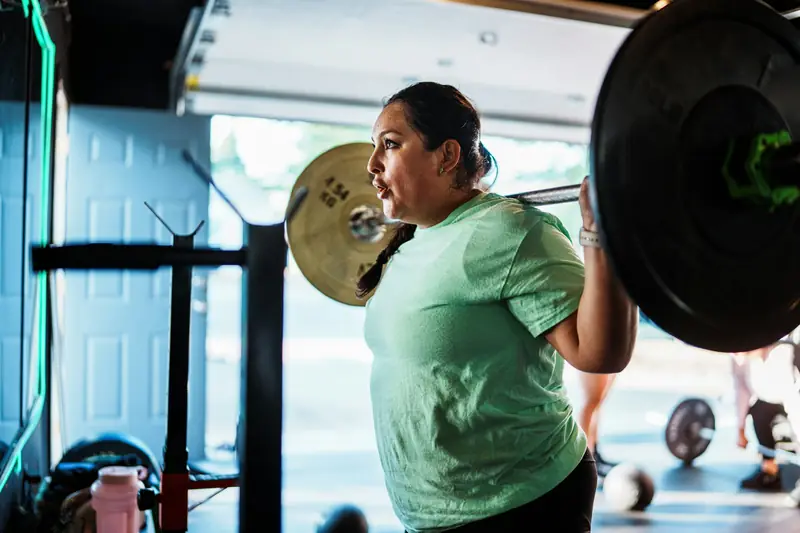
In the New York first-timer study, half the runners were given a 10-minute bodyweight routine to do three times a week. It made no difference to injuries or finish times.[1] Light, quick routines are easy to fit in, and easy for the body to ignore.
Heavier work tells a different story. In marathoners over 40, a short programme of lifting close to maximal loads improved running economy at marathon pace by about 6%, while the groups that didn't lift heavy stayed the same.[7] A 2025 trial found that strength and jumping work kept runners' economy from fading after 90 minutes of running, which is exactly where a marathon starts to hurt.[8] Reviews pooling dozens of trials find the same: heavy and combined strength training makes distance runners faster.[9]
What that looks like in practice:
- Two sessions a week through the build, one in the last month, none in the final week
- A few big movements done properly: squats or split squats, deadlifts or hip hinges, calf raises, step-ups
- Loads heavy enough that 4 to 8 reps is genuinely hard by the last couple, built up over several weeks
- Some hopping or skipping drills once the basics feel solid
If heavy lifting is new to you, start lighter for the first few weeks to learn the movements, then progress. Keep strength sessions away from the day before your long run.
The wall, and how to avoid it
Hitting the wall is a sustained, heavy slowdown late in the race, usually after about 32 km, when your muscles run short of stored carbohydrate. An analysis of more than 4 million marathon results found that 28% of men and 17% of women hit it.[10]

How the race starts matters a lot. In data from 1.7 million finishers, runners who went out too fast finished slower overall and were more likely to hit the wall.[11] A 2025 study of 146,000 Valencia Marathon finishers found that years with more even pacing produced faster times and fewer collapses late on.[12]
So pick a realistic goal pace from your training and long runs, and hold back for the first 10 km even when it feels too easy. A small slowdown in the final 10 km is normal; a sudden collapse is what you are trying to avoid.
Run-walk is a perfectly good strategy too. In a randomised trial of 42 recreational marathoners, the run-walk group finished in a similar time to the group that ran continuously, with less muscle pain and fatigue.[13]
Taper: the last three weeks
Tapering works in marathoners. In data from about 158,000 runners, those who cut their training steadily over three weeks finished a median of about 5.5 minutes faster than those who barely tapered.[14] Earlier reviews found the best tapers cut volume by around 40 to 60% while keeping some race-pace running in.[15]
A simple shape: your last big long run three weeks out, then cut weekly distance to roughly 75%, then 60%, then 40% in race week. Keep your usual running days and a few short efforts at goal pace.
Fuelling: train your gut like your legs
For a marathon, fuel is part of the plan, not an afterthought.
- The days before. For the last 36 to 48 hours, make carbohydrate the bulk of every meal and snack. Sports nutrition guidance for events this long puts it at around 10 to 12 g per kilogram of body weight a day, which is far more pasta and rice than most people expect.[16] Lighter training that week makes it easier to top up.
- Race morning. A familiar, carbohydrate-rich breakfast two to four hours before the start.
- During the race. Aim for 30 to 60 g of carbohydrate an hour, and up to 90 g if you will be out for more than two and a half hours. Above about 60 g an hour, products that mix glucose and fructose are absorbed better.[16]
- Caffeine. If you already use it, around 3 mg per kilogram of body weight about an hour before the start helps endurance performance. Don't try it for the first time on race day.[17]
The catch is that your stomach has to cope. Gut trouble is one of the most common reasons marathons go wrong, and it is trainable. In one study, two weeks of practising carbohydrate intake during runs cut gut symptoms by around 60% and improved performance.[18] Use your long runs to rehearse exactly what you will eat and drink on race day, at race-day amounts.
Drinking: to thirst, not to a schedule
Drinking too much is a real risk in a marathon, especially for slower runners. At the 2002 Boston Marathon, 13% of finishers tested had low blood sodium, mostly linked to drinking so much that they gained weight during the race and to finishing times over four hours.[19]
Drinking when you are thirsty is the simplest guard against both dehydration and over-drinking.[20] Experts still debate whether thirst alone is always enough, especially in heat, so a sensible middle ground is to drink to thirst, sip at aid stations rather than downing full cups, and use a sports drink or electrolyte tablets on hot days.
After the finish line
A marathon leaves real muscle damage, and soreness fades before your muscles have fully recovered. Markers of muscle damage peak around a day after the race and can take one to two weeks to settle.

That doesn't mean you have to sit still. In a randomised study of 64 marathon finishers, those who did 40 minutes of easy running two, four and six days after the race recovered just as well as those who rested, and their legs were springier by day four.[21]
A good rule: walk and move gently for the first couple of days, add short easy runs once stairs stop being a problem, and leave hard sessions and long runs for two to three weeks.
A word on safety
Marathons are very safe. A study of 10.9 million race entrants found cardiac arrest during a marathon happens to about 1 in 100,000 runners,[22] and a 2025 update found the chance of surviving one has more than doubled thanks to defibrillators and CPR on the course.[23] If you have symptoms such as chest pain or unusual breathlessness when you exercise, get them checked before you start a plan.
A marathon plan that fits your life
The research gives you the principles: a base before you start, steady progression without spikes, a long run that peaks around 30 km, heavy strength work, a three-week taper, a patient start and a well-rehearsed fuelling plan. Turning those into 16 to 20 weeks that fit your job, your family and your body is the hard part. A plan copied from a magazine or an app that gives everyone the same schedule can't adjust when you lose a week to a cold.
Achilles can. Choose Finish an endurance event as your goal, pick the marathon, and tell it where you are starting: how much you run now, the days you can train, the equipment you have and any old injuries. A fixed set of safety questions comes first. Then Achilles builds your plan from a library of sports-science research, with your runs and strength sessions laid out week by week, each exercise with its sets, reps and rest, and the studies behind it.
As you log your sessions, or tell it about a holiday or an illness, the plan moves with you, so the build stays steady all the way to the start line.
See how Achilles worksFurther reading
- Toresdahl B. et al. (2020). First-time New York City marathon runners: injuries and risk factors. Sports Health, 12(1). Link
- Fokkema T. et al. (2020). Training volume, long runs and marathon finish time in 441 runners. Scandinavian Journal of Medicine & Science in Sports. Link
- Rasmussen C. et al. (2013). Weekly running volume and injury during a marathon in 662 finishers. International Journal of Sports Physical Therapy, 8(2). Link
- Knopp M. et al. (2024). An analysis of 92 sub-elite marathon training plans. Sports Medicine – Open. Link
- Toresdahl B. et al. (2023). Training load and injury in 735 New York City marathon runners. British Journal of Sports Medicine, 57(3). Link
- Frandsen J. et al. (2025). How much running is too much? Identifying high-risk running sessions in a 5200-person cohort study. British Journal of Sports Medicine, 59(17). Link
- Piacentini M. et al. (2013). Strength training and running economy in master marathon runners. Journal of Strength and Conditioning Research, 27(8). Link
- Zanini M. et al. (2025). Strength training improves running economy durability and fatigued high-intensity performance in well-trained male runners: a randomised controlled trial. Link
- Llanos-Lagos C. et al. (2024). The effect of strength training methods on middle- and long-distance runners' athletic performance. Sports Medicine, 54(7). Link
- Smyth B. (2021). How recreational marathon runners hit the wall: a large-scale data analysis of late-race pacing collapse in the marathon. PLOS ONE, 16(5). Link
- Smyth B. (2018). Fast starters and slow finishers: pacing in the marathon for 1.7 million recreational runners. Journal of Sports Analytics. Link
- Latorre-Román P. et al. (2025). Influence of sex, athletic category and athletic level on marathon pacing strategy. European Journal of Sport Science, 25(7). Link
- Hottenrott K. et al. (2016). Does a run/walk strategy decrease cardiac stress during a marathon in non-elite runners? Journal of Science and Medicine in Sport, 19(1). Link
- Smyth B., Lawlor A. (2021). Longer disciplined tapers improve marathon performance for recreational runners. Frontiers in Sports and Active Living, 3. Link
- Bosquet L. et al. (2007). Effects of tapering on performance: a meta-analysis. Medicine & Science in Sports & Exercise, 39(8). Link
- Burke L. et al. (2011). Carbohydrates for training and competition. Journal of Sports Sciences, 29(Suppl 1). Link
- Guest N. et al. (2021). International Society of Sports Nutrition position stand: caffeine and exercise performance. Journal of the International Society of Sports Nutrition, 18. Link
- Costa R. et al. (2017). Gut-training: the impact of two weeks repetitive gut-challenge during exercise on gastrointestinal status and running performance. Applied Physiology, Nutrition, and Metabolism, 42(5). Link
- Almond C. et al. (2005). Hyponatremia among runners in the Boston Marathon. New England Journal of Medicine, 352. Link
- Hew-Butler T. et al. (2015). Statement of the Third International Exercise-Associated Hyponatremia Consensus Development Conference. Clinical Journal of Sport Medicine, 25(4). Link
- Martínez-Navarro I. et al. (2021). Easy running, elliptical training or rest in the week after a marathon: a randomised trial. European Journal of Sport Science, 21(12). Link
- Kim J. et al. (2012). Cardiac arrest during long-distance running races. New England Journal of Medicine, 366. Link
- Kim J. et al. (2025). Cardiac arrest during long-distance running races, 2010 to 2023. JAMA. Link