Blog · Golf
Golf, shot by shot: how club golfers hit it further, score lower and keep playing for decades
Set-up, the backswing, the downswing, driving, the short game and putting, explained for club and weekend golfers, with the off-course training that adds distance and protects your back.

Every club has one. Sixty-something, a swing that looks almost lazy, and somehow they're 20 yards past you off the tee and down in two from the edge of the green. On the 17th, when your back is starting to talk to you, they're still making the same smooth turn they made on the first.
They aren't doing anything magic. They set up well, turn instead of lift, start the downswing from the ground, and have a body that can make that motion a hundred times a round without complaint. This guide walks through the parts of the game that matter for club golfers: what each one is for, how to do it, the classic mistake, and what you can do off the course to make it easier on your body. Where the research has something useful to say, we say it, and every number links to the study it comes from.
The big idea: your body sets the limits of your swing
Golf looks like a game of technique, and it is. But the swing your coach wants you to make needs a body that can make it: hips and a mid-back that can turn, legs that can push into the ground, and a trunk that holds it all together.
The good news is that this is trainable, at any age. A review of 20 studies found that strength training increased clubhead speed by about 4% and hitting distance by about 5% when it combined general gym work with golf-specific exercises.[1] Speed turns straight into distance: in recreational golfers, each extra mile an hour of clubhead speed was worth about 2.8 yards off the tee.[2]
Set-up: most bad shots start here
Nearly every swing fault starts before the club moves. Grip, posture, ball position and aim are the boring part of golf, and the part most worth getting right.
How to do it:
- Set the clubface behind the ball first, aimed at the target, then build your stance around it
- Grip mostly in the fingers of your lead hand, with a pressure of about 4 or 5 out of 10
- Hinge, don't squat. Push your backside back and let your chest tilt over the ball, knees softly bent
- Let your arms hang straight down from your shoulders, with room for a hand between the grip and your thighs
- Ball in the middle of your stance for wedges, moving forward as the clubs get longer, to just inside your lead heel for the driver
- Feet, hips and shoulders parallel to the target line, like railway tracks
The classic mistake is aiming right of the target (for a right-hander) and then swinging across the ball to bring it back. You get a slice or a pull and blame your swing, when the cause was your aim. Lay a club on the ground at the range to check. Your eyes lie. The other classic is a death grip, which locks your forearms and kills the release.
There is very little research on set-up in amateur golfers. This is coaching wisdom, and it is good wisdom.
Train it off the course. A good address position is a hip hinge with a long spine. Romanian deadlifts and hinging with a broomstick along your back teach it. Loaded carries and holds build grip endurance, so your hands stay relaxed but secure through a whole round.
The backswing: turn, don't lift
In the backswing your upper body turns further than your hips, coiling your trunk like a spring. The gap between your shoulder turn and hip turn at the top is called the X-factor. It matters: in 100 recreational golfers, those with more separation between the torso and hips, and who created it faster, had higher ball speeds.[3]
How to do it:
- Turn your back to the target
- Let your lead shoulder work under your chin
- Keep your trail knee flexed. Resist with the legs, turn with the chest
- Push your hands away from you for width, rather than lifting them
- Let your hips turn a little. If you're stiff, let your lead heel come up rather than forcing a huge gap
The classic mistake is lifting the arms instead of turning, which gives you a short, steep, arms-only backswing. The opposite mistake is chasing a huge shoulder turn with locked hips, so you sway off the ball or crank your lower back. There's little evidence that a big X-factor causes back pain, but forcing it with a stiff body is not the way to get one.

Train it off the course. Separation depends on how well your mid-back rotates and how well your hips rotate, especially the lead hip turning inwards. Open books, half-kneeling upper-back rotations and 90/90 hip switches build the range. Pallof presses teach your trunk to hold still while your chest turns.
The downswing: start from the ground
Good players start the downswing from the ground up. Pressure shifts into the lead foot, the hips unwind first, then the chest, then the arms, then the club. Each part speeds up and then slows, passing its energy on to the next, like cracking a whip. Coaches call it the kinematic sequence. Golfers who push harder into the ground tend to swing faster, and better golfers produce bigger ground forces.[4]
How to do it:
- Start down with the lead foot. Feel pressure into the ground before your arms move
- Hips lead, hands follow
- Bump and turn: a small move of the hips towards the target, then rotate
- Keep your back to the target a split second longer
- Finish tall, belt buckle facing the target, weight on your lead foot
The classic mistake is "over the top": the arms and shoulders start the downswing, the club comes across the ball, and you slice, pull or hit it weakly. The other is hanging back on your trail foot, trying to help the ball into the air.
Train it off the course. A ground-up swing needs legs that can push quickly. Kettlebell swings, trap-bar deadlifts and jumps build that drive. Rotational medicine-ball throws and cable chops teach your trunk to pass the energy on. Split squats and single-leg Romanian deadlifts build the stable lead leg you rotate around.
Driving: speed you can train
Distance off the tee comes down to clubhead speed and the quality of the strike. The average male amateur swings the driver at about 94 mph.[5] You don't need tour speed. A few extra miles an hour is enough to change which club you hit into the green.
How to do it:
- Tee it high, ball forward, and hit up on it
- Make a wide turn and a full finish
- Swing at 80% and find the middle of the face. A centred strike beats raw effort
- Let your hips fire. Don't throw your arms at it
The classic mistake is trying to hit harder with your arms and shoulders, which breaks the sequence and often gives you less ball speed, not more. Teeing it too low and hitting down on the driver costs carry and roll.
Getting older doesn't stop you gaining speed. In golfers with an average age of 65, eight weeks of strength and flexibility training raised clubhead speed from about 85 to 87 mph, while the control group didn't change.[6] On the yards-per-mph figure above, that's roughly 6 extra yards off the tee.

Train it off the course. Lower-body strength (squats, deadlifts, split squats) and power (jumps and rotational throws), plus upper-body pushing and pulling. Train both sides, not just your swing direction. Speed-stick sessions, a few maximum-effort swings with full rest between, are the golf-specific add-on.
The short game: chipping and pitching
A chip is a short, low shot that flies a little and rolls a lot, played with a stroke like a putt and quiet wrists. A pitch flies higher, with more carry and less roll, and uses more wrist hinge and body turn. Choose by asking how much of the trip should be in the air and how much along the ground.
How to do it:
- Chip with a narrow stance, weight favouring your lead side, ball back of centre, hands slightly ahead
- Rock your shoulders. Your chest turns through and your wrists stay quiet
- Pick a landing spot, not the hole
- On a pitch, let the bounce of the club glide through the turf and turn your body rather than flicking your wrists
- Match the length of your backswing and follow-through, and never slow down into the ball
The classic mistake is trying to scoop the ball into the air. Your wrists flip, your weight hangs back, and you thin it or hit it fat. And a myth worth questioning: "drive for show, putt for dough". Data from tour players suggest that most of the difference in scores between golfers comes from the long game, not from putting.[7] The short game still saves strokes, but your long game matters more than the saying suggests.
Train it off the course. Touch is a skill, not a physical quality. What helps is a stable lower body and a quiet trunk so your stroke repeats: balance work and split-stance anti-rotation holds. When you practise, vary it. Fifty balls from the same spot teaches less than ten from five different spots.
Putting: face, pace and a quiet eye
Putting comes down to start line and pace. On short and medium putts, where the ball starts depends mostly on where the putter face points at impact. In elite players, face angle accounted for about 80% of how consistently they started the ball on line, and the path of the stroke only about 17%.[8] Pace decides whether a miss finishes close.
How to do it:
- Eyes over the ball or just inside it. Your shoulders rock and your wrists stay out of it
- Keep your gaze on the back of the ball through impact and just after. That is the quiet eye
- Use the same routine every time: read, rehearse, set, look, go
- A square face beats a perfect path
- On long putts, pace first. Aim to finish inside a dustbin-lid circle
The classic mistake is lifting your eyes early to watch the ball, which opens your shoulders and twists the face. In one trial with low-handicap golfers, those trained to hold a steady gaze longer kept it under pressure and took 1.9 fewer putts per round afterwards.[9] They were good players already, but the drill costs nothing to try on your living-room carpet.

Train it off the course. Putting needs very little strength, but it does need you to hold a bent-over posture over many putts without your back tiring. Back and hip endurance work (bird dogs, side planks, hip hinges) help with that, and with the hundreds of small bends in a round.
Eighteen holes is real exercise
A walked round is a long, moderate-intensity walk with 30 or 40 full swings and many more partial ones, over three and a half to four and a half hours. A review of 19 studies found golf is mostly moderate-intensity activity, and that people who ride in a buggy get noticeably less of it than people who walk.[10] In golfers aged 65 and over, a round of golf used more energy than a 6 km walk or Nordic walk, because it lasted longer, and gave healthy short-term changes in blood fats and blood sugar.[11]
The classic mistake is arriving cold, playing 18 holes, and doing nothing in between rounds, so fatigue unpicks your swing on the back nine.
Train it off the course. General fitness (brisk walking, cycling) keeps the back nine as good as the front. Leg strength helps on hilly courses. Eat and drink every few holes.
Warming up: move, don't hold
Only about 18% of recreational golfers in one survey did a proper warm-up before playing.[12] Long static stretches aren't the answer: in a small study, 20 minutes of static stretching before hitting cut clubhead speed by about 4% and accuracy by about 31%.[13] A review of golf warm-ups found that dynamic warm-ups, especially those with some resistance exercise, improved performance, while the evidence on injuries was mixed.[14]
Spend 5 to 10 minutes on hip hinges, trunk rotations, lunges and band work, then hit balls working up from wedge to driver. Save the long stretches for after the round.
Does training off the course really help?
For distance, yes. Strength training reliably increases clubhead speed and distance[1], and stronger lower and upper bodies go with faster swings.[15] The evidence in women and older golfers is thinner, with smaller studies, but it points the same way.
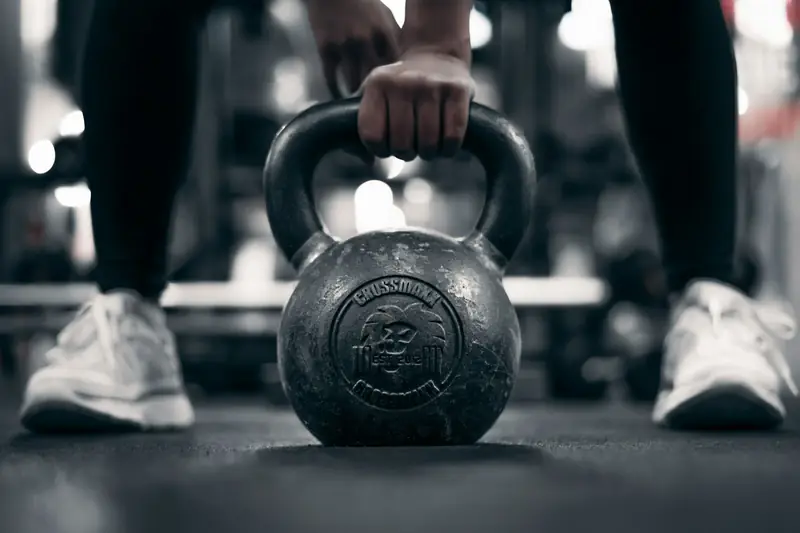
Two short sessions a week alongside your golf is plenty to start. Here is how the work lines up with the swing:
| Build this | It helps your | Try |
|---|---|---|
| Hip hinge | Set-up posture, a pain-free back | Romanian deadlifts, broomstick hinges |
| Upper-back rotation | Backswing turn, X-factor | Open books, half-kneeling rotations |
| Hip rotation | Turn and follow-through | 90/90 hip switches, lead-hip internal rotation stretches |
| Leg power | Clubhead speed, distance | Kettlebell swings, trap-bar deadlifts, jumps |
| Rotational power | The downswing sequence | Medicine-ball throws, cable chops |
| Trunk endurance | The back nine, putting posture | Pallof presses, side planks, bird dogs |
Staying on the course
Golf is gentle, but it isn't injury-free. Across more than 9,000 golfers, 57% of amateurs had been injured playing at some point.[16] Three areas take most of the strain.
The lower back. It is the most common injury site in amateurs, about a quarter of injuries in a large Australian survey.[17] Older age and higher body weight are the risk factors with the best support.[18] In professional golfers, those with a history of back pain had less inward rotation in the lead hip[19], which fits the idea that when your hips and mid-back don't turn, your lower back does the turning instead. Keep those joints moving and build trunk endurance, and watch how many range balls you hit.
The lead elbow and wrist. Hitting the ground hard (fat shots, range mats), a tight grip and big practice sessions all add up. Grip and forearm work and a softer grip help.
The lead shoulder. For a right-hander that's the left, which is squeezed across the body at the top of the backswing. Impingement and rotator cuff problems are common in middle-aged golfers.[20] Band work for the rotator cuff and upper back is cheap insurance. If pain sticks around for more than a couple of weeks, get it checked rather than playing through it.
The long game
Golf is one of the few sports people play well into their eighties. In a study of more than 300,000 Swedish golfers, death rates were about 40% lower than in the general population.[21] Golfers tend to be healthier and wealthier to begin with, so not all of that is the golf, but it's a remarkable figure. A review of 301 studies linked golf to better heart, lung and metabolic health.[22] The off-course work in this guide is what keeps you swinging freely long enough to collect it.
Training built around your golf
Most club golfers never do any of this, not because they don't care, but because it's hard to know where to start. A generic gym plan doesn't know you play twice a week, that your lower back stiffens after 18 holes, or that you only have a kettlebell and a resistance band at home.
Achilles does. Pick a goal such as Play my sport better or Stop getting injured, and tell it how often you play, the time and equipment you have, and anything that bothers you, from a stiff back to a sore lead elbow. Achilles builds your plan from a library of sports-science research: the warm-up, the work for your hips, back, trunk and legs, and how to progress it, each exercise with its sets, reps and rest, and the studies behind it.
Log your sessions and your rounds, and the plan moves with you, so you keep getting stronger without overdoing the weeks you play the most.
See how Achilles worksFurther reading
- Uthoff A. et al. (2021). Effects of resistance training methods on golf clubhead speed and hitting distance: a systematic review. Journal of Strength and Conditioning Research. Link
- USGA (2023). Distance Insights: golfer performance measurement, 2023 update. Link
- Myers J. et al. (2008). The role of upper torso and pelvis rotation in driving performance during the golf swing. Journal of Sports Sciences, 26(2). Link
- Watson A. et al. (2026). Ground reaction force and centre of pressure during the golf swing and associations with clubhead speed and skill level: a systematic review. Sports Medicine. Link
- TrackMan. What is club speed? (launch-monitor company data). Link
- Thompson C.J. & Osness W.H. (2004). Effects of an 8-week multimodal exercise program on strength, flexibility, and golf performance in 55- to 79-year-old men. Journal of Aging and Physical Activity, 12(2). Link
- Broadie M. (2012). Assessing golfer performance on the PGA TOUR. Interfaces, 42(2). Link
- Karlsen J., Smith G. & Nilsson J. (2008). The stroke has only a minor influence on direction consistency in golf putting among elite players. Journal of Sports Sciences, 26(3). Link
- Vine S.J., Moore L.J. & Wilson M.R. (2011). Quiet eye training facilitates competitive putting performance in elite golfers. Frontiers in Psychology, 2. Link
- Luscombe J. et al. (2017). A rapid review to identify physical activity accrued whilst playing golf. BMJ Open, 7. Link
- Kettinen J. et al. (2023). Comparative effectiveness of playing golf to Nordic walking and walking on acute physiological effects on cardiometabolic markers in healthy older adults. BMJ Open Sport & Exercise Medicine, 9. Link
- Fradkin A.J. et al. (2008). Describing the warm-up habits of recreational golfers. In Science and Golf V. Link
- Gergley J.C. (2009). For golfers, active warm-up beats passive stretching (press summary of a study in the Journal of Strength and Conditioning Research). Link
- A systematic review of golf warm-ups: behaviors, injury, and performance (2019). Journal of Strength and Conditioning Research. Link
- Brennan A. et al. (2024). Associations between physical characteristics and golf clubhead speed: a systematic review with meta-analysis. Sports Medicine. Link
- Williamson T. et al. (2024). Injury prevalence in golf: a systematic review and meta-analysis. British Journal of Sports Medicine, 58(11). Link
- McHardy A., Pollard H. & Luo K. (2007). The epidemiology of golf-related injuries in Australian amateur golfers: a multivariate analysis. South African Journal of Sports Medicine. Link
- Smith J.A. et al. (2018). Risk factors associated with low back pain in golfers: a systematic review and meta-analysis. Sports Health. Link
- Vad V.B. et al. (2004). Low back pain in professional golfers: the role of associated hip and low back range-of-motion deficits. American Journal of Sports Medicine, 32(2). Link
- Kim D.H. et al. (2004). Shoulder injuries in golf. American Journal of Sports Medicine. Link
- Farahmand B. et al. (2009). Golf: a game of life and death: reduced mortality in Swedish golf players. Scandinavian Journal of Medicine & Science in Sports, 19(3). Link
- Murray A.D. et al. (2017). The relationships between golf and health: a scoping review. British Journal of Sports Medicine, 51(1). Link