Blog · Football
Football, skill by skill: how Sunday league and 5-a-side players play better and stay off the injury list
First touch, passing, shooting, sprinting and stopping, defending and heading, explained for Sunday league and 5-a-side players, with the off-pitch training that makes each skill easier on your body.
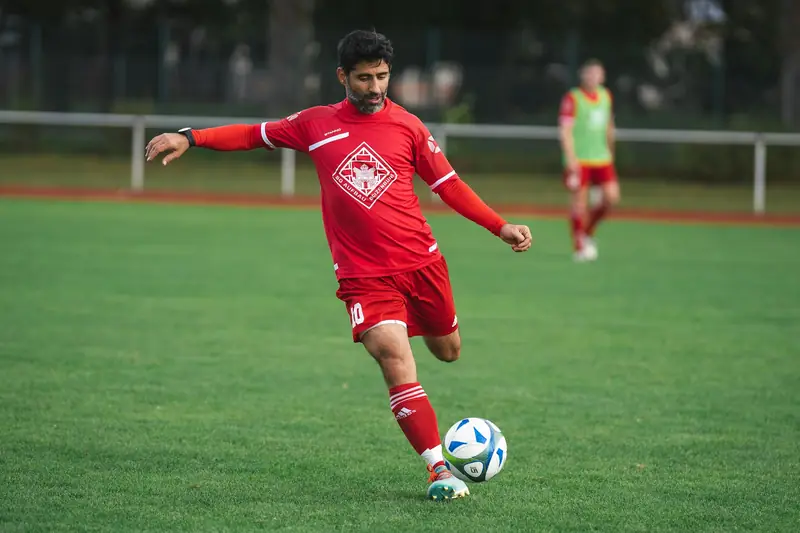
Every five-a-side group has one. They never seem to run much, they're never in a hurry, and the ball always seems to arrive at their feet with time to spare. In the last ten minutes, when everyone else is blowing, they're still picking passes.
They aren't doing anything magic. They look before the ball comes, take a first touch that sets up the next one, pick their spot instead of blasting it, and have legs that can stop as well as go. This guide walks through the skills that matter in Sunday league and small-sided football: what each one is for, how to do it, the classic mistake, and what you can do off the pitch to make it easier on your body. Where the research has something useful to say, we say it, and every number links to the study it comes from.
The big idea: football is a stop-start sport
On TV, football looks like running. Up close, it is walking, jogging, a sprint, a stop, a turn, and again, for an hour or more. It is harder work than it looks. Untrained men playing small-sided games for an hour averaged about 82% of their maximum heart rate.[1] Smaller pitches don't make it easy, either: in a study of recreational players, 5-a-side produced higher heart rates and more accelerations and decelerations than 3- or 4-a-side.[2]
So the qualities that matter most aren't top speed. They are the first few steps, the ability to brake and turn, and enough fitness to keep doing both late in the game. All three can be trained.
First touch: look before it arrives
A good first touch doesn't just stop the ball. It moves it where you want to go next. That starts before the ball reaches you: a quick look over your shoulder to see where the space and the opponents are, and a body position that lets you play forward.
How to do it:
- Check your shoulder before the pass is played, and again while it travels
- Open up. Stand half-turned so you can see both the passer and the pitch ahead
- Receive on your back foot, the one furthest from the ball, so you can play forward in one movement
- Cushion it. Give slightly with the foot as the ball arrives, like catching an egg
- Touch it into space, away from pressure
The classic mistake is receiving square-on with your back to goal, so the ball dies under your feet and your second touch comes under pressure. In a season-long study at a Premier League club, central midfielders and defenders scanned the most, forwards the least, and everyone scanned less when they were tightly marked.[3] That's elite data, but the habit is free for anyone to copy.
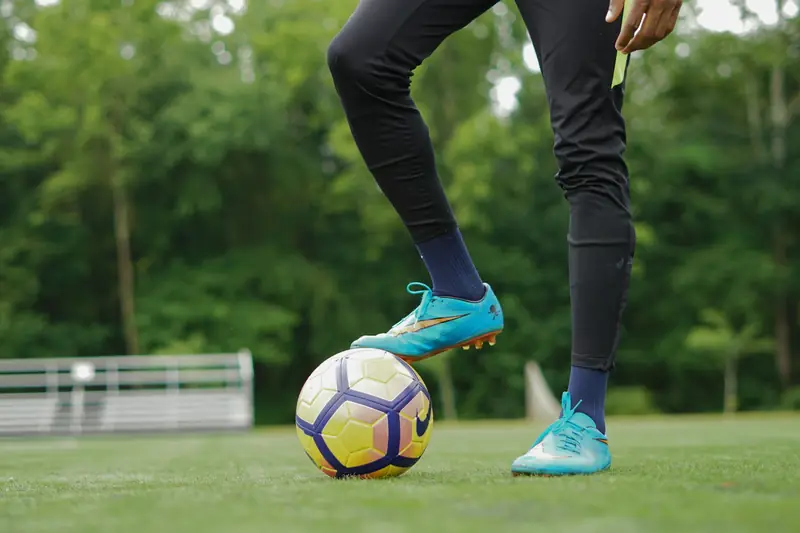
Train it off the pitch. First touch is mostly trained with a ball, and no study shows gym work improves it. What helps is being balanced and quick on your feet in a half-turned stance: single-leg balance work and quick-feet drills. Upper-back rotation stretches make checking your shoulder easier.
Passing: inside foot for accuracy, laces for distance
The short pass uses the inside of the foot because it gives you the biggest, flattest surface to hit with. Accuracy beats power. The longer driven pass uses the laces, with a longer run-up and more hip drive, to send the ball further, lower and faster.
How to do it:
- Plant your standing foot beside the ball, pointing at your target
- Short pass: turn the kicking foot out, ankle locked, toes up, and strike through the middle of the ball
- Driven pass: approach at a slight angle, toes pointed down, strike with the laces, and keep your body over the ball
- Follow through towards the target and keep your head steady at contact
- Weight it for your teammate's front foot, not just "to them"
The classic mistake is a floppy ankle, which sends the ball off at odd angles. The other is leaning back on a driven pass so it sails over everyone. The quality of the contact between foot and ball decides most of the speed, path and spin of a kick.[4]
Train it off the pitch. Every pass is a balance on one leg. Split squats and single-leg Romanian deadlifts make the standing leg steadier. The kicking leg swings from the hip, so hip flexor work (banded knee drives) and inner-thigh strength (Copenhagen planks, more on those below) help both your range and your groin.
Shooting: pass it into the net
At our level, a placed shot on target beats a thunderbolt over the bar. The laces give you power. The side-foot gives you accuracy. Choosing the right one for the moment matters more than hitting it as hard as you can.
How to do it:
- Pick your spot before you strike, usually low and across the keeper
- On a laces strike, toes down, ankle locked, knee over the ball
- Land on your striking foot. It means your weight went through the ball
- In close, side-foot it into the corner
- Keep your head still and your eyes on the ball at contact, not on the goal
The classic mistake is leaning back and blazing over the bar. The other is trying to break the net from eight yards when a side-foot would do. Early lab data suggest the most accurate kicks come from a slightly slower swing and a slower ball, which is a fair argument for placement over power.[4]
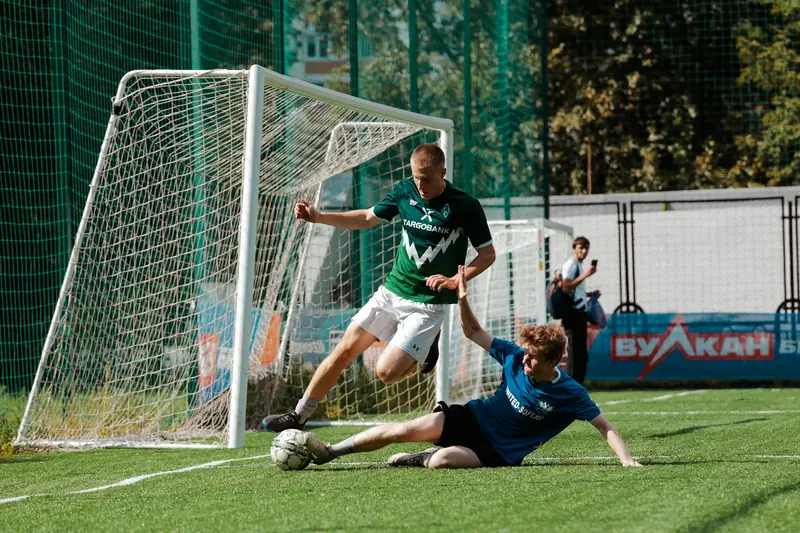
Train it off the pitch. Striking power comes from a fast swing built on a stable standing leg and a strong trunk: split squats, single-leg balance, hip flexor work, and rotational trunk work such as cable or band chops. Strong quads and hip flexors also help protect against the thigh and groin strains that come from kicking.
Sprinting, stopping and turning
Every sprint in football ends in a stop, and stopping hard puts big loads through your knees, hamstrings and thighs. Braking well matters as much as going fast, and the first three steps matter more than your top speed.
How to do it:
- To accelerate, lean forward from the ankles, not the waist, and drive the ground backwards with short, powerful steps
- Pump your arms hard. They set the rhythm for your legs
- To stop, lower your hips and take shorter, quicker steps
- Brake over several steps, not in one big lunge
- When you cut, keep your knee over your toes, not caving inwards
The classic mistake is stopping or turning on a straight, stiff leg with the knee collapsing inwards. That matters, because most serious knee injuries in football don't involve a collision. In a video study of ACL injuries in professional men's football, 88% happened without direct contact to the knee, most often while pressing, being tackled or kicking.[5] The other classic mistake is making your first flat-out sprint of the day in the first five minutes, without a warm-up.
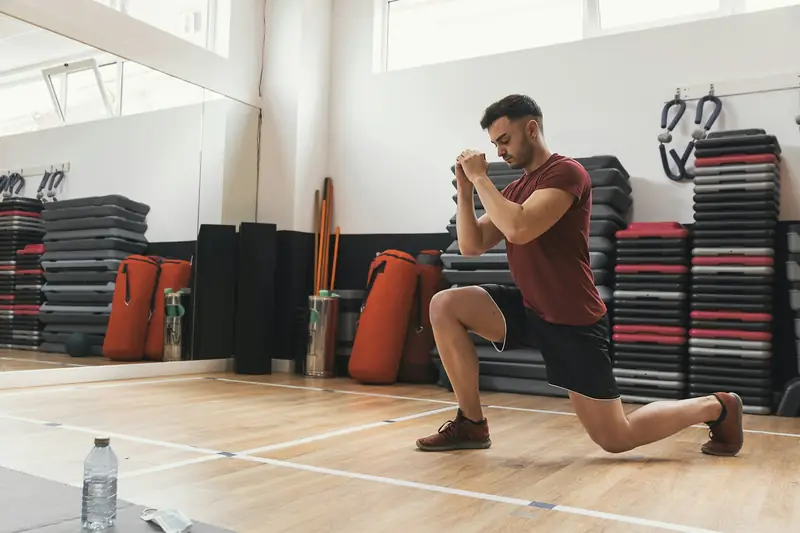
Train it off the pitch. This is where the gym helps most. For acceleration: hill or sled sprints, broad jumps and single-leg bounds. For braking: Nordic hamstring curls, slow-lowering split squats, and drop landings where you stick the landing with your hips back and knees over toes. For turning: lateral bounds and shuffle-to-sprint drills.
Defending: jockey, don't dive in
Good defending is mostly patience. Jockeying means staying on your feet, side-on and close enough to pressure the attacker, steering them where you want them to go, and only tackling when you're sure. The block tackle is a strong, square contact through the middle of the ball.
How to do it:
- Stand side-on, low, on the balls of your feet, about an arm's length away
- Show them one way, usually away from goal or onto their weaker foot
- Watch the ball, not their hips or step-overs
- Wait for the heavy touch, then go
- For a block, get close first, lock your ankle, bend your standing knee and get your body behind it
The classic mistake is diving in and getting beaten, or getting hurt. The other is standing square-on and flat-footed so any turn beats you. And on hard or artificial pitches, leave the slide tackles to the professionals.
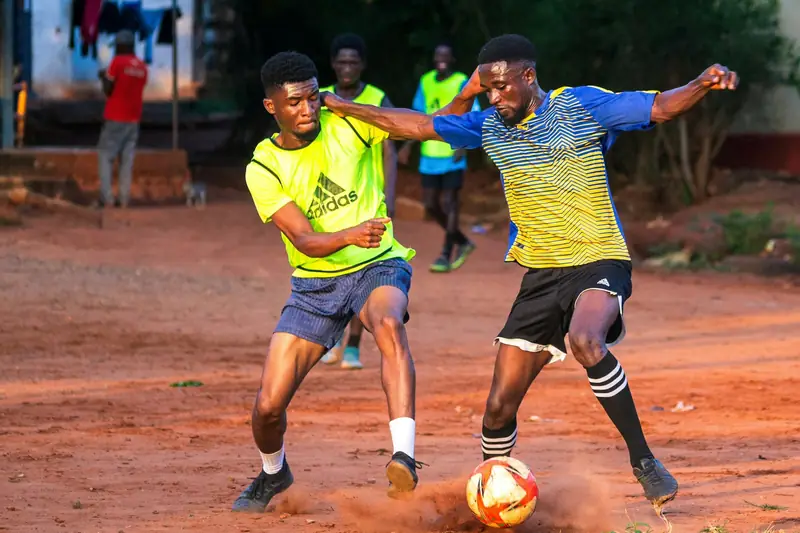
Train it off the pitch. Jockeying is a long hold in a low position with quick sideways steps. Lateral lunges, Cossack squats, banded side shuffles and split-squat holds build the endurance. Strong inner thighs help with the sideways push-off and the block tackle, so Copenhagen planks come in again. Balance work helps your ankles cope with contact on bumpy ground.
Heading: forehead, eyes open, attack it
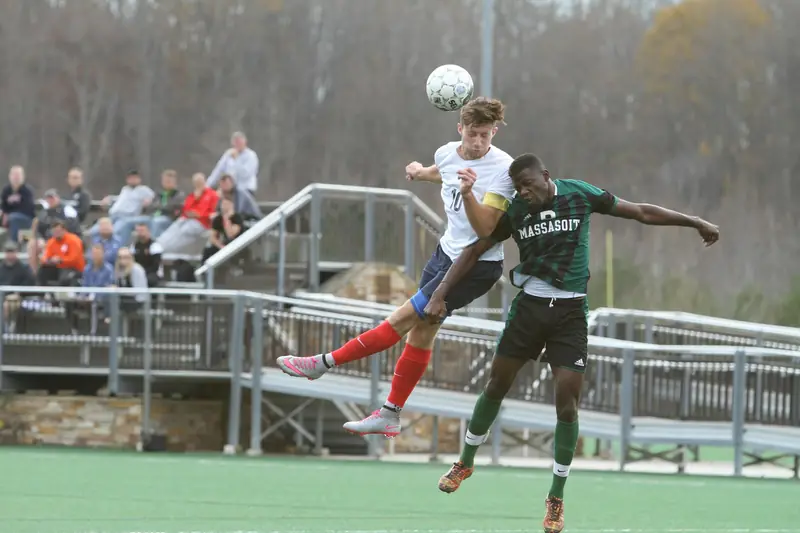
Head the ball with your forehead, the flat, hard part at your hairline. Keep your eyes open, brace your neck and trunk, and move your whole upper body through the ball instead of letting it hit you.
How to do it:
- Forehead contact, eyes open, mouth closed
- Brace your neck and move from the trunk
- Arms out for balance and space, not elbows into opponents
- Time your jump to meet the ball at its highest point
The classic mistake is closing your eyes and letting the ball land on the top of your head. In England, the FA's guidance for adult amateur football limits heading practice to 10 headers in one session a week.[6] That is a precaution: a large study found former professional players were more likely to die of neurodegenerative disease than the general population.[7] It tells us nothing direct about Sunday league players, but there's no reason to practise heading more than you need.
Train it off the pitch. Gentle neck work (pushing your head into your hand in four directions and holding) and trunk bracing exercises make the movement steadier. Nobody has shown that neck training prevents concussion, so think of it as better technique, not protection.
Does training off the pitch really help?
For injuries, yes, with a few honest caveats.
A proper warm-up. FIFA 11+ is a free, 20-minute warm-up of running, strength, jumping and balance exercises, done at least twice a week. In recreational and sub-elite players it cut injuries by 39%.[8] The one trial in veteran players, with an average age around 44, found no drop in injuries overall, but severe injuries roughly halved.[9] For the over-35s, that is the most realistic promise: fewer of the injuries that keep you out for months.
Hamstrings. The Nordic hamstring curl is the most studied exercise in football. In 942 Danish players, new hamstring injuries fell by about 70% and repeat injuries by about 85%.[10] In Dutch amateur players, 25 sessions over 13 weeks cut the odds of a hamstring injury by about 70%.[11] A review pooling 15 studies concluded that including the Nordic halves hamstring injuries[12], though a later reanalysis argued the evidence is less certain than that.[13] We'd still do them.
Groin. Semi-professional players who did the Copenhagen adductor programme through a season had 41% lower odds of groin problems.[14]
One caveat: most of this research is in younger, fitter players than the average Sunday league squad. But the principle carries over. Stronger hamstrings, inner thighs and legs that are used to braking give your football more to work with.
Two short sessions a week alongside your games is plenty to start. Here is how the work lines up with the skills:
| Build this | It helps your | Try |
|---|---|---|
| Hamstring strength | Sprinting, stopping, reaching for the ball | Nordic hamstring curls, Romanian deadlifts |
| Inner-thigh strength | Passing, tackling, turning | Copenhagen planks, lateral lunges |
| Braking strength | Stops, turns, pressing | Slow-lowering split squats, drop and stick |
| Single-leg balance | Every pass, shot and first touch | Single-leg Romanian deadlifts, balance holds |
| Calves and ankles | First steps, bumpy pitches | Calf raises, pogo hops, single-leg balance |
| Repeated sprints | The last 15 minutes | 15 seconds hard, 15 seconds easy; shuttle runs with turns |
Staying on the pitch
Amateur players get injured about as often as professionals, around 8 injuries per 1,000 hours of football.[15] Most of them are in the legs, and four body parts take the most punishment.
Hamstrings. The classic strain happens in a sprint, often late in a game when you're tired. Nordics and a proper warm-up are your best bets.
Groin. Kicking and turning load the inner thigh hard. If your groin gets tight after games, Copenhagen planks are worth adding before it becomes an injury.
Ankles. The biggest risk factor for an ankle sprain is having had one before. In people from a range of sports who had recently sprained an ankle, eight weeks of home balance-board training cut repeat sprains by about a third.[16] If you've rolled an ankle, that is the most useful thing you can do.
The Achilles. This is the middle-aged footballer's injury. In one UK hospital's series of 88 ruptures, football was the most common cause, and the typical patient was 44.[17] No trial has shown how to prevent ruptures, but strong calves and a gradual return after time off are sensible. The classic story is the player who hasn't played all summer and goes straight back into a full-speed game.
The long game
Football is very good for you. In untrained men aged 20 to 43, three months of small-sided football two or three times a week raised fitness by 13%, more than running did, and lowered blood pressure from 130/77 to 122/72.[1] Across many studies, recreational football lowered blood pressure by a few points and resting heart rate by about 6 beats a minute compared with doing nothing.[18] And in a small study of men in their late sixties, a year of football increased bone density at the hip.[19]
Walking football is a good way back in for older players, but it isn't injury-free: in one study of community clubs, injuries were far more common in matches than in training.[20] The off-pitch work in this guide is what keeps you playing long enough to collect all those benefits.
Training built around your football
Most Sunday league players never do any of this, not because they don't care, but because it's hard to know where to start. A generic gym plan doesn't know you play five-a-side on Tuesdays and 11-a-side on Sundays, that your hamstring went last season, or that you only have a pair of dumbbells at home.
Achilles does. Pick a goal such as Stop getting injured or Play my sport better, and tell it how often you play, the time and equipment you have, and anything that bothers you, from a tight groin to an old ankle sprain. Achilles builds your plan from a library of sports-science research: the warm-up, the work for your hamstrings, inner thighs, calves and trunk, and how to progress it, each exercise with its sets, reps and rest, and the studies behind it.
Log your sessions and your games, and the plan moves with you, so you keep getting stronger without overdoing the weeks you play the most.
See how Achilles worksFurther reading
- Krustrup P. et al. (2009). Recreational soccer is an effective health-promoting activity for untrained men. British Journal of Sports Medicine, 43(11). Link
- Stojanović E. et al. (2021). Heart rate and movement demands of 3-, 4- and 5-a-side small-sided games in recreational players. Journal of Exercise Science & Fitness. Link
- Jordet G. et al. (2020). Scanning, contextual factors, and association with performance in English Premier League footballers: an investigation across a season. Frontiers in Psychology, 11. Link
- Kellis E. & Katis A. (2007). Biomechanical characteristics and determinants of instep soccer kick. Journal of Sports Science and Medicine, 6(2). Link
- Della Villa F. et al. (2020). Systematic video analysis of ACL injuries in professional male football (soccer). British Journal of Sports Medicine, 54(23). Link
- The FA (2021). Adult amateur heading guidance. Link
- Mackay D.F. et al. (2019). Neurodegenerative disease mortality among former professional soccer players. New England Journal of Medicine, 381. Link
- Thorborg K. et al. (2017). Effect of specific exercise-based football injury prevention programmes on the overall injury rate in football: a systematic review and meta-analysis of the FIFA 11 and 11+ programmes. British Journal of Sports Medicine, 51(7). Link
- Hammes D. et al. (2015). Injury prevention in male veteran football players: a randomised controlled trial using "FIFA 11+". Journal of Sports Sciences, 33(9). Link
- Petersen J. et al. (2011). Preventive effect of eccentric training on acute hamstring injuries in men's soccer: a cluster-randomized controlled trial. American Journal of Sports Medicine, 39(11). Link
- van der Horst N. et al. (2015). The preventive effect of the Nordic hamstring exercise on hamstring injuries in amateur soccer players: a randomized controlled trial. American Journal of Sports Medicine, 43(6). Link
- van Dyk N., Behan F.P. & Whiteley R. (2019). Including the Nordic hamstring exercise in injury prevention programmes halves the rate of hamstring injuries. British Journal of Sports Medicine, 53(21). Link
- Impellizzeri F.M., McCall A. & van Smeden M. (2021). Why methods matter in a meta-analysis: a reappraisal showed inconclusive injury preventive effect of Nordic hamstring exercise. Journal of Clinical Epidemiology, 140. Link
- Harøy J. et al. (2019). The Adductor Strengthening Programme prevents groin problems among male football players: a cluster-randomised controlled trial. British Journal of Sports Medicine, 53(3). Link
- Epidemiology of injuries in men's professional and amateur football, part I (2023). Journal of Clinical Medicine, 12(17). Link
- Hupperets M.D.W., Verhagen E.A.L.M. & van Mechelen W. (2009). Effect of unsupervised home based proprioceptive training on recurrences of ankle sprain: randomised controlled trial. BMJ, 339. Link
- Retrospective epidemiological study of Achilles tendon ruptures in a UK population (2025). Link
- Milanović Z. et al. (2019). Broad-spectrum physical fitness benefits of recreational football: a systematic review and meta-analysis. British Journal of Sports Medicine, 53(15). Link
- Helge E.W. et al. (2014). Recreational football improves bone mineral density and bone turnover marker profile in elderly men. Scandinavian Journal of Medicine & Science in Sports, 24. Link
- Price et al. (2025). Injury incidence in community-based walking football: a four-month cohort study. Sports. Link