Blog · Desk work
Desk work, hour by hour: how to keep your neck, back and hips happy when you sit for a living
Posture myths, your set-up, neck and shoulders, the lower back, hips, wrists and breaking up sitting, explained for office and home workers, with the short strength routine that makes a desk day easier on your body.

Every office has one. They're up and down all day: fetching water, taking calls on their feet, wandering over to ask a question instead of typing it. They never seem to sit still for long, and at half five, when you're unfolding yourself from your chair like a deckchair, they look as if they've just arrived.
They aren't doing anything magic. They don't have a perfect chair or perfect posture. They move often, change position without thinking about it, and have a body strong enough to shrug off a long day of not doing much. This guide walks through the parts of the body a desk job tests: your set-up, your neck and shoulders, your lower back, your hips and your wrists, and how to break up the hours. For each one: what matters, what to do, the classic mistake, and the short bits of training that make it easier. Where the research has something useful to say, we say it, and every number links to the study it comes from.
The big idea: your next posture is your best posture
You've probably been told to sit up straight since you were at school. The evidence behind that advice is surprisingly thin. A group of physiotherapy researchers argued in 2019 that the belief that back pain comes from sitting, standing or bending the "wrong" way has little support, and that a whole industry of braces, apps and posture programmes has grown up around it anyway.[1] A review that pulled together 41 systematic reviews found no consensus that any particular spinal posture, or sitting, bending or twisting, causes low back pain.[2]
That doesn't mean how you sit never matters. Holding any position for hours, slumped or bolt upright, tends to get uncomfortable, and that discomfort is mostly your body asking you to move. So the aim isn't to find one perfect posture and hold it all day. It's to have plenty of comfortable postures, to change between them often, and to be strong enough that none of them is a problem. There's a saying for it: your next posture is your best posture.
Your set-up: comfortable, not perfect
A good set-up makes it easy to see, type and sit comfortably, and just as easy to shift position. It is the starting point, not the cure. Think of it as removing obstacles, so your body doesn't have to fight the furniture.
How to do it:
- Feet flat on the floor or a footrest, with the seat high enough that your hips sit level with or slightly above your knees
- Screen about an arm's length away, with the top of it at or a little below eye level
- Keyboard and mouse close, so your elbows rest near your sides and your shoulders can drop
- On a laptop for more than an hour or two, raise it on a stand or a pile of books and use a separate keyboard and mouse
- Put your water, printer or charger somewhere you have to stand up to reach
The classic mistake is spending £400 on an ergonomic chair and then sitting in it, motionless, for four hours. The other is the home worker's special: a whole day hunched over a laptop on the sofa or the kitchen table. Most set-up advice is sensible common sense rather than proven medicine. A Cochrane review of 15 trials couldn't say for sure whether ergonomic changes, such as an arm support used with the mouse, prevent neck and arm problems in office workers.[3] Get it comfortable, then stop fiddling with it.
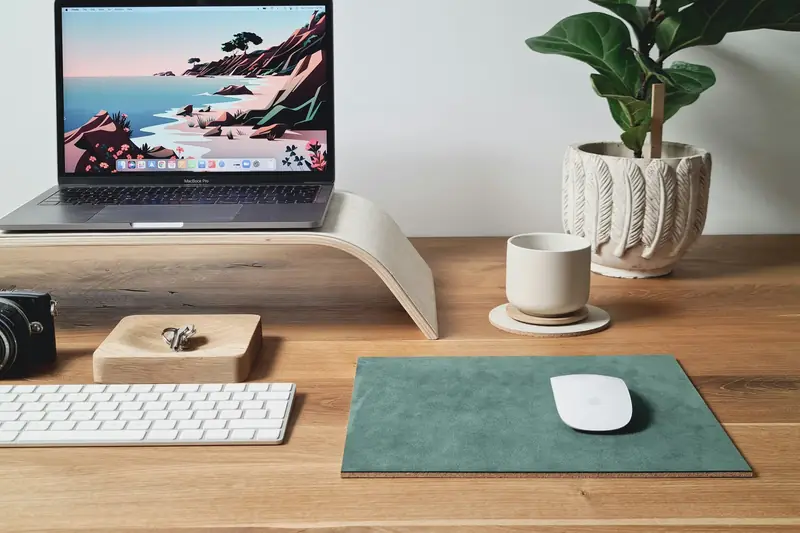
Two minutes at the desk. The best set-up is the one you leave regularly. Tie movement to habits you already have: stand up for every phone call, walk to refill your water, roll your shoulders and turn your head slowly side to side while a file uploads. None of this is a workout. It's a change of position, which is the whole point.
Neck and shoulders: tech neck isn't a life sentence
Your neck and upper back hold your head up all day while your eyes stay locked on a screen. When the work gets intense, your head drifts towards the monitor and your shoulders creep up towards your ears and stay there. By mid-afternoon, the tops of your shoulders feel like they've been carrying a rucksack.
How to do it:
- Bring the screen to you, not your head to the screen
- Every so often, gently tuck your chin and lengthen the back of your neck, then relax
- Let your shoulders drop and your elbows rest, and check them when you're concentrating hard
- A few times an hour, look away from the screen and turn your head slowly from side to side
- Take phone and video calls standing up, or walking, when you can
The classic mistake is treating posture as the problem and correcting it as the fix. "Tech neck", the head poking forward, gets blamed for almost everything. In a review of the research, adults with neck pain held their heads slightly further forward on average than adults without it, teenagers showed little link at all, and studies like these can't show that the posture causes the pain.[4] The other mistake is resting a sore neck completely. What has the best evidence is making the muscles around it stronger.

Two minutes at the desk. This is where tiny doses work. In 48 working women with long-term neck and shoulder muscle pain, 10 weeks of strength training for those muscles cut their worst pain by about 79%, while cycling for general fitness gave only a small, short-lived drop.[5] A follow-up trial in 198 adults working at least 30 hours a week with frequent neck and shoulder pain went further: just 2 minutes a day, five days a week, with an elastic band, cut pain by 1.4 points on a 0 to 10 scale compared with a group who got health advice. Twelve minutes a day did only a little better.[6] A review of workplace exercise for office workers with neck pain found that strengthening helped, worked best when it targeted the neck and shoulders, and worked better the more consistently people actually did it.[7] Keep a band in your drawer. Band lateral raises, pull-aparts and rows, done until the last few reps feel hard, take two minutes.
Low back: keep it moving, don't wrap it in cotton wool
The lower back is the part desk workers worry about most, and the part most surrounded by scary stories. Start with the reassuring bit. A review of the research on sitting found limited evidence that sitting on its own causes low back pain: of 15 studies, only one, on sitting at work, found a link.[8] Scans can be scary too, and they often mislead. In people with no back pain at all, 37% of 20-year-olds and 96% of 80-year-olds show "disc degeneration" on a scan, and disc bulges rise from 30% to 84% over the same ages.[9] Most of these findings are normal signs of getting older, like grey hair on the inside.
How to do it:
- Change position often: sit back, sit forward, perch, stand, walk
- If your back stiffens up, get up and move rather than sitting still and waiting for it to pass
- Use a cushion or lumbar roll if it feels better, and skip it if it doesn't
- When your back is sore, keep up your normal activities as much as you can
- Walk every day. A brisk 10 minutes at lunch counts
The classic mistake is treating a sore back as a fragile one: no bending, no lifting, bracing every movement and resting until it feels perfect. Backs are strong and they like being used. For long-standing back pain without a specific cause, which is most of it, exercise is one of the best-supported treatments there is. A Cochrane review of 249 trials and around 24,500 people found exercise reduced pain by about 15 points on a 0 to 100 scale compared with no treatment, usual care or placebo.[10]
Exercise helps prevent it, too. A review of prevention trials found that exercise cut the risk of a new bout of back pain over the following year by about a third, and exercise plus education by nearly half. Back belts and shoe insoles didn't help, and the effect faded after a year, so the exercise has to keep going.[11] Even walking counts: in 701 adults who had just recovered from low back pain, a progressive walking and education programme stretched the typical time before the next bout from 112 days to 208.[12]
Train it outside work hours. A back that copes with long days comes from using it. Romanian deadlifts and hip hinges with a broomstick along your spine, bird dogs, side planks, glute bridges and carrying something heavy in each hand all build one. Start light enough to feel easy, and add a little load or a few reps each week. A common coaching rule of thumb is that mild discomfort while you exercise is fine if it settles by the next day.
Hips: tight at the front, sleepy at the back?
Sitting keeps your hips bent for hours, and many desk workers feel tight at the front of the hip when they first stand up. Gym talk says sitting shortens your hip flexors and "switches off" your glutes. To be honest, there's little good research behind either idea. The stiffness is real, but it usually wears off once you get moving. Strong hips are still worth having: they do the work every time you stand up, climb stairs or pick something up off the floor.
How to do it:
- Stand up and walk around for a minute or two at least every half hour to hour
- When you stand, let your hips come fully forward and give your glutes a gentle squeeze
- Sit with your feet flat and your knees roughly hip-width apart, rather than crossed for hours
- At the end of the day, try a half-kneeling hip flexor stretch for 30 seconds a side
- Take the stairs, every time
The classic mistake is stretching endlessly and never strengthening. Stretching feels good and does no harm, but a tight-feeling hip is often a tired or under-used one. The other is going straight from eight hours in a chair to a flat-out evening run or five-a-side without any warm-up.
Train it outside work hours. Glute bridges and hip thrusts, split squats, step-ups and goblet squats build the muscles that get you out of your chair and up the stairs. A half-kneeling hip flexor stretch between sets keeps the front of the hip happy, and lateral band walks wake up the sides.
Wrists and hands: small muscles, long days
Typing and mousing are thousands of small, repeated movements a day. Aching forearms, wrists and thumbs are common, and many people worry about carpal tunnel syndrome. The research is reassuring: a review pooling six studies found no clear link between computer work and carpal tunnel syndrome. The estimate for heavy mouse use was higher, but too uncertain to say either way.[13]
How to do it:
- Keep your wrists roughly straight, not bent up or sharply sideways while you type
- Type lightly. The keys don't need hammering
- Keep the mouse close to the keyboard so you aren't reaching for it
- Rest your palms or forearms between bursts of typing
- Learn a few keyboard shortcuts so you click less
The classic mistake is gripping the mouse as if it might escape. The other is ignoring symptoms that don't fit "a bit achy". Numbness or pins and needles in the thumb and first fingers, especially at night, is worth getting checked by a doctor.
Two minutes at the desk. Open and close your hands, spread your fingers wide, circle your wrists and stretch your forearms with your palm up and then down. Outside work hours, grip work builds forearms that cope with a full day at the keyboard: farmer's carries, wrist curls and hangs from a bar.
Breaking up sitting: the hour-by-hour bit
This is the part that matters most, and the easiest to forget when you're busy. Height-adjustable desks do get people sitting less: a Cochrane review of 34 studies found sit-stand desks cut sitting at work by roughly 84 to 116 minutes a day, though the evidence was rated very low quality. The same review found that short, frequent breaks reduced sitting more than two long ones.[14] In a trial with 146 NHS office workers, a height-adjustable desk plus some coaching meant 83 fewer minutes a day sitting at work, a year later.[15]
How to do it:
- Get up at least every 30 to 60 minutes, even if only for a minute or two
- If you have a sit-stand desk, alternate. Don't swap all-day sitting for all-day standing
- Every 20 minutes, look at something about 6 metres away for 20 seconds
- Walk your calls and one-to-one meetings when you can
- Take a proper lunch break away from your desk, and walk part of it
The classic mistake is buying a standing desk, standing at it all day, and wondering why your feet and lower back ache. Standing still is still still. And don't expect a standing desk to fix pain on its own. A review of eight studies found sit-stand desks slightly reduced lower-back discomfort, by about half a point on a 10-point scale at most, in people who weren't in pain to begin with. There were too few studies in people who already had back pain to say.[16] A later Cochrane review couldn't conclude that standing or walking at work reduces aches and pains at all.[17]
The bigger payoff may be elsewhere. In overweight adults, getting up for 2 minutes of light walking every 20 minutes cut the rise in blood sugar after a drink by about a quarter compared with sitting straight through.[18] And for your eyes, the 20-20-20 rule (every 20 minutes, look 20 feet away for 20 seconds) has a little support: in 29 computer users with eye strain, two weeks of break reminders reduced eye strain and dry-eye symptoms, though the benefit was gone a week after the reminders stopped.[19] The trick, for your eyes and the rest of you, is making breaks a habit.
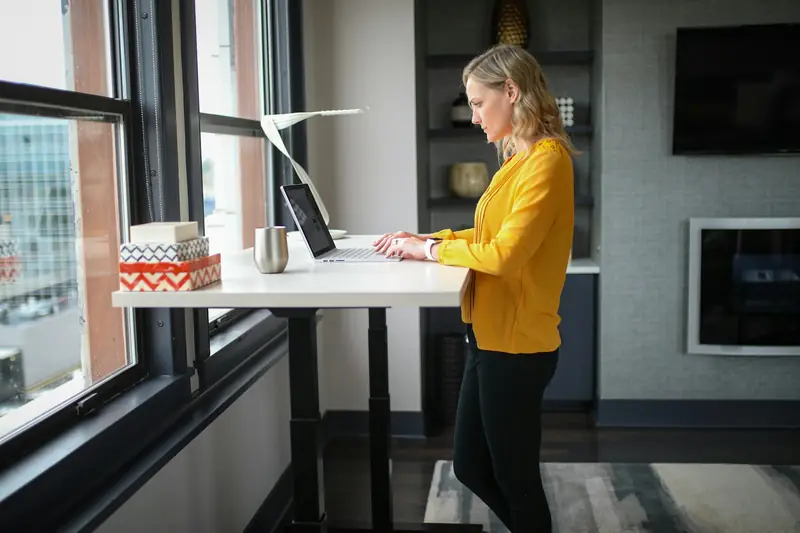
Two minutes at the desk. A break doesn't have to be wasted time. Ten sit-to-stands from your chair, calf raises while the kettle boils, a set of band pull-aparts, or a walk to the furthest toilet in the building all count. Set a timer if you need to, because a good afternoon of focus can swallow three hours without you noticing.
Does training outside work hours really help?
For neck and back pain, yes, and the doses are smaller than you might expect. Two minutes a day with a band made a real difference to neck and shoulder pain[6], targeted neck and shoulder strengthening is the best-supported workplace exercise for neck pain[7], and exercise is one of the best-supported ways to both treat and prevent low back pain.[10][11] For hips and wrists, the evidence is thinner, and nobody has shown that a particular routine prevents problems there. But strong hips and forearms make everyday life easier, and the training costs little.
Most of the research is in people who already had pain, and the two neck trials above were mostly in women. That doesn't make it less useful. It means the best evidence is for using exercise when something hurts, and the sensible bet is to start before it does.
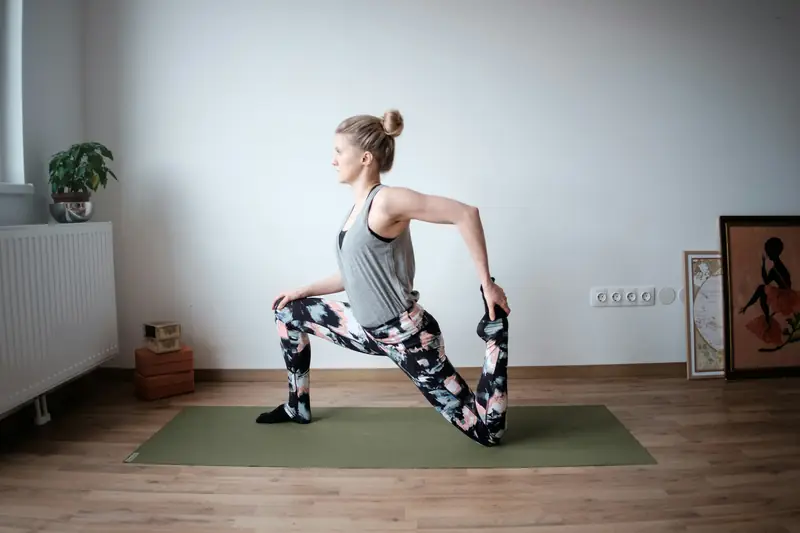
Two short sessions of 20 to 30 minutes a week, plus your two-minute desk breaks, is plenty to start. A simple routine: Romanian deadlifts, split squats, rows, band pull-aparts, side planks and farmer's carries, two or three sets of 8 to 12 reps each, finishing each set with a couple of reps left in the tank. Here is how the work lines up with the desk day:
| Build this | It helps your | Try |
|---|---|---|
| Neck and shoulder strength | Neck ache, shoulders creeping up | Band lateral raises, shrugs, band pull-aparts |
| Upper-back strength | Long screen days, sitting tall without effort | Rows, face pulls, prone Y raises |
| Hip hinge | Bending, lifting, a back that copes with long days | Romanian deadlifts, broomstick hinges |
| Trunk endurance | Long meetings, a grumbling lower back | Bird dogs, side planks, dead bugs |
| Glutes and legs | Getting out of your chair, stairs, stiff hips | Glute bridges, split squats, step-ups |
| Grip and forearms | Typing, mousing, carrying bags | Farmer's carries, wrist curls, bar hangs |
When something hurts
Most desk aches are exactly that: aches. They come from doing too little, for too long, in one position, and they get better with movement, strength and time. Three areas cause most of the trouble.
The neck and shoulders. The tension headache, the knot at the top of the shoulder, the stiff neck after a deadline. Two minutes a day of band work, regular breaks and a screen at the right height are your best bets.
The lower back. Keep moving, keep working if you can, and build up walking and strength rather than resting. If it flares, ease off rather than stop, then build back up.
The wrists and forearms. Lighter typing, a closer mouse, regular hand breaks and grip strength. Tingling or numbness in the fingers needs a doctor's opinion, not more stretching.
Serious causes of back and neck pain are rare, but they matter and need spotting early.[20] The NHS advice on back pain is a good guide.[21] Ask for an urgent GP appointment, or call 111, if your pain comes with a fever or feeling generally unwell, is severe and getting worse quickly, or doesn't ease with rest or is worse at night. Call 999 or go to A&E straight away if you have numbness around your genitals or bottom, new problems controlling your bladder or bowels, or pain, tingling, weakness or numbness in both legs. And see your GP if it hasn't started to improve after a few weeks of looking after it at home.
The long game
The good news is that the fix for a desk body is also very good for the rest of you. In data from more than a million people, about 60 to 75 minutes a day of moderate activity, such as brisk walking, seemed to remove the higher risk of early death that comes with lots of sitting.[22] The World Health Organization recommends that adults get 150 to 300 minutes of moderate activity a week, do muscle-strengthening work on at least two days, and cut down their sitting time.[23] Strength training earns its place: across 16 studies, people who did muscle-strengthening activities had a 10 to 17% lower risk of dying early and of heart disease, cancer and diabetes, with the biggest benefits at around 30 to 60 minutes a week.[24]
You don't need a perfect chair, a perfect posture or an hour a day in the gym. You need to get up often, and to be a bit stronger than your job requires. That's what keeps you comfortable at your desk for the next 30 years, and what keeps you capable well beyond it.
Training built around your working day
Most desk workers never do any of this, not because they don't care, but because it's hard to know where to start. A generic plan doesn't know you sit for nine hours on the days you're in the office, that your neck tightens up by mid-afternoon, or that you've got a resistance band and 20 minutes before the school run.
Achilles does. Pick a goal such as Fix something that hurts, Get stronger or Stay capable as I age, and tell it how often you can train, the time and equipment you have, and anything that bothers you, from a stiff neck to a back that grumbles after long days. Achilles builds your plan from a library of sports-science research: the short desk breaks, the work for your neck, upper back, trunk and hips, and how to progress it, each exercise with its sets, reps and rest, and the studies behind it.
Log your sessions and the plan moves with you, so you keep getting stronger, even in the weeks when work takes over.
See how Achilles worksFurther reading
- Slater D., Korakakis V., O'Sullivan P. et al. (2019). "Sit up straight": time to re-evaluate. Journal of Orthopaedic & Sports Physical Therapy, 49(8). Link
- Swain C.T.V. et al. (2020). No consensus on causality of spine postures or physical exposure and low back pain: a systematic review of systematic reviews. Journal of Biomechanics, 102. Link
- Hoe V.C.W. et al. (2018). Ergonomic interventions for preventing work-related musculoskeletal disorders of the upper limb and neck among office workers. Cochrane Database of Systematic Reviews, 10. Link
- Mahmoud N.F. et al. (2019). The relationship between forward head posture and neck pain: a systematic review and meta-analysis. Current Reviews in Musculoskeletal Medicine, 12(4). Link
- Andersen L.L. et al. (2008). Effect of two contrasting types of physical exercise on chronic neck muscle pain. Arthritis & Rheumatism, 59(1). Link
- Andersen L.L. et al. (2011). Effectiveness of small daily amounts of progressive resistance training for frequent neck/shoulder pain: randomised controlled trial. Pain, 152(2). Link
- Chen X. et al. (2018). Workplace-based interventions for neck pain in office workers: systematic review and meta-analysis. Physical Therapy, 98(1). Link
- Chen S.M. et al. (2009). Sedentary lifestyle as a risk factor for low back pain: a systematic review. International Archives of Occupational and Environmental Health, 82(7). Link
- Brinjikji W. et al. (2015). Systematic literature review of imaging features of spinal degeneration in asymptomatic populations. American Journal of Neuroradiology, 36(4). Link
- Hayden J.A. et al. (2021). Exercise therapy for chronic low back pain. Cochrane Database of Systematic Reviews, 9. Link
- Steffens D. et al. (2016). Prevention of low back pain: a systematic review and meta-analysis. JAMA Internal Medicine, 176(2). Link
- Pocovi N.C. et al. (2024). Effectiveness and cost-effectiveness of an individualised, progressive walking and education intervention for the prevention of low back pain recurrence in Australia (WalkBack): a randomised controlled trial. The Lancet, 404(10448). Link
- Mediouni Z. et al. (2014). Is carpal tunnel syndrome related to computer exposure at work? A review and meta-analysis. Journal of Occupational and Environmental Medicine, 56(2). Link
- Shrestha N. et al. (2018). Workplace interventions for reducing sitting at work. Cochrane Database of Systematic Reviews, 6. Link
- Edwardson C.L. et al. (2018). Effectiveness of the Stand More AT (SMArT) Work intervention: cluster randomised controlled trial. BMJ, 363. Link
- Agarwal S., Steinmaus C. & Harris-Adamson C. (2018). Sit-stand workstations and impact on low back discomfort: a systematic review and meta-analysis. Ergonomics, 61(4). Link
- Parry S.P. et al. (2019). Workplace interventions for increasing standing or walking for decreasing musculoskeletal symptoms in sedentary workers. Cochrane Database of Systematic Reviews, 11. Link
- Dunstan D.W. et al. (2012). Breaking up prolonged sitting reduces postprandial glucose and insulin responses. Diabetes Care, 35(5). Link
- Talens-Estarelles C. et al. (2023). The effects of breaks on digital eye strain, dry eye and binocular vision: testing the 20-20-20 rule. Contact Lens and Anterior Eye, 46(2). Link
- Finucane L.M. et al. (2020). International framework for red flags for potential serious spinal pathologies. Journal of Orthopaedic & Sports Physical Therapy, 50(7). Link
- NHS. Back pain. Link
- Ekelund U. et al. (2016). Does physical activity attenuate, or even eliminate, the detrimental association of sitting time with mortality? A harmonised meta-analysis of data from more than 1 million men and women. The Lancet, 388(10051). Link
- Bull F.C. et al. (2020). World Health Organization 2020 guidelines on physical activity and sedentary behaviour. British Journal of Sports Medicine, 54(24). Link
- Momma H. et al. (2022). Muscle-strengthening activities are associated with lower risk and mortality in major non-communicable diseases: a systematic review and meta-analysis of cohort studies. British Journal of Sports Medicine, 56(13). Link