Blog · Cycling
Cycling, from saddle to summit: ride further, climb easier and stay comfortable for years
Saddle height, cadence, climbing, group riding, pacing and fuelling, explained for road and leisure riders, with the off-bike training that makes riding easier and keeps your back, knees and bones strong.
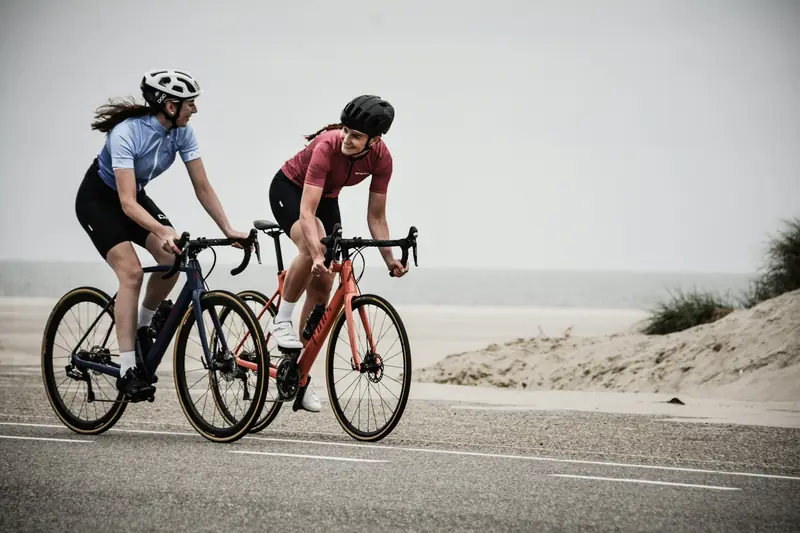
Every club ride has one. The rider who never seems to be working, chats the whole way up the climb, and still has legs for the sprint to the café. Meanwhile you are hanging on, your neck aches, and you're wondering whether a lighter bike would fix it.
It probably wouldn't. That rider has a bike that fits, spins a gear that suits the road, paces the hills, eats before they're hungry, and most likely does some work off the bike too. This guide walks through the skills that matter for road and leisure riders, from setting your saddle to your first 100 km: what each one is for, how to do it, the classic mistakes, and what you can do off the bike to make it easier on your body. Where the research has something useful to say, we say it, and every number links to the study it comes from.
The big idea: riding more is not the whole answer
Cycling is one of the best things you can do for your health. In a study of more than 260,000 UK adults, people who cycled to work had a 41% lower risk of dying over the study period than people who drove or took public transport.[1] (It is an observational study, so it shows a link rather than proof.)
But cycling has a catch: it repeats the same movement thousands of times an hour, in one position, without much load on your bones. In a survey of 518 recreational riders, 85% had had at least one overuse problem, most often in the neck and knees.[2] And on a six-day recreational tour, the riders most likely to get hurt were the inexperienced ones who hadn't prepared.[3] The fix is rarely a new bike. It's a good setup, smart riding, and a bit of work off the bike.
Bike fit: start with the saddle
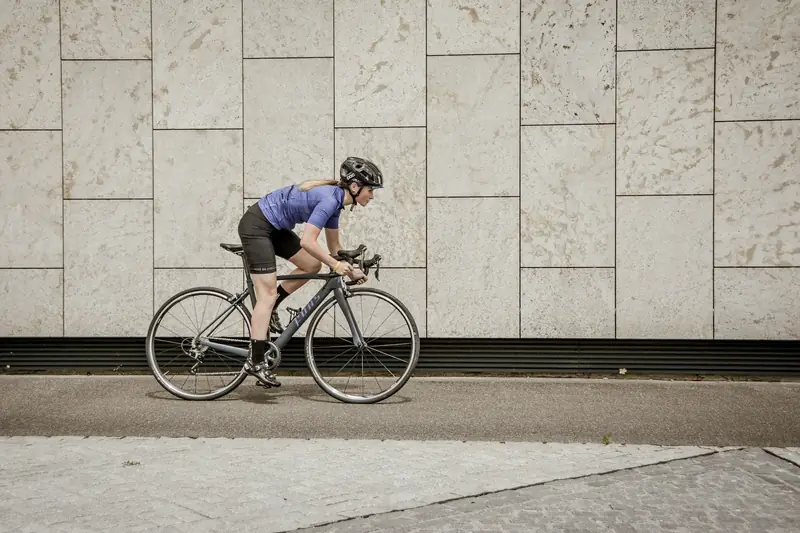
Your body touches the bike in three places: saddle, bars and pedals. Fit means putting those three points where your legs can push well and your back, neck and hands can hold the position for hours. Saddle height comes first, because everything else is built around it.
How to do it:
- At the bottom of the pedal stroke, your knee should still be softly bent. Measured on a stand, a review of the research suggests about 25 to 30 degrees.[4] On video while you ride it looks a bit more bent, around 30 to 40 degrees
- No tools? Put your heel on the pedal at the bottom of the stroke. Your leg should be straight. When you ride normally on the ball of your foot, that leaves a small bend
- If your hips rock side to side on the saddle, it is probably too high
- Change one thing at a time, in steps of 2 to 5 mm, and ride after each change
- At the bars, you should be able to ride with relaxed, slightly bent elbows and turn your head without straining your neck
Small changes matter. In lab studies, raising or lowering the saddle by 5% changed how much the knee moves by about a third, and a low saddle pushes the kneecap harder into the joint.[4]
The classic mistake is a saddle set too low because it feels safe to touch the ground, or copying a pro's long, low position. One honest note: no trial has shown that a bike fit prevents injuries, and one study found fit measures didn't predict who got hurt.[5] Think of fit as the sensible first check, not a guarantee.
Train it off the bike. Holding a forward position for hours is trunk endurance: planks, side planks, bird dogs and back extensions. Rows, chin tucks and prone Y and T raises help your upper back and neck hold the head up. Hip and hamstring mobility make the reach to the bars easier.
Pedalling and cadence: spin, don't grind
Cadence is how fast your pedals turn. At the same effort you can push a big gear slowly or spin a smaller gear quickly. Professional riders averaged about 90 revolutions per minute on flat stages, and about 71 on mountain climbs.[6] Most leisure riders feel good somewhere around 80 to 95 on the flat, lower on steep climbs. That's a coaching rule of thumb, not a law.
How to do it:
- Shift before the climb or the stop, not halfway up when the chain is under full load
- If your knees ache, drop a gear or two and spin a little faster at the same effort
- Pedal in smooth circles with a quiet upper body. Bouncing on the saddle means your cadence is too high for now; rocking and grinding means it's too low
- Use your gears to keep your effort steady over rolling roads
The classic mistake is grinding a big gear at 50 or 60 revolutions everywhere because it feels powerful. In competitive cyclists, pedalling at 90 instead of 70 at the same effort lowered the force on the kneecap by about 29%.[7] On a sore knee, spinning is your friend. A wider range of gears is a perfectly respectable fix.
Train it off the bike. The stronger your legs, the smaller each pedal stroke is as a share of what you can do: squats, split squats, step-ups and leg presses. Single-leg work such as step-downs and single-leg Romanian deadlifts keeps the knee tracking straight. Cyclists with knee pain tend to let the knee drift sideways during the stroke.[5]
Climbing: pace it, don't race it
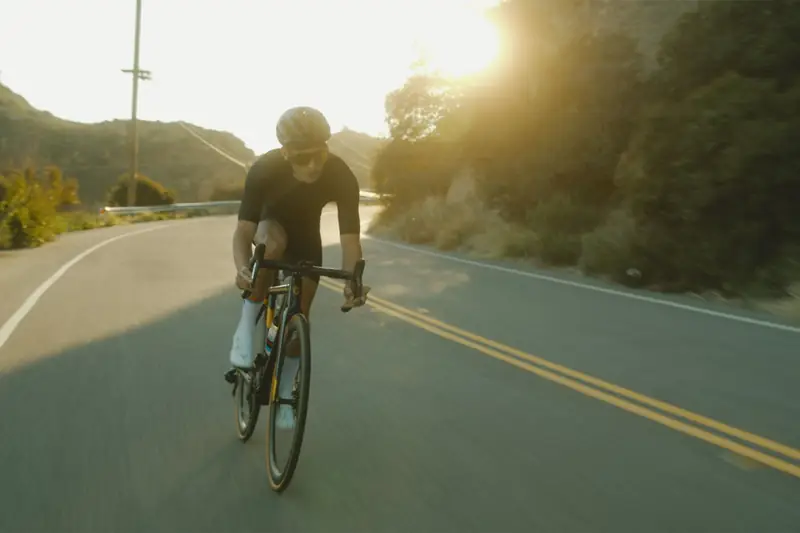
On a climb you lift your body and bike against gravity. The rider who gets up it fastest is usually the one who started at an effort they could hold all the way to the top.
How to do it:
- Start at an effort you could hold for the whole climb, and finish harder if you have anything left
- Sit for most of it. Stand to change muscles, get over a steep ramp, or accelerate. Alternating is fine
- When you stand, shift up one gear first so your legs don't spin out, and let the bike rock gently under you
- Loose grip, bent elbows, breathe from your belly
- If you're in your easiest gear halfway up, you started too hard
Sitting and standing are about equally efficient. Standing gives you much more power for short bursts (around 800 watts against 635 seated in one study), but it costs more heart rate and breath.[8] And pushing slightly harder on the climbs and easing off on the descents gets you round a hilly course faster than riding at one steady power.[9] The key word is slightly.
The classic mistake is charging the bottom in a big gear, blowing up in the middle and grinding to the top.
Train it off the bike. Heavy leg strength training improves the power you can produce on the bike, with the push coming earlier in the pedal stroke.[10] Single-leg strength and hip stability help standing efforts, and rows strengthen the pull on the bars when you stand.
Group riding, descending and corners
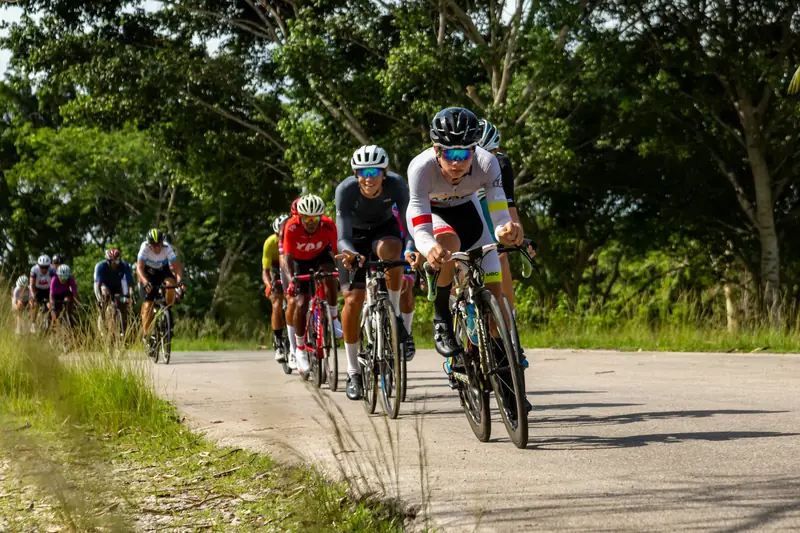
Riding in a group is the biggest free speed in cycling. Sitting close behind another rider cut the air resistance on the second rider by about a quarter in wind modelling studies[11], and deep in a big race bunch riders face as little as 5 to 10% of the drag they'd meet alone.[12] It only works if everyone rides smoothly and predictably.
How to do it:
- Follow a wheel about half to one bike length back until you're confident, and never overlap the wheel in front
- Ride level with the rider beside you, not half a wheel ahead
- Point out and call hazards, and avoid sudden braking or swerving. Every change gets bigger towards the back of the group[13]
- In corners, brake upright before the bend, then release and roll through
- Outside pedal down with your weight on it, inside pedal up, and look through to the exit, not at the pothole
The classic mistakes are braking hard in the middle of a corner, staring at the hazard you want to avoid, and overlapping wheels in a group.
Train it off the bike. A stiff, stable trunk keeps you calm when the bike leans: Pallof presses and side planks. Neck and upper-back endurance help on long spells in the drops, and single-leg balance work helps your bike handling.
Pacing your week: mostly easy, some hard
How hard you ride matters as much as how far. Elite endurance athletes tend to do about 80% of their sessions easy and about 20% hard.[14] In one trial with trained cyclists, a block of mostly easy riding with some very hard intervals beat a block of steady, moderately hard riding, despite an hour less training per week.[15] Reviews say the edge is real but small[16], so the exact split matters less than getting the easy days easy and the hard days hard.
How to do it:
- Keep most rides easy enough to chat in full sentences
- One or two properly hard sessions a week is plenty for most riders, for example four to six efforts of three to five minutes
- Grow your long ride first and your speed second
- Every third or fourth week, ride less
The classic mistake is turning every ride into a medium-hard race with the club or a Strava segment, so the hard days aren't hard and the easy days aren't easy.
Train it off the bike. Put your strength sessions on hard days or well away from them, so easy days stay easy.
Fuelling and drinking on long rides
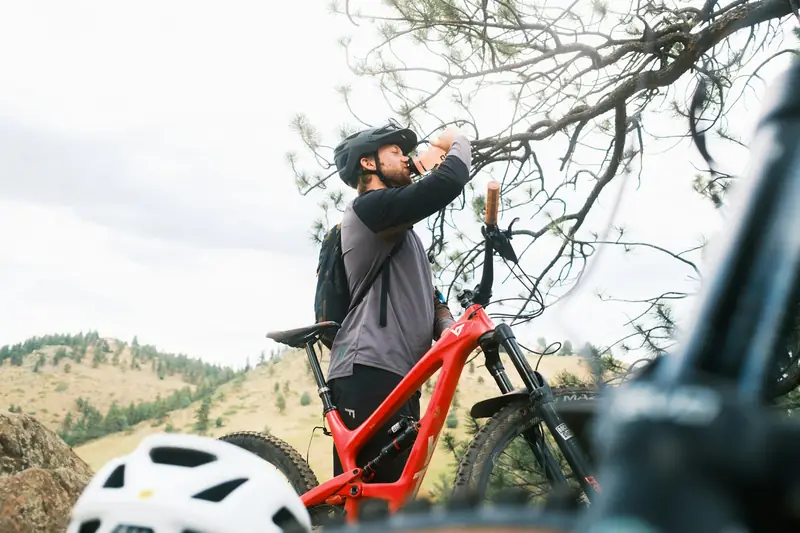
Your muscles and liver only store so much carbohydrate. On a long ride, if you don't top up, your blood sugar drops and you bonk: sudden weakness, a foggy head, legs that won't respond. In a classic study, trained cyclists riding without carbohydrate ran out of steam after about three hours, and feeding them carbohydrate kept them going longer.[17]
How to do it:
- Rides under about 90 minutes: water is usually enough
- Two to three hours: up to about 60 grams of carbohydrate an hour, from drinks, gels or real food[18]
- Longer and harder: up to about 90 grams an hour, but only with sports products that mix glucose and fructose, and only after practising on training rides[18]
- Start eating in the first 30 to 45 minutes, then something every 20 to 30 minutes. Don't wait until you're hungry
- Drink to avoid losing more than about 2% of your body weight. Weigh yourself before and after a long ride to learn how much you sweat[19]
Those higher targets are for long, hard efforts. If you ride at a gentle pace, you need less.[18]
The classic mistake is riding a 100 km sportive on breakfast and one emergency gel, or trying a new drink for the first time on the day.
Does training off the bike really help?
For performance, yes. When well-trained cyclists added heavy leg strength training twice a week to their riding, their power over a 40-minute all-out effort went up, in men[20] and in women.[21] A review of this research concludes that heavy lower-body strength training can improve both short and long endurance performance, as long as you keep some of it going in the riding season.[22] One useful detail: the gains showed up most when strength work replaced some riding, rather than being piled on top.[23]
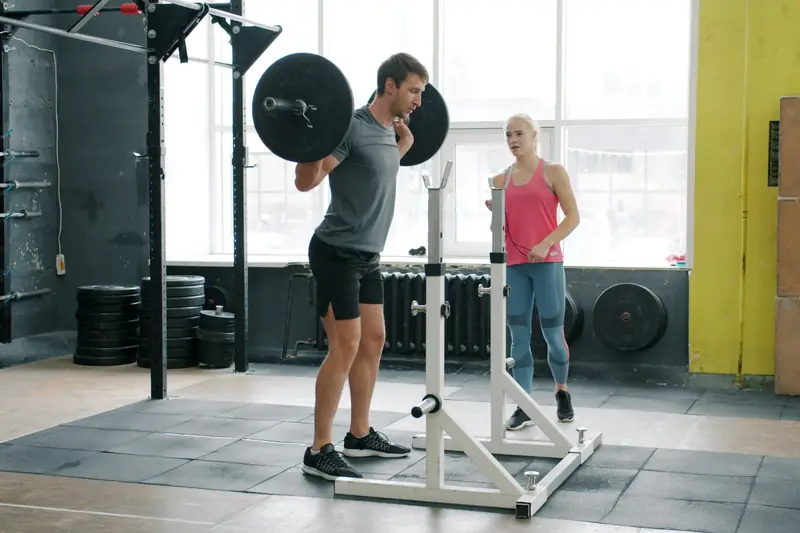
For your bones, it matters even more. Road cycling supports your weight, so it doesn't load your skeleton the way running or lifting does, and adult road cyclists tend to have low bone density in the lower spine.[24] In one study, recreational cyclists had seven times the odds of thinning bone in the spine compared with runners[25], and long-time master cyclists in their fifties had lower bone density than men of the same age who didn't train.[26] Among competitive cyclists, the ones who lifted weights had stronger spines and hips.[27] If you're over 40 and cycling is your only sport, this is the strongest reason to train off the bike.
A caveat: most of the strength trials were small and in younger, well-trained riders. But the principle carries over.
Two short sessions a week alongside your riding is plenty to start. Here is how the work lines up with your riding:
| Build this | It helps your | Try |
|---|---|---|
| Leg strength | Every pedal stroke, climbs, sprints | Squats, split squats, leg presses, step-ups |
| Single-leg control | Knee tracking, standing on climbs | Step-downs, single-leg Romanian deadlifts |
| Trunk endurance | Holding your position, lower back | Planks, side planks, bird dogs, back extensions |
| Upper back and neck | Long rides in the drops, neck comfort | Rows, prone Y and T raises, chin tucks |
| Bone loading | Bone density, long-term health | Heavy lifting, hops and skipping, brisk walking or running |
| Mobility | Reaching the bars comfortably | Hip flexor and hamstring stretches, upper-back extensions |
Staying on the bike
In recreational riders, the neck is the most common complaint, followed by the knees, the saddle area, the hands and the lower back.[2] Professionals are a little different: more than half had lower back pain in a year and about a third had pain at the front of the knee, and knee problems cost them the most time off the bike.[28]
Knees. Pain at the front of the knee often goes with a saddle that is too low or too far forward, and pain at the back of the knee with one that is too high. Check your saddle, spin a lighter gear, and strengthen your thighs and hips.
Lower back and neck. Bars that are too low or too far away load your neck, shoulders and back. Raise the bars or shorten the reach before you blame your body, and build the trunk and upper-back endurance from the table above.
Hands. Tingling or numb fingers are common on long rides. Change your hand position often, keep your elbows soft, and make sure you're not leaning all your weight on the bars.
Building up. Most overuse problems come from doing too much too soon. Add distance gradually and build in easier weeks.[3] If numbness, pain or swelling keeps coming back, get it checked rather than riding through it.
The long game
Cycling is one of the easiest ways to stay fit for decades. The research is clear that it improves your fitness and helps heart health[29], and regular cyclists live longer on average.[1] It's gentle on your joints, you can do it with friends, and it gets you places. The work off the bike in this guide is what keeps your back, knees and bones in good enough shape to enjoy it for the next 30 years.
Training built around your riding
Most riders never do any of this, not because they don't care, but because it's hard to know where to start. A generic gym plan doesn't know you ride three times a week, that you're building up to your first 100 km, that your neck aches after two hours, or that you only have a pair of dumbbells at home.
Achilles does. Pick a goal such as Play my sport better or Stop getting injured, and tell it how often you ride, the time and equipment you have, and anything that bothers you, from a sore knee to a stiff lower back. Achilles builds your plan from a library of sports-science research: the strength work for your legs, hips, trunk and upper back, the bone-loading work cycling doesn't give you, and how to progress it, each exercise with its sets, reps and rest, and the studies behind it.
Log your sessions and your rides, and the plan moves with you, so you keep getting stronger without overdoing your biggest riding weeks.
See how Achilles worksFurther reading
- Celis-Morales C.A. et al. (2017). Association between active commuting and incident cardiovascular disease, cancer, and mortality: prospective cohort study. BMJ, 357. Link
- Wilber C.A. et al. (1995). An epidemiological analysis of overuse injuries among recreational cyclists. International Journal of Sports Medicine, 16(3). Link
- Dannenberg A.L. et al. (1996). Predictors of injury among 1638 riders in a recreational long-distance bicycle tour: Cycle Across Maryland. American Journal of Sports Medicine, 24. Link
- Bini R., Hume P.A. & Croft J.L. (2011). Effects of bicycle saddle height on knee injury risk and cycling performance. Sports Medicine, 41(6). Link
- Bini R.R. & Flores Bini A. (2018). Potential factors associated with knee pain in cyclists: a systematic review. Open Access Journal of Sports Medicine, 9. Link
- Lucía A., Hoyos J. & Chicharro J.L. (2001). Preferred pedalling cadence in professional cycling. Medicine & Science in Sports & Exercise, 33(8). Link
- Effects of workload and pedalling cadence on knee forces in competitive cyclists (2013). Sports Biomechanics, 12(2). Link
- Millet G.P. et al. (2002). Level ground and uphill cycling efficiency in seated and standing positions. Medicine & Science in Sports & Exercise, 34. Link
- Atkinson G., Peacock O. & Passfield L. (2007). Variable versus constant power strategies during cycling time-trials: prediction of time savings using an up-to-date mathematical model. Journal of Sports Sciences, 25(9). Link
- Rønnestad B.R. et al. (2015). Strength training improves performance and pedaling characteristics in elite cyclists. Scandinavian Journal of Medicine & Science in Sports, 25(1). Link
- Blocken B. et al. (2013). CFD simulations of the aerodynamic drag of two drafting cyclists. Computers & Fluids, 71. Link
- Blocken B. et al. (2018). Aerodynamic drag in cycling pelotons: new insights by CFD simulation and wind tunnel testing. Journal of Wind Engineering & Industrial Aerodynamics, 179. Link
- Cycling UK. Riding safely in a group. Link
- Seiler S. (2010). What is best practice for training intensity and duration distribution in endurance athletes? International Journal of Sports Physiology and Performance, 5(3). Link
- Neal C.M. et al. (2013). Six weeks of a polarized training-intensity distribution leads to greater physiological and performance adaptations than a threshold model in trained cyclists. Journal of Applied Physiology, 114(4). Link
- Oliveira P.S., Boppre G. & Fonseca H. (2024). Comparison of polarized versus other types of endurance training intensity distribution on athletes' endurance performance: a systematic review with meta-analysis. Sports Medicine. Link
- Coyle E.F. et al. (1986). Muscle glycogen utilization during prolonged strenuous exercise when fed carbohydrate. Journal of Applied Physiology. Link
- Jeukendrup A. (2014). A step towards personalized sports nutrition: carbohydrate intake during exercise. Sports Medicine, 44(Suppl 1). Link
- American College of Sports Medicine (2007). Exercise and fluid replacement (position stand). Medicine & Science in Sports & Exercise, 39(2). Link
- Rønnestad B.R., Hansen E.A. & Raastad T. (2010). Effect of heavy strength training on thigh muscle cross-sectional area, performance determinants, and performance in well-trained cyclists. European Journal of Applied Physiology, 108. Link
- Vikmoen O. et al. (2016). Strength training improves cycling performance, fractional utilization of VO2max and cycling economy in female cyclists. Scandinavian Journal of Medicine & Science in Sports, 26(4). Link
- Mujika I., Rønnestad B.R. & Martin D.T. (2016). Effects of increased muscle strength and muscle mass on endurance-cycling performance. International Journal of Sports Physiology and Performance, 11(3). Link
- Yamamoto L.M. et al. (2010). The effects of resistance training on road cycling performance among highly trained cyclists: a systematic review. Journal of Strength and Conditioning Research, 24(2). Link
- Olmedillas H. et al. (2012). Cycling and bone health: a systematic review. BMC Medicine, 10. Link
- Rector R.S. et al. (2008). Participation in road cycling vs running is associated with lower bone mineral density in men. Metabolism, 57(2). Link
- Nichols J.F., Palmer J.E. & Levy S.S. (2003). Low bone mineral density in highly trained male master cyclists. Osteoporosis International, 14(8). Link
- Resistance training is associated with higher lumbar spine and hip bone mineral density in competitive male cyclists (2018). Journal of Strength and Conditioning Research, 32(1). Link
- Clarsen B., Krosshaug T. & Bahr R. (2010). Overuse injuries in professional road cyclists. American Journal of Sports Medicine, 38(12). Link
- Oja P. et al. (2011). Health benefits of cycling: a systematic review. Scandinavian Journal of Medicine & Science in Sports, 21(4). Link