Blog · Climbing
Climbing, move by move: how indoor climbers climb harder, fall safely and keep their fingers in one piece
Footwork, straight arms, grips, drop knees and flagging, dynamic moves and falling, explained for beginner and intermediate boulderers and rope climbers, with the off-wall training that protects your fingers, elbows and shoulders.
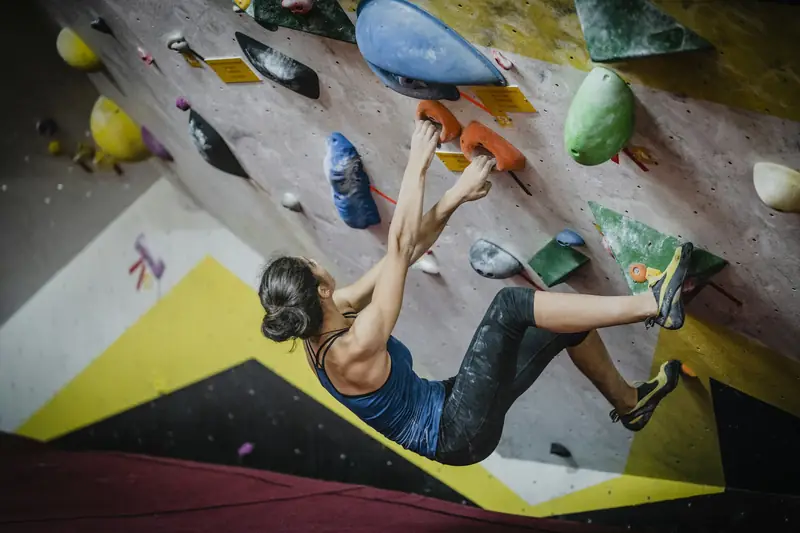
Every climbing wall has one. They aren't especially muscly, they don't grunt, and they drift up problems that leave you hanging off one arm with your feet skating around. When you're pumped and flailing on your fourth attempt, they're chatting at the bottom of the mat, chalking up for another go.
They aren't doing anything magic. They watch their feet onto every hold, keep their arms long, turn their hips into the wall and fall like they've done it a thousand times, because they have. This guide walks through the moves that matter for beginner and intermediate climbers, bouldering or on a rope: what each one is for, how to do it, the classic mistake, and what you can do off the wall to make it easier on your body. Where the research has something useful to say, we say it, and every number links to the study it comes from.
The big idea: climb with your feet, look after your fingers
Climbing looks like an arm sport. Watch a good climber and it's a leg sport with the hands steering. Your legs carry the biggest muscles you have. Your fingers carry some of the smallest structures in your body that are ever asked to hold your whole weight. Every kilo your feet take is a kilo your fingers don't have to.
It is proper exercise, too. In 20 recreational climbers on a moving treadmill wall, heart rate stayed above 65% of maximum, and energy use reached the level counted as vigorous exercise in every condition tested.[1] Bouldering works more like intervals: in a simulated bouldering competition, heart rate peaked at about 88% of maximum, yet climbers were back to resting values within about four minutes.[2] Those were elite climbers, but the rhythm of hard effort and long rest is the same for everyone.
So what decides how hard you can climb? In 205 sport climbers, grip strength, hang tests, body fat, climbing volume and experience together explained almost all the difference in grades, and volume and experience worked mainly by building hand and arm strength.[3] In plain English: finger strength matters, and in your first couple of years you build most of it just by climbing a lot. The coaches' rule of thumb is that muscles get stronger faster than the tendons and pulleys in your fingers, which is why newer climbers can often pull harder than their fingers can tolerate. Good technique is what closes that gap.
Footwork: precise feet, quiet feet
Good footwork puts your weight through your legs instead of your arms, so you can rest, reach further and climb for longer. It is the single biggest difference between a beginner and an intermediate climber, and it costs nothing but attention.
How to do it:
- Watch your foot all the way onto the hold, then look up
- Place it once and keep it still. No shuffling once it's on
- Edge on small holds with the inside of your big toe, or the outside edge when you're side-on
- Smear when there's no hold: press the sole flat against the wall, heel low, weight over it
- Take small steps and keep your feet under you rather than stretching for big ones
The classic mistake is looking for the next handhold while your foot scrapes around the wall looking for its own, then landing on the wrong edge of the hold and slipping. Listen to yourself. If your feet are loud, they're imprecise. The classic drill is "silent feet": climb an easy route making no noise at all with your shoes. There's surprisingly little research on footwork itself. This is coaching wisdom, and it is good wisdom.
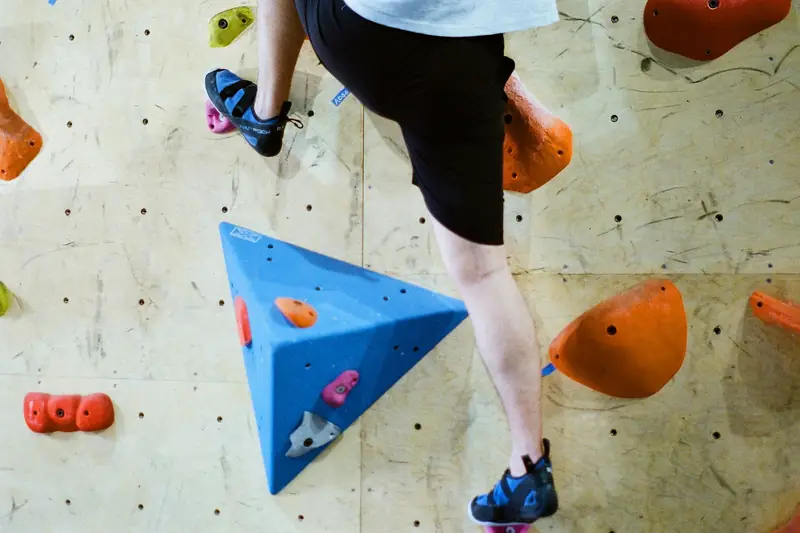
Train it off the wall. Standing on a small edge is a calf raise you hold for a long time. Slow calf raises on a step, single-leg balance work and ankle mobility drills make it steadier. High steps need hips that bend and open: deep goblet squats and Cossack squats build that range.
Straight arms and hips to the wall
Bent arms burn out your biceps and forearms fast. Straight arms let your skeleton take the load while your legs do the moving. And the closer your hips are to the wall, the more of your weight sits over your feet instead of hanging off your fingers.
How to do it:
- Hang from straight arms between moves, like a coat on a hook
- Push up with your legs. Your arms guide, they don't haul
- On vertical walls, face in and bring your hips close to the wall
- On overhangs, turn side-on and twist the hip of your reaching arm's side into the wall
- Shake out each arm on good holds and breathe
The classic mistake is "chicken-winging": elbows up, arms bent, bum sticking out, every move pulled through the forearms. Ten moves later, your forearms are rock hard with pump and your grip goes. The fix is mostly patience. Set your feet, straighten your arms, then move.
Train it off the wall. Straight-arm hanging still needs shoulders that hold you in place: scapular pull-ups and active hangs from a bar teach you to hang "switched on" rather than limp. Hip mobility (frog stretches, deep squats) lets you get your hips in on vertical walls. Hanging knee raises and hollow holds help you keep your feet on when the wall gets steep.
Grips: open hand where you can, crimp with care
There are two main ways to hold an edge. In a crimp, your fingers bend sharply at the middle knuckle, sometimes with your thumb wrapped over your index finger. In an open-hand grip, your fingers are flatter and drape over the hold. The half crimp sits in between. Crimping feels more secure on tiny edges, but it costs your fingers. In a computer model of the finger, the force on the A2 pulley, the band near the base of the finger that keeps the tendon against the bone, was more than 30 times higher in a full crimp than in an open-hand grip.[4]
How to do it:
- On slopers and rounded holds, open hand, fingers flat, wrist low for maximum skin contact
- On small edges, half crimp: fingers bent at about a right angle, thumb off
- Save the full crimp, thumb locked over, for the moves that really need it
- Grip only as hard as the hold needs
- On pockets, use as many fingers as fit, rather than hanging off one or two
The classic mistake is crimping everything, at full strength, all session, especially once you're tired. The story climbers tell most often about a finger injury goes like this: full crimp on a small edge, foot slips, the fingers suddenly take the whole body, pop. Climbing more on open-hand holds when you're fresh makes the open grip feel safe, so you reach for it naturally.
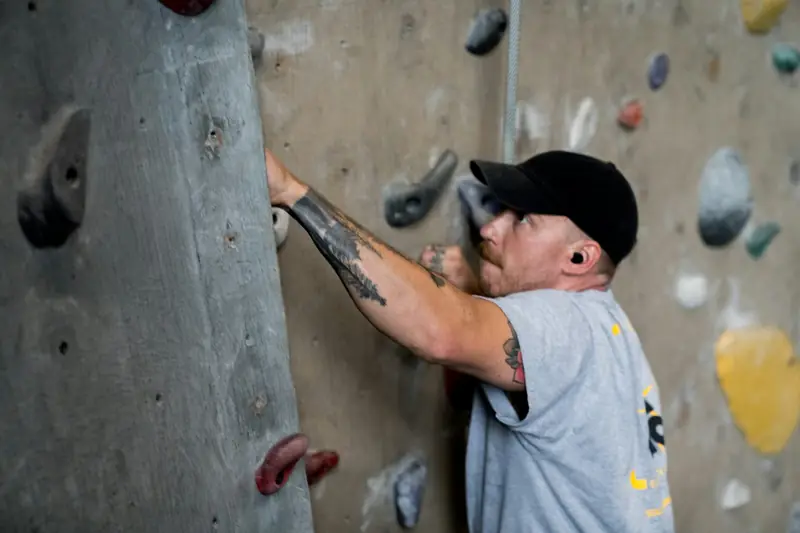
Train it off the wall. For newer climbers, climbing lots of different holds is the finger training. Off the wall, wrist curls, reverse wrist curls and finger extensions against a rubber band build the forearms and give your elbows more capacity. Hangboards come later, and we cover when below.
Drop knees and flagging
These are the moves that make climbing feel clever. A flag is putting a leg out to the side, on nothing, as a counterweight, so you don't swing off the wall like a door on its hinges (climbers call it "barn-dooring"). A drop knee twists one knee down and in, so your hip turns into a steep wall and your reach gets longer without any extra pulling.
How to do it:
- When you feel yourself swinging open, flag: free leg out to the opposite side of the hand you're moving
- Rest your flagging toe lightly on the wall for balance
- For a drop knee, get both feet on holds pushing in opposite directions, then rotate one knee down towards the floor
- Turn your hip in as the knee drops and reach with the opposite hand
- Only go as deep as your knee is comfortable. Never force the twist
The classic mistake is cranking a deep drop knee, or a hard heel hook, with the knee twisted under load. Knees aren't the first thing you think of in climbing, but they do get hurt. In 77 acute knee injuries in climbers, 40% happened during heel hooks, 21% during high steps, 17% during drop knees and 22% in falls, and the most common damage was a torn medial meniscus, the cartilage on the inside of the knee.[5]
Train it off the wall. Drop knees need hips that rotate inwards: 90/90 hip switches and seated hip rotations build that range, so your knee isn't doing the twisting for your hip. Heel hooks pull with the hamstrings, so Romanian deadlifts and hamstring bridges help. Cossack squats and split squats make your legs strong in the deep, awkward positions climbing puts them in.
Dynamic moves: commit, then catch
Sometimes the next hold is too far to reach slowly. A deadpoint is a quick move where you catch the hold at the top of your movement, the instant you're almost weightless. A dyno is the full version, where both hands, and often both feet, leave the wall. Both are about timing far more than strength.
How to do it:
- Look at the target hold and keep looking at it
- Sink low on straight arms, then drive with your legs
- Push your hips up and into the wall. The arms guide the move
- Catch the hold at the top of the movement, elbows slightly bent and shoulders braced
- If your feet cut loose, tighten your middle to control the swing
The classic mistake is half-committing: a timid jump that falls short, or a pull with the arms that leaves the legs behind. The other is catching on straight, loose arms, so the shoulder takes the jolt. There is no research on how to teach a dyno. Practise on big holds near the ground, and fall off a few on purpose so you learn how you land.
Train it off the wall. Leg drive is jump training: box jumps and squat jumps. Pull-ups, and once you're strong enough, fast pull-ups, help you stay on through the catch. Band external rotations and scapular push-ups build the shoulder control to absorb it. Hollow holds and hanging knee raises help you control the swing when your feet come off.
Falling and landing
In bouldering you are going to fall, often. That's the point. Most of the injuries indoors come from how you land. In a survey of 245 injured boulderers, two-thirds of injuries were to the legs, mostly ankle sprains. About 85% of falls were unplanned, three quarters landed feet first, and most injuries came from falls off the top and middle of vertical and steep walls.[6] In 430 patients seen at a German trauma centre after bouldering, the ankle was the most common injury site at 37%, then the knee and the elbow. About 23% of injuries were fractures, and about one patient in five needed surgery.[7]
How to do it:
- Before you start, look at the mat and check nobody is underneath you
- Climb down, or down-climb most of the way, rather than dropping from the top
- Land on both feet, hip-width apart, and bend your knees to soak it up
- Let yourself roll back onto your bottom and back, chin tucked
- Keep your arms in. Don't reach out to catch yourself on a straight arm
The classic mistake is landing stiff-legged on one foot, or on the seam between two mats, then throwing an arm out. The other classic is topping out on a tall problem and jumping off the top. The reassuring part is that serious injuries are rare. At one German climbing wall, over more than 500,000 visits, injuries needing a doctor or paramedic worked out at 0.02 per 1,000 hours of climbing. Most bouldering injuries were falls onto the mat, and on ropes the most common cause was belaying mistakes.[8] So if you climb on a rope, do your partner checks every time: knot, harness, belay device. One study of boulderers found the usual precautions didn't seem to cut injuries much[9], which is one more reason to practise falling rather than trusting the mat to do the work.
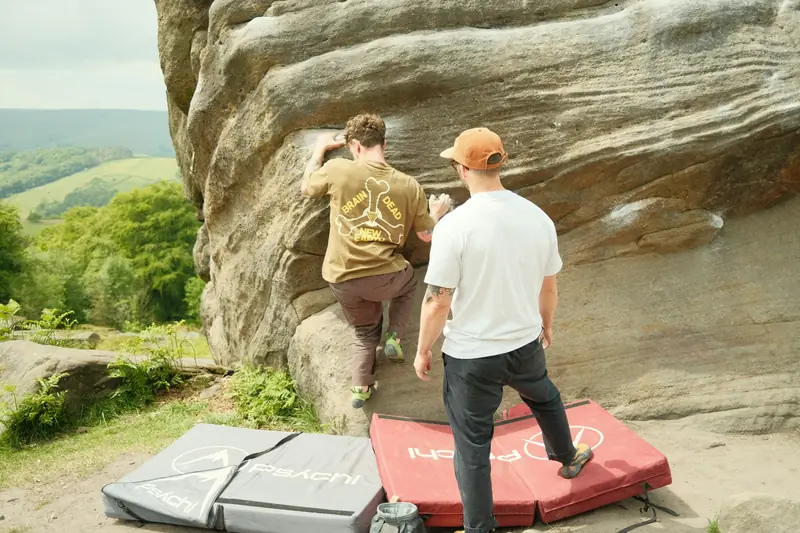
Train it off the wall. Drop landings, stepping off a low box and sticking the landing with knees bent, teach you to absorb a fall. Single-leg balance work and slow calf raises make your ankles more robust. And practise falling on the wall itself: a few deliberate falls from low down at the start of each session.
Does training off the wall really help?
For finger strength, yes, eventually. For injuries, the evidence is thin.
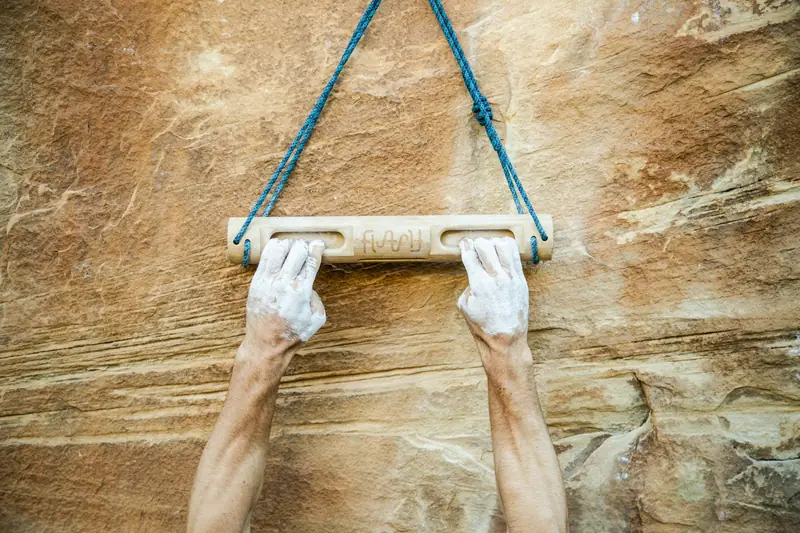
Hangboards. A hangboard (or fingerboard) is a board of edges and pockets you hang from to train your fingers. A review of 11 trials found that climbing-specific strength training improved climbing-specific tests more than climbing alone, with a moderate effect, and that finger training built finger strength and forearm endurance better than climbing did. The authors also stressed how few trials there are.[10] In 23 advanced boulderers, four weeks of fingerboard training raised grip strength by 2.5 kg and lengthened hang times by 26 seconds, while the group that just bouldered didn't improve significantly.[11] In 30 intermediate to advanced climbers, eight weeks of hangs with a little more weight added each week improved grip strength more than climbing alone.[12]
Notice who those studies were in: experienced, strong climbers. We found no trial of hangboard training in beginners. The best clue comes from a survey of 434 Finnish climbers. In those with six or more years of climbing, regular fingerboard training went with less finger pain and injury. In men with under six years who were already climbing hard grades, it went with more.[13] That is a survey, not a trial, but it fits the coaching advice: beginners get stronger fingers from climbing, and the hangboard can wait. The usual convention is a year or two of regular climbing, no finger pain, and a plateau on the wall before you start. Then begin gently: feet on the floor or a chair to take some weight, a big edge, hangs of around ten seconds, stopping well short of failure, twice a week.
Antagonists. Climbing is almost all pulling, so coaches have long recommended training the opposite, pushing muscles to balance the shoulders. The research is weak. In one small trial of 84 male student climbers, the group given a year of strength work with closed-chain and slow-lowering exercises had fewer shoulder injuries, but the trial wasn't blinded and scores poorly on standard quality checks.[14] It's cheap insurance all the same. Push-ups and rotator cuff band work take ten minutes.
Two short sessions a week alongside your climbing is plenty to start. Here is how the work lines up with the moves:
| Build this | It helps your | Try |
|---|---|---|
| Finger strength (when ready) | Small edges, crimps, steep walls | Lots of varied climbing; later, feet-assisted hangboard hangs |
| Forearms and wrists | Grip endurance, elbows | Wrist curls, reverse wrist curls, band finger extensions |
| Pushing strength | Shoulders, mantles, top-outs | Push-ups, dips, overhead presses |
| Shoulder control | Dynamic catches, straight-arm hangs | Scapular pull-ups, band external rotations |
| Hip mobility | High steps, drop knees, hips to the wall | 90/90 hip switches, deep squats, frog stretches |
| Leg power and landing | Dynos, falls | Box jumps, drop and stick |
| Trunk strength | Keeping your feet on steep walls | Hanging knee raises, hollow holds |
Staying on the wall
Most climbing injuries don't come from one bad fall. They creep up. In a survey of 667 climbers, 385 had a long-running injury in the previous six months, and the fingers (41%), shoulders (19%) and elbows (18%) took most of it.[15] In a clinic series of 911 climbing injuries, fingers made up 52%, pulley injuries were still the single most common problem, and shoulder injuries were on the rise.[16] Even in teenage climbers, repetitive overuse was the most common cause of injury, and the hands and fingers were hurt most.[17]
Fingers. The A2 pulley is the one that goes most often. A strain shows up as an ache at the base of the middle or ring finger, worse when crimping. Use open-hand grips when you can, warm up your fingers on easy climbs before anything hard, and don't add lots of extra sessions or harder grades in the same week. If you hear or feel a pop in a finger, or it swells or bruises, stop climbing and get it looked at by a doctor or physio who knows climbing injuries.
Elbows. Climber's elbow is pain on the bony bump on the inside of the elbow, where the forearm muscles that curl your fingers and wrist attach. Elbow problems are the fourth most common climbing injury.[18] No trial has tested a treatment specifically in climbers. The usual approach is borrowed from other tendon problems: ease off the volume for a while, and build the forearms back up with slow wrist curls and forearm rotation work, rather than resting completely and then going straight back to a full session.
Shoulders. Steep walls, big reaches and dynos all load the shoulder at the edge of its range. Keep your shoulders braced when you hang, build your pushing and rotator cuff strength[14], and don't make your hardest dyno of the year your first move of the session.
Ankles and knees. Ankles get hurt in falls[6][7], knees in heel hooks, drop knees and high steps.[5] Practise landing, keep the drop knees comfortable, and build strong, mobile hips and legs. If you can't put weight on your ankle after a fall, get it X-rayed. A fair share of these injuries are fractures, not sprains.
The long game
Climbing is good for more than your forearms. In a trial in people with depression, a bouldering-based therapy programme helped more than exercise alone.[19] In a small trial of people with chronic low back pain, four weeks of therapeutic climbing did about as well as a standard exercise programme, with bigger gains in physical function and how healthy people felt.[20] Add the problem-solving, and the chat at the bottom of the mat, and it's easy to see why people stay hooked for decades.
The climbers who keep going into their fifties and sixties tend to be the ones who learned to climb with their feet, held small edges with an open hand and trained the boring stuff between sessions. The off-wall work in this guide is what keeps you climbing long enough to get there.
Training built around your climbing
Most climbers never do any of this, not because they don't care, but because it's hard to know where to start. A generic gym plan doesn't know you boulder three evenings a week, that your ring finger aches after crimpy sessions, or that you only have a pull-up bar and a resistance band at home.
Achilles does. Pick a goal such as Play my sport better or Stop getting injured, or Fix something that hurts if an elbow or finger is already complaining, and tell it how often you climb, the time and equipment you have, and anything that bothers you. Achilles builds your plan from a library of sports-science research: the warm-up, the work for your forearms, shoulders, hips and legs, and when and how to start finger training, each exercise with its sets, reps and rest, and the studies behind it.
Log your sessions and your climbing, and the plan moves with you, so you keep getting stronger without overdoing the weeks you climb the most.
See how Achilles worksFurther reading
- Heil D. (2019). Characterizing steady-state cardiovascular and metabolic responses of recreational climbers during motorized treadmill climbing. Link
- Cardiorespiratory demands of competitive rock climbing (2021). Applied Physiology, Nutrition, and Metabolism, 46(2). Link
- Baláš J., Pecha O., Martin A.J. & Cochrane D. (2012). Hand-arm strength and endurance as predictors of climbing performance. European Journal of Sport Science, 12(1). Link
- Vigouroux L., Quaine F., Labarre-Vila A. & Moutet F. (2006). Estimation of finger muscle tendon tensions and pulley forces during specific sport-climbing grip techniques. Journal of Biomechanics, 39(14). Link
- Lutter C. et al. (2020). Mechanisms of acute knee injuries in bouldering and rock climbing athletes. American Journal of Sports Medicine. Link
- Beurienne E. et al. (2025). The art of falling: identifying the falls scenarios associated with bouldering injuries. Frontiers in Sports and Active Living, 7. Link
- Müller M. et al. (2022). Characteristics of bouldering injuries based on 430 patients presented to an urban emergency department. Injury, 53(4). Link
- Schöffl V.R., Hoffmann G. & Küpper T. (2013). Acute injury risk and severity in indoor climbing: a prospective analysis of 515,337 indoor climbing wall visits in 5 years. Wilderness & Environmental Medicine, 24(3). Link
- Josephsen et al. (2007). Injuries in bouldering: a prospective study. Wilderness & Environmental Medicine, 18(4). Link
- Stien, Riiser, Shaw, Saeterbakken & Andersen (2023). Effects of climbing- and resistance-training on climbing-specific performance: a systematic review and meta-analysis. Biology of Sport, 40(1). Link
- Medernach, Kleinöder & Lötzerich (2015). Fingerboard in competitive bouldering: training effects on grip strength and endurance. Journal of Strength and Conditioning Research, 29(8). Link
- Mundry et al. (2021). Hangboard training in advanced climbers: a randomized controlled trial. Scientific Reports, 11. Link
- Sjöman A.E., Grønhaug G. & Julin M.V. (2023). A finger in the game: sport-specific finger strength training and onset of injury. Wilderness & Environmental Medicine, 34(4). Link
- Kozin et al. (2021). Application of closed kinematic chain exercises with eccentric and strength exercises for the shoulder injuries prevention in student rock climbers: a randomized controlled trial. Acta of Bioengineering and Biomechanics, 23(2). Link
- Grønhaug G. (2018). Self-reported chronic injuries in climbing: who gets injured when? BMJ Open Sport & Exercise Medicine, 4(1). Link
- Schöffl, Popp, Küpper & Schöffl (2015). Injury trends in rock climbers: evaluation of a case series of 911 injuries between 2009 and 2012. Wilderness & Environmental Medicine, 26(1). Link
- Woollings K.Y., McKay C.D., Kang J., Meeuwisse W.H. & Emery C.A. (2015). Incidence, mechanism and risk factors for injury in youth rock climbers. British Journal of Sports Medicine, 49(1). Link
- Simon, Lutter C. & Schöffl V. (2022). Elbow and forearm. In Climbing Medicine: A Practical Guide. Springer. Link
- Karg N., Dorscht L., Kornhuber J. & Luttenberger K. (2020). Bouldering psychotherapy is more effective in the treatment of depression than physical exercise alone: results of a multicentre randomised controlled intervention study. BMC Psychiatry, 20. Link
- Engbert K. & Weber M. (2011). The effects of therapeutic climbing in patients with chronic low back pain: a randomized controlled study. Spine, 36(11). Link