Blog · Running
Your first 5K, step by step: how beginners and returners get round, get faster and stay injury-free
Run-walk starts, easy pace, form, breathing, building up, shoes and parkrun day, explained for new and returning runners, with the off-road training that keeps your legs in one piece.
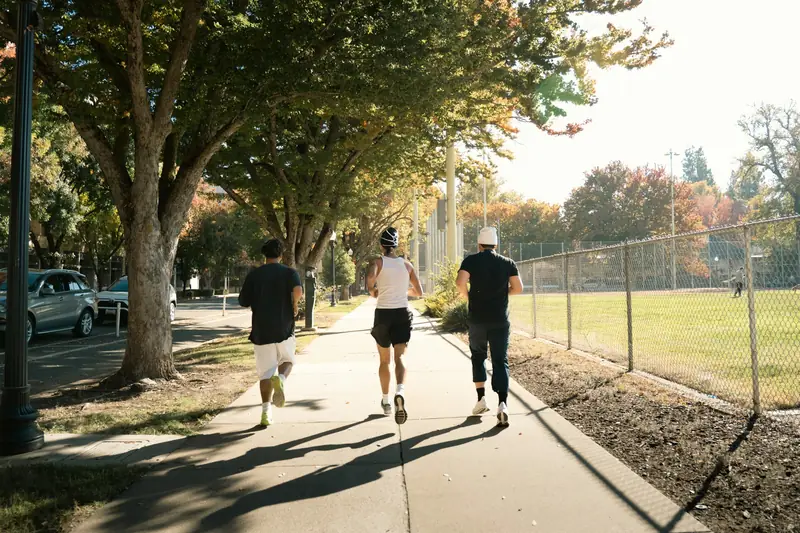
Every parkrun has one. In January they're near the back, walking the hill and wondering what they've signed up for. By June they're chatting their way round mid-field. By September they've knocked two minutes off their best and can't stop grinning.
They aren't doing anything magic. They started slower than felt necessary, walked when they needed to, added a little at a time, and gave their legs a reason to cope. This guide walks through your first 5K, whether you've never run or are coming back after years off: what each step is for, how to do it, the classic mistake, and what you can do off the road to make it easier on your body. Where the research has something useful to say, we say it, and every number links to the study it comes from.
The big idea: your lungs are ahead of your legs
Running is simple, and that's the trap. Within weeks your heart and lungs are noticeably fitter. Your tendons, bones and muscles adapt too, but over months. Most beginner injuries come from that gap: doing what your breathing says you can, before your legs are ready.
Pooling 13 studies, researchers found that new runners picked up about 18 injuries per 1,000 hours of running, more than twice the rate of established recreational runners, at about 8.[1] That isn't a reason not to start. It's a reason to start slowly, with a little strength work alongside.
Start with run-walk
Almost every beginner plan starts here, including the NHS's free Couch to 5K: short runs broken up by walking, with the running stretched and the walking cut over about nine weeks. It builds running time while giving your legs regular breaks from the impact.
How to do it:
- Start every session with five minutes of brisk walking
- Run for a short block, then walk until your breathing settles, and repeat
- Aim for 20 to 30 minutes in total, three times a week, with a rest day between
- Each week, run a little more and walk a little less
- Repeat a week if it felt hard. There's no prize for finishing the plan on schedule
The classic mistake is treating walking as failure and running until you have to stop, then dreading the next session. Walk breaks are a tool, not a cheat. In a trial of 42 non-elite marathon runners, those who took planned walk breaks finished in a similar time to those who ran the whole way, and reported less muscle pain and fatigue.[2] That was a marathon, but the principle holds.
Train it off the road. Your calves push you off the ground thousands of times a session. Calf raises on a step, slow on the way down, are the best single exercise to start with. Add sit-to-stands from a chair or squats for your thighs.
Easy pace: if you can't talk, slow down
Most of your running, now and later, should be easy. It builds the engine (heart, lungs and the blood supply to your muscles) and gives your legs time to adapt, without leaving you too tired for the next run.
How to do it:
- Use the talk test: you should be able to speak in full sentences
- If you can only manage a word or two, slow down or walk
- Ignore the pace on your watch. Easy is a feeling, not a number
- Expect easy to feel almost too slow at first
- Hills count. Walk up them if that's what keeps it easy
The classic mistake is running every run flat out, chasing a faster time each session. The talk test isn't just folk wisdom: being able to speak comfortably lines up well with the ventilatory and lactate thresholds, the points where effort starts to cost much more.[3] If you can talk, you're below them.

Train it off the road. Easy running is easier when your legs aren't the limit, so stronger calves and thighs help. A gentle bike ride or swim adds fitness without more impact.
Running form: shorter steps, quiet landings
There's no single correct way to run, and your body has already chosen most of it. But a few tweaks can take load off your knees.
How to do it:
- Take slightly shorter, quicker steps, landing with your foot under your body, not out in front
- Run tall, with a slight lean forward from the ankles, not the waist
- Keep your shoulders low and loose and your hands relaxed, as if holding crisps without crushing them
- Bend your elbows to about 90 degrees and swing your arms forwards and back, not across your body
- Look ahead, not at your feet
The classic mistake is over-striding: reaching out and landing on a straight leg with your heel well ahead of you, which works like a brake. In a lab study of 45 recreational runners, raising step rate by 5 to 10% at the same speed reduced the load absorbed at the knee, and at 10% at the hip too.[4] That's lab loading, not fewer injuries, and we found no good evidence for the magic 180 steps a minute. Aim for a little more than you do now.
And forget the foot-strike debate. Of 936 runners filmed 10 km into a road race, about 89% landed heel first.[5] Heel striking is normal. What matters is that your foot lands under you. Forcing yourself onto your toes moves the load to your calves and Achilles, the last thing a new runner needs.
Train it off the road. Running tall when tired takes a trunk and hips that don't tire: side planks and glute bridges. Split squats and step-ups matter most, because running is one single-leg landing after another.
Breathing: let it find its own rhythm
Being out of breath is the first thing most beginners notice. Some breathlessness is normal. Gasping usually means you're going too fast.
How to do it:
- Breathe through your mouth and nose together. There's no need to nose-breathe only
- Breathe low, letting your belly move, not just your upper chest
- Let your breathing fall into step with your feet if it wants to, but don't force a count
- If you're gasping, walk for a minute until you can talk again
- On cold days, a buff over your mouth takes the edge off the air
The classic mistake is trying a complicated breathing pattern while running too fast for any pattern to work. Fix the pace and the breathing usually follows. Up to 40% of runners may get breathless during exercise, and slow, deep breathing helps at rest, but a recent review found it is still unclear whether breathing techniques help during running itself.[6] Chest pain, dizziness or breathlessness far beyond what the effort should cause are different: stop, and see a doctor.
Train it off the road. Getting fitter is the real breathing fix. Dead bugs and planks help you hold a tall posture, so your ribs and belly have room to move.
Building up: how much, how fast
Once you can run for 30 minutes without stopping, 5K is within reach. After that, how quickly you add more is where most beginner injuries are made or avoided.
How to do it:
- Three runs a week is plenty for a first 5K, and many people do well on two
- Add one thing at a time: an extra run, a few more minutes, or a slightly longer longest run, not all three
- Every three or four weeks, take an easier week
- Never double your running in a week, even to catch up on sessions you missed
- After time off, restart below where you left off, not at it
The classic mistake is the big jump: a good week or a new watch, and suddenly you're running twice as much. The 10% rule (add no more than 10% a week) is a sensible ceiling, but it isn't magic. In a Dutch trial, 532 beginners training for a 4-mile race followed either a standard 8-week plan or a gentler 13-week plan built on the 10% rule, and about one in five got injured in both groups.[7] One of the Danish novice-runner studies led by Rasmus Nielsen gave 874 new runners GPS watches for a year. Overall, how fast they progressed made no clear difference, but those who added more than 30% to their weekly distance over two weeks may have been more prone to some overuse injuries, though that result was borderline.[8] Steady beats spiky.
Train it off the road. Strength work builds up the part of you that lags behind. Two short sessions a week of calf raises, split squats and bridges make each new week a smaller jump for your legs.
Shoes: comfort first
Shoes are the one bit of kit worth getting right, and the research makes choosing simpler than the shop does.
How to choose:
- Pick the pair that feels most comfortable when you jog in them
- Go for reasonable cushioning, especially if you're on the lighter side
- Leave about a thumb's width at the toe, as feet swell on longer runs
- Change one thing at a time: new shoes aren't for a long run on day one
- Think about replacing them when they feel flat or you start aching in new places
The classic mistake is buying shoes to fix a foot problem you don't have. Pronation, the inward roll of the foot as it lands, has been blamed for injuries for decades, but when 927 Danish beginners were all given the same neutral shoe and followed for a year, runners with pronated feet were no more likely to get injured than those with neutral feet.[9] Cushioning does seem to matter. In a trial of 848 recreational runners randomly given harder or softer versions of the same shoe, injury risk was higher in the harder shoe, with the effect clearest in lighter runners.[10] Leading shoe researchers suggest simply choosing the most comfortable pair.[11] No injury trial has proved that, but it beats a foot-type diagnosis in a shop.

Train it off the road. No shoe makes up for weak feet and calves. Calf raises, bare-foot balance and toe scrunches strengthen your own suspension, whatever you wear.
Race day and parkrun
parkrun is the easiest 5K race there is: free, timed, every Saturday morning, with walkers welcome and always someone at the back. It turns "I'm trying to get fit" into "I'm doing a 5K on Saturday".
How to do it:
- Register once, bring your barcode, and arrive a few minutes early for the briefing
- Warm up with five minutes of walking and easy jogging
- Start near the back and go out slower than you think you should
- Take walk breaks if you need them. Plenty of people do
- Try to run the second half a little faster than the first. It's far more fun than fading
The classic mistake is getting swept along in the first kilometre and walking from 3 km feeling dreadful. The other is trying something new on the day, such as new shoes or a big breakfast. Above all, parkrun is a habit. In a survey of 60,000 UK parkrunners, nearly nine in ten of those who had been inactive when they signed up said they had become more active since.[12]

Train it off the road. A strong finish needs legs that cope with fatigue: walking lunges and step-ups build it.
After the first one: getting faster at 5K
Once you've done one, you'll want to go quicker. Most people improve just by running a bit more, consistently, for a few months. After that, a little structure helps:
- Keep most of your running easy. Elite endurance athletes do about 80% of their sessions at low intensity[13]
- Add one quality session a week, such as five or six repeats of 400 m to 1 km at about your 5K effort, with easy jogging between
- Or try a tempo run: 15 to 20 minutes comfortably hard, where you can say a few words but not chat
- Finish some easy runs with four to six relaxed 20-second strides
- Stretch your longest easy run, over weeks, towards 6 or 8 km
The classic mistake is making every run a hard run. In a pooled analysis of trials, mostly-easy training with a small amount of hard work may even beat plans built on lots of medium-hard running.[14] Those trials were in trained athletes, but mostly easy is the safer, less miserable way for anyone to train.
Train it off the road. In trained distance runners, two or three sessions a week of strength and jump training for 8 to 12 weeks made running more economical, so the same pace cost less energy.[15] Weighted squats or step-ups, plus small hops and skips, are the place to start.
Does training off the road really help?
For performance, yes. For injuries, probably, with honest caveats.
Across sports, a review of 25 trials found strength training was the most protective type of exercise for preventing injuries, while stretching showed no benefit.[16] But no big trial has yet shown that strength training cuts injuries in new runners. Advice on its own isn't enough: when 2,378 recreational runners were given an online injury-prevention programme of information and tips, they got injured as often as those who weren't.[17] A 10-minute bodyweight routine three times a week didn't reduce injuries in first-time marathon runners either.[18] Where strength training clearly helps is in treating the common running injuries. If the exercise that fixes an injury is a calf raise, getting strong calves before you need them is a fair bet.
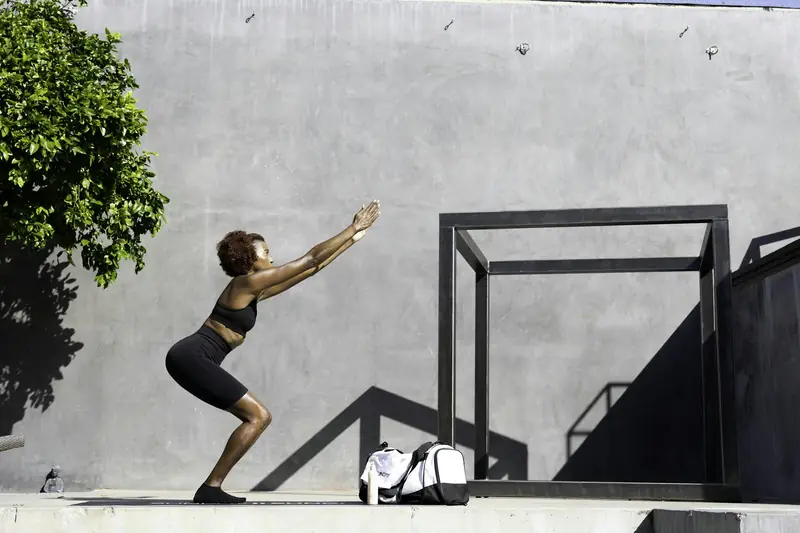
Two short sessions a week alongside your running is plenty to start. Here is how the work lines up with your running:
| Build this | It helps your | Try |
|---|---|---|
| Calf strength | Every step, Achilles, shins | Calf raises on a step, straight-knee and bent-knee |
| Thigh strength | Knees, hills, the last kilometre | Split squats, step-ups, sit-to-stands |
| Hip strength | Knee control, posture late in a run | Glute bridges, side-lying leg raises, banded side steps |
| Foot strength | Heels and arches | Heel raises with a towel under your toes, bare-foot balance |
| Trunk endurance | Running tall when tired | Side planks, dead bugs |
| Spring | Speed and economy | Pogo hops, skips, small bounds |
Staying on the road
Running injuries are common. Across studies, about four in ten runners picked one up during the study period.[19] Four problems account for a big share, and each has something that helps.
Shin pain. An ache along the inside edge of the shinbone, often called shin splints, is classic in new runners and anyone who ramps up quickly. A review found no treatment with good enough evidence to recommend[20], so easing back and rebuilding more gradually, with calf work, is the usual answer. Pain in one small spot on the bone, pain when you hop, or pain at night can be a bone stress injury: get that checked by a doctor or physiotherapist rather than running through it.
Runner's knee. Pain around or behind the kneecap, worse on stairs, hills or after sitting. An international expert consensus recommends exercise as the main treatment, particularly hip and knee strengthening combined rather than knee exercises alone.[21] Bridges, side-lying leg raises and step-ups, plus a break from hills and slightly shorter steps, are the usual start.
The Achilles. Stiffness or pain in the tendon above the heel, often worst first thing in the morning. It topped the list of new injuries in the review above.[19] Loading the tendon is the treatment: in a trial of 58 people with long-standing Achilles pain, slow, heavy calf raises worked as well as the traditional lowering-only exercise, and people completed more of their sessions.[22] If you feel a sudden pop or a kick in the back of the calf, stop and get it seen the same day.
Plantar heel pain. A sharp pain under the heel with your first steps in the morning. In a small trial, adding heavy single-leg heel raises with a rolled towel under the toes, every other day, improved symptoms faster than stretching did, though both groups were similar after six months.[23] Comfortable shoes and a gentle build-up help too.
The long game
Running is one of the best things you can do for your health, and you don't need much of it. In a pooled analysis of six large studies following more than 230,000 people, runners were 27% less likely to die during follow-up than non-runners, with lower risks of death from heart disease and cancer, and the benefit didn't clearly grow with more running.[24] Studies like these can't prove cause and effect, but the signal is consistent. As for knees, a review of the evidence found recreational runners were no more likely to have hip or knee arthritis than people who didn't run.[25]
The first 5K is the start, not the finish. The strength work in this guide is what keeps you running long enough to collect all of that.
Training built around your running
Most new runners never do any of this, not because they don't care, but because it's hard to know where to start. A generic plan doesn't know you're coming back after ten years off, that your left knee grumbles on stairs, or that you only have time for three short runs a week and a pair of dumbbells at home.
Achilles does. Pick a goal such as Get back to running or Get stronger, and tell it how often you run, the time and equipment you have, and anything that bothers you, from sore shins to a stiff Achilles. Achilles builds your plan from a library of sports-science research: the strength work for your calves, thighs, hips and feet, fitted around your runs, and how to progress it, each exercise with its sets, reps and rest, and the studies behind it.
Log your sessions and your runs, and the plan moves with you, so you keep building without overdoing the weeks you run the most.
See how Achilles worksFurther reading
- Videbæk S., Bueno A.M., Nielsen R.O. & Rasmussen S. (2015). Incidence of running-related injuries per 1000 h of running in different types of runners: a systematic review and meta-analysis. Sports Medicine, 45(7). Link
- Hottenrott K. et al. (2016). Does a run/walk strategy decrease cardiac stress during a marathon in non-elite runners? Journal of Science and Medicine in Sport, 19(1). Link
- Reed J.L. & Pipe A.L. (2014). The talk test: a useful tool for prescribing and monitoring exercise intensity. Current Opinion in Cardiology, 29(5). Link
- Heiderscheit B.C. et al. (2011). Effects of step rate manipulation on joint mechanics during running. Medicine & Science in Sports & Exercise, 43(2). Link
- Larson P. et al. (2011). Foot strike patterns of recreational and sub-elite runners in a long-distance road race. Journal of Sports Sciences, 29(15). Link
- Harbour E. et al. (2022). Breath tools: a synthesis of evidence-based breathing strategies to enhance human running. Frontiers in Physiology, 13. Link
- Buist I. et al. (2008). No effect of a graded training program on the number of running-related injuries in novice runners: a randomized controlled trial. American Journal of Sports Medicine, 36(1). Link
- Nielsen R.O. et al. (2014). Excessive progression in weekly running distance and risk of running-related injuries: an association which varies according to type of injury. Journal of Orthopaedic & Sports Physical Therapy, 44(10). Link
- Nielsen R.O. et al. (2014). Foot pronation is not associated with increased injury risk in novice runners wearing a neutral shoe: a 1-year prospective cohort study. British Journal of Sports Medicine, 48(6). Link
- Malisoux L. et al. (2020). Shoe cushioning influences the running injury risk according to body mass: a randomized controlled trial involving 848 recreational runners. American Journal of Sports Medicine, 48(2). Link
- Nigg B.M. et al. (2015). Running shoes and running injuries: mythbusting and a proposal for two new paradigms: "preferred movement path" and "comfort filter". British Journal of Sports Medicine, 49(20). Link
- Quirk H. et al. (2021). Exploring the benefits of participation in community-based running and walking events: a cross-sectional survey of parkrun participants. BMC Public Health, 21. Link
- Seiler S. (2010). What is best practice for training intensity and duration distribution in endurance athletes? International Journal of Sports Physiology and Performance, 5(3). Link
- Rosenblat M.A., Perrotta A.S. & Vicenzino B. (2019). Polarized vs. threshold training intensity distribution on endurance sport performance: a systematic review and meta-analysis of randomized controlled trials. Journal of Strength and Conditioning Research, 33(12). Link
- Balsalobre-Fernández C., Santos-Concejero J. & Grivas G.V. (2016). Effects of strength training on running economy in highly trained runners: a systematic review with meta-analysis of controlled trials. Journal of Strength and Conditioning Research, 30(8). Link
- Lauersen J.B., Bertelsen D.M. & Andersen L.B. (2014). The effectiveness of exercise interventions to prevent sports injuries: a systematic review and meta-analysis of randomised controlled trials. British Journal of Sports Medicine, 48(11). Link
- Fokkema T. et al. (2019). Online multifactorial prevention programme has no effect on the number of running-related injuries: a randomised controlled trial. British Journal of Sports Medicine, 53(23). Link
- Toresdahl B.G. et al. (2020). A randomized study of a strength training program to prevent injuries in runners of the New York City Marathon. Sports Health, 12(1). Link
- Kakouris N., Yener N. & Fong D.T.P. (2021). A systematic review of running-related musculoskeletal injuries in runners. Journal of Sport and Health Science, 10(5). Link
- Winters M. et al. (2013). Treatment of medial tibial stress syndrome: a systematic review. Sports Medicine, 43(12). Link
- Collins N.J. et al. (2018). 2018 consensus statement on exercise therapy and physical interventions (orthoses, taping and manual therapy) to treat patellofemoral pain. British Journal of Sports Medicine, 52(18). Link
- Beyer R. et al. (2015). Heavy slow resistance versus eccentric training as treatment for Achilles tendinopathy: a randomized controlled trial. American Journal of Sports Medicine, 43(7). Link
- Rathleff M.S. et al. (2015). High-load strength training improves outcome in patients with plantar fasciitis: a randomized controlled trial with 12-month follow-up. Scandinavian Journal of Medicine & Science in Sports, 25(3). Link
- Pedisic Z. et al. (2020). Is running associated with a lower risk of all-cause, cardiovascular and cancer mortality, and is the more the better? A systematic review and meta-analysis. British Journal of Sports Medicine, 54(15). Link
- Alentorn-Geli E. et al. (2017). The association of recreational and competitive running with hip and knee osteoarthritis: a systematic review and meta-analysis. Journal of Orthopaedic & Sports Physical Therapy, 47(6). Link